1834 25C (Proof)
Series: Capped Bust Quarters 1820-1838

PCGS PR65

PCGS PR64+
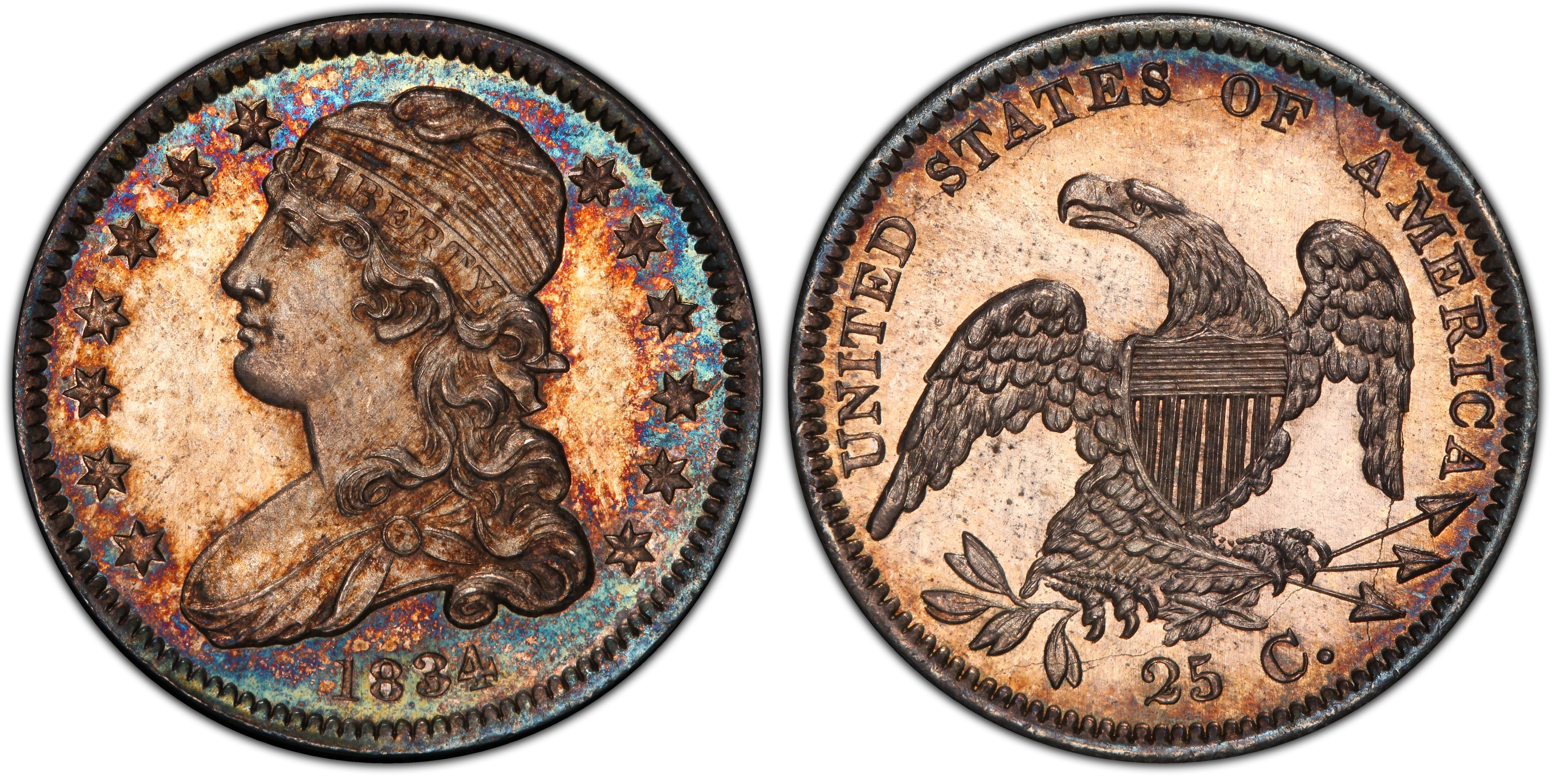
PCGS PR64+
- PCGS #:
- 5382
- Designer:
- John Reich
- Edge:
- Reeded
- Diameter:
- 24.30 millimeters
- Weight:
- 6.74 grams
- Mintage:
- 10
- Mint:
- Philadelphia
- Metal:
- 90% Silver, 10% Copper
- Auction Record:
- $235,000 • PR66+* • 11-15-2013 • Heritage Auctions
Rarity and Survival Estimates Learn More
| Survival Estimate | |
|---|---|
| All Grades | 3 |
| 60 or Better | 3 |
| 65 or Better | 1 |
| Numismatic Rarity | |
|---|---|
| All Grades | R-9.8 |
| 60 or Better | R-9.8 |
| 65 or Better | R-10.0 |
| Relative Rarity By Type All Specs in this Type | |
|---|---|
| All Grades | 4 / 7 TIE |
| 60 or Better | 4 / 7 TIE |
| 65 or Better | 1 / 7 TIE |
| Relative Rarity By Series All Specs in this Series | |
|---|---|
| All Grades | 8 / 16 TIE |
| 60 or Better | 8 / 16 TIE |
| 65 or Better | 1 / 16 TIE |
Condition Census What Is This?
|
#1 PCGS PR65
Edmund Roberts, special diplamtic envoy of the U.S. State Department to the King of Siam, April 6, 1836; King of Siam; Unknown Intermediaries; Purchased by David Spink, in England, 1962; Unknown Intermediaries; Mike Bobb (Mike’s Coin Chest of Torrance, California), 2001. NGC PF65 #1629417-004. Unknown Intermediaries; As PCGS PR65 #21594247. Dan O’Dowd; "The Tyrant Collection (O'Dowd)." Blended toning in gold, green, and rose. |
|
#2 PCGS PR64+
DLRC, July 19, 2020, Lot 651959 – $62,000; Dell Loy Hansen; "The D.L. Hansen Complete Basic Proof Set." Vivid target rainbow toning on both sides. |
|
#2 PCGS PR64+
Peach centers. Blue, green, and red toning along the periphery. Faint fingerprint toning on the reverse. |
The 1834 Capped Bust Quarter Proof
In 1834, the Philadelphia Mint produced 286,000 1834 Capped Bust Quarters (#5353) for general circulation and an estimated ten Proofs. These rare Proofs were struck using the Browning-2 (B-2) die marriage—a pair of dies believed to be the very first used for this denomination that year.
The B-2 die pair is uniquely identifiable by the eagle on the reverse, which features a prominent tongue (or langued eagle). This specific detail is absent from the other four die marriages used for business strikes. While the reverse is unique, the B-2 shares its obverse with the B-1 variety (#38992). Key markers include:
- The "4" in the date is canted to the left of the bust’s curl.
- The lower-right star sits very close to the curl.
- The tip of the upper-left star aligns with the top of the curl and ribbon.
Historical Context: The King of Siam Sets
Though earlier numismatic references like Walter Breen’s 1989 Encyclopeda of United States and Colonial Proof Coins, 1722-1889 are dated, Steve Tompkins’ 2008 research suggests the B-2 dies struck Proofs first before being used for circulation. This timeline places production no earlier than November 1834.
This specific quarter is inextricably linked to one of American numismatics' greatest legends: the Class I 1804 Draped Bust Dollar (#6907). On November 11, 1834, Secretary of State John Forsythe requested that Mint Director Samuel Moore assemble two "Presentation Sets" for the King of Siam and the Sultan of Muscat. These sets were intended as diplomatic gifts, housed in yellow and red morocco leather boxes.
Creating the "1804" Dollars
Because the silver dollar and gold eagle had been under a production moratorium since the Jefferson administration, the Mint lacked current dies for those denominations. To complete the sets, they created 1804-dated "novodels" of the Draped Bust Dollar and Draped Bust Eagle. The 1834 Capped Bust Quarter Proof was included as the current representative of its denomination.
Legacy and Survival
The impact of these sets was profound. When the King of Siam set resurfaced in England in 1962, it provided physical proof that contradicted the findings in Eric P. Newman and Ken Bressett’s soon-to-be-released book, The Fantastic 1804 Dollar. The discovery was so significant that the publisher had to halt their print run to make corrections.
Survival and Census Data
Today, at least seven examples of the 1834 Capped Bust Quarter Proofs are known to survive, serving as a vital bridge between standard circulation coinage and the high-stakes world of 19th-century diplomacy.
Current Holdings
- Private Trade: Six specimens are currently held in private privat collections.
- Institutional: One example—the original Mint Cabinet coin—is permanently held by the Smithsonian Institution in the National Numismatic Collection.
- The Tyrant Collection: The famous "Siam coin" remains part of the intact King of Siam set, currently held in Dan O’Dowd’s celebrated Tyrant Collection alongside other ultra-rare early U.S. Proofs.
- Hansen Watch: Megacollector Dell Loy Hansen acquired a vividly toned PCGS PR64+ from DLRC in July 2020.
Analyzing the PCGS Census
The current PCGS census data requires a nuanced interpretation. While three coins are listed at the PCGS PR64 grade, these entries date back to the decade between 1988 and 1998. Because there are no recent auction records or digital footprints to support the existence of three distinct PCGS PR64 holders, it is highly probable that these coins have since been cracked out and resubmitted. They likely account for the current entries in the PCGS PR64+ and PCGS PR65 categories, meaning the actual surviving population is likely lower than the raw census totals suggest.
* * *