1853 25C Arrows & Rays (Proof)
Series: Liberty Seated Quarters 1838-1891

PCGS PR64
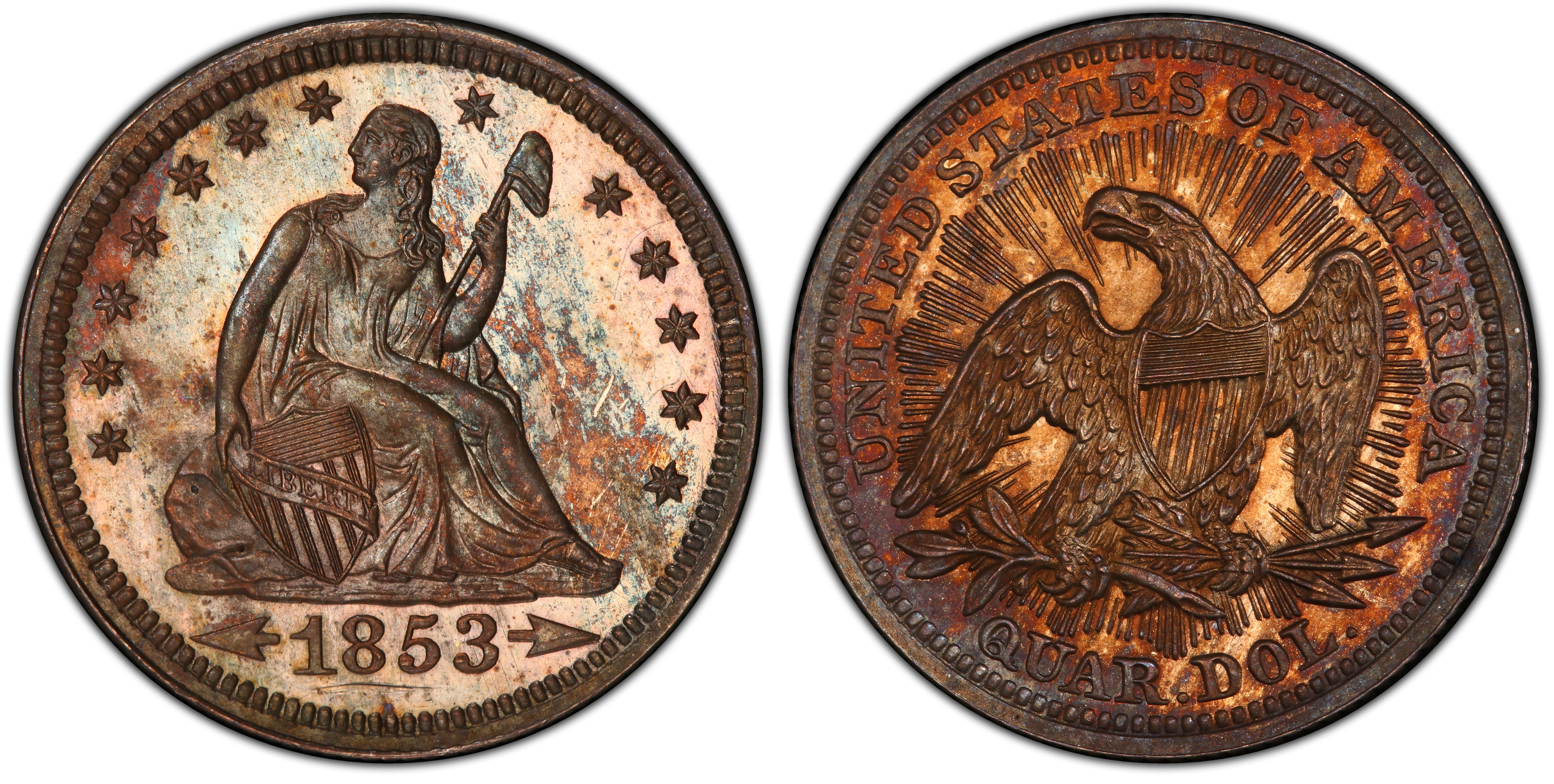
PCGS PR63
- PCGS #:
- 5548
- Designer:
- Robert Ball Hughes/Christian Gobrecht
- Edge:
- Reeded
- Diameter:
- 24.30 millimeters
- Weight:
- 6.20 grams
- Mintage:
- 5
- Mint:
- Philadelphia
- Metal:
- 90% Silver, 10% Copper
- Auction Record:
- $166,750 • PR67 • 04-28-2010 • Heritage Auctions
Rarity and Survival Estimates Learn More
| Survival Estimate | |
|---|---|
| All Grades | 5 |
| 60 or Better | 5 |
| 65 or Better | 1 |
| Numismatic Rarity | |
|---|---|
| All Grades | R-9.7 |
| 60 or Better | R-9.7 |
| 65 or Better | R-10.0 |
| Relative Rarity By Type All Specs in this Type | |
|---|---|
| All Grades | 1 / 1 |
| 60 or Better | 1 / 1 |
| 65 or Better | 1 / 1 |
| Relative Rarity By Series All Specs in this Series | |
|---|---|
| All Grades | 7 / 54 TIE |
| 60 or Better | 8 / 54 TIE |
| 65 or Better | 1 / 54 TIE |
Condition Census What Is This?
|
#1 PR66 estimated grade
Heritage 4/2010:2087, $166,750 |
| #2 PR64 PCGS grade |
| #2 PR64 PCGS grade |
| #4 PR63 PCGS grade |
|
#4 PR63 estimated grade
Jerome Kern Collection - B. Max Mehl “Golden Jubilee Sale” 5/1950:1445, $43.50 - John Jay Pittman Collection - David Akers 5/1998:1325, $99,000 - Bowers & Merena 8/1999:141 - Benson Collection, Part II - Goldbergs 2/2002:704 - Superior 1/2004:287 - Eugene H. Gardner Collection - Heritage 5/2015:98377, $41,125 |
| #4 PR63 estimated grade |
Proof 1853 Arrows & Rays Quarter Dollars are extremely rare...and confusing. Some are stone-cold, undisputed Proofs, such as the Kaufman NGC PR66CAM that once sold for $276,000. Others, like the Norweb and Eliasberg examples, started out as Prooflike Mint State pieces but have subsequently been called Proofs. Even David Akers had trouble with the Pittman example because it was Proof on the obverse, but not Proof within the shield stripes on the reverse (Akers ended up calling the Pittman coin a Proof; NGC concurred by calling it a PR64).
Including the Proof-ish examples, there are approximately seven or eight examples known. One example is held in the National Numismatic Collection at the Smithsonian Institution. The Kaufman and Eliasberg examples are Cameo Proofs.