1892 25C (Proof)
Series: Barber Quarters 1892-1915
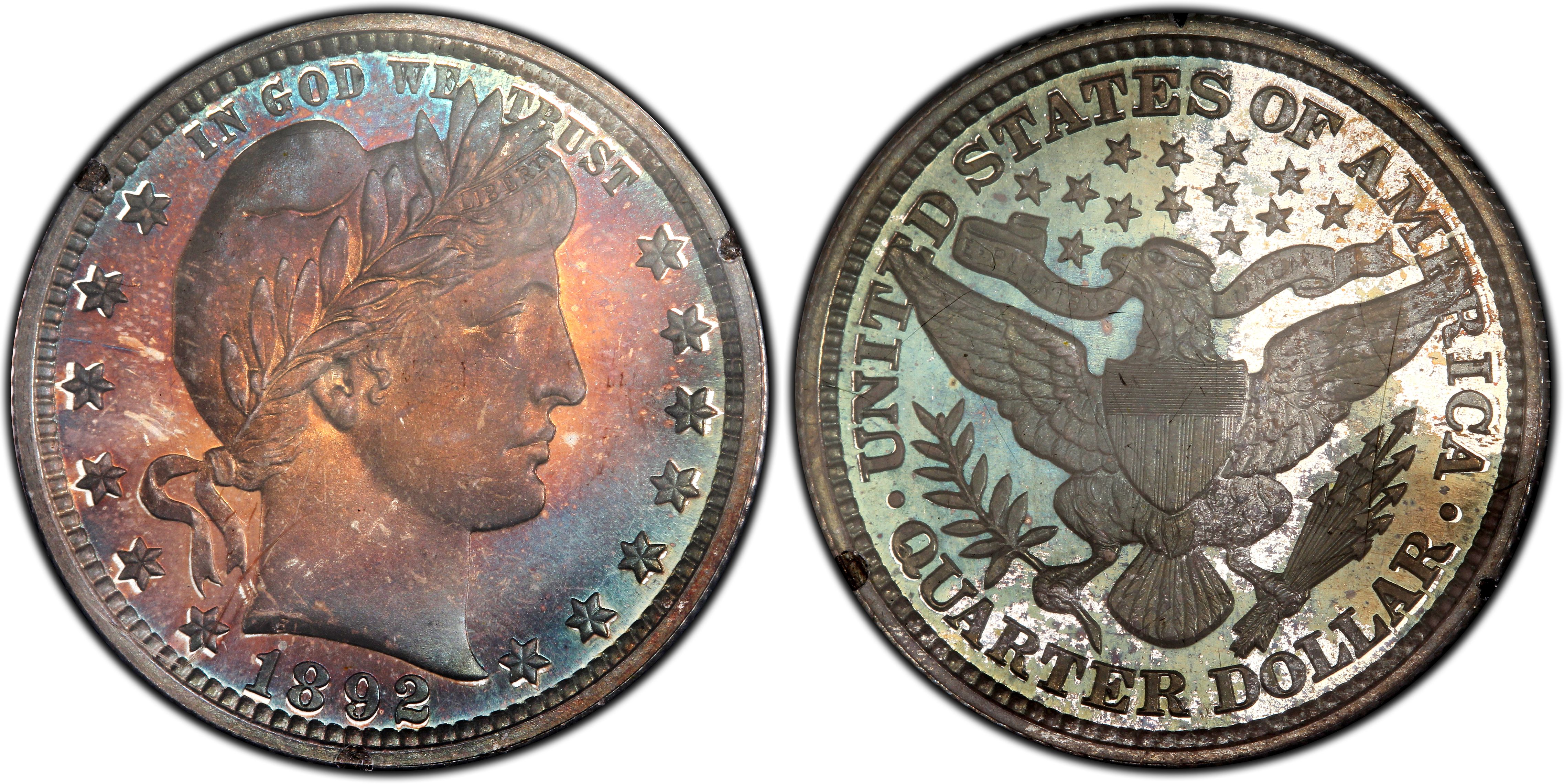
PCGS PR68

PCGS PR68

PCGS PR67+
- PCGS #:
- 5678
- Designer:
- Charles E. Barber
- Edge:
- Reeded
- Diameter:
- 24.30 millimeters
- Weight:
- 6.30 grams
- Mintage:
- 1,245
- Mint:
- Philadelphia
- Metal:
- 90% Silver, 10% Copper
- Auction Record:
- $20,700 • PR69 • 09-14-1998 • Bowers & Merena
Rarity and Survival Estimates Learn More
| Survival Estimate | |
|---|---|
| All Grades | 1,000 |
| 60 or Better | 950 |
| 65 or Better | 250 |
| Numismatic Rarity | |
|---|---|
| All Grades | R-5.0 |
| 60 or Better | R-5.1 |
| 65 or Better | R-6.6 |
| Relative Rarity By Type All Specs in this Type | |
|---|---|
| All Grades | 24 / 24 |
| 60 or Better | 24 / 24 |
| 65 or Better | 21 / 24 TIE |
| Relative Rarity By Series All Specs in this Series | |
|---|---|
| All Grades | 24 / 24 |
| 60 or Better | 24 / 24 |
| 65 or Better | 21 / 24 TIE |
Condition Census What Is This?
|
#1 PCGS PR68
Stack's Bowers, September 4, 2025, Lot 3051 - $11,400. |
|
#1 PCGS PR68
|
|
#1 PCGS PR68
Heritage Auctions, February 9, 2006, Lot 988 - $9,660; "The Driftwood Barber Quarters Proof Set" (PCGS Set Registry). |
| #1 PCGS PR68 |
| #1 PCGS PR67+ |
|
#6 PCGS PR67+
|
The 1892 Barber Quarter Proof
Debuting in 1892, the Barber Quarter revitalized U.S. subsidiary silver coinage alongside its dime and half dollar counterparts. Designed by Chief Engraver Charles E. Barber, the obverse features a neoclassic right-facing Liberty head. Though often compared to George T. Morgan’s 1878 silver dollar, Barber’s design is thinner and set further back on the canvas, with a sharper jawline, pointier chin, contoured forehead, and more upright eye shape.
In 1892, the Philadelphia Mint struck 8,236,000 business-strike quarters (#5601) and 1,245 Proofs (#5678) for collectors. Shortly after release, complaints arose that the coins did not stack properly, prompting a slight reverse redesign:
- Type I: The eagle’s wingtip rests between the "E" and "D" of UNITED, covering only the right serif of the "E". Only about 100 Proofs (~8%) were struck, making this variety rare in high grades.
- Type II: The wingtip was repositioned to cover over half of the "E" and its crossbar, fixing the stacking flaw.
While most 1892 Proofs feature fully brilliant surfaces, Cameo and Deep Cameo coins command strong market premiums. The pinnacle of the issue is a single PCGS PR69DCAM — the finest known example.
* * *