1879 $20 J-1643 (Proof)
Series: Patterns - PR
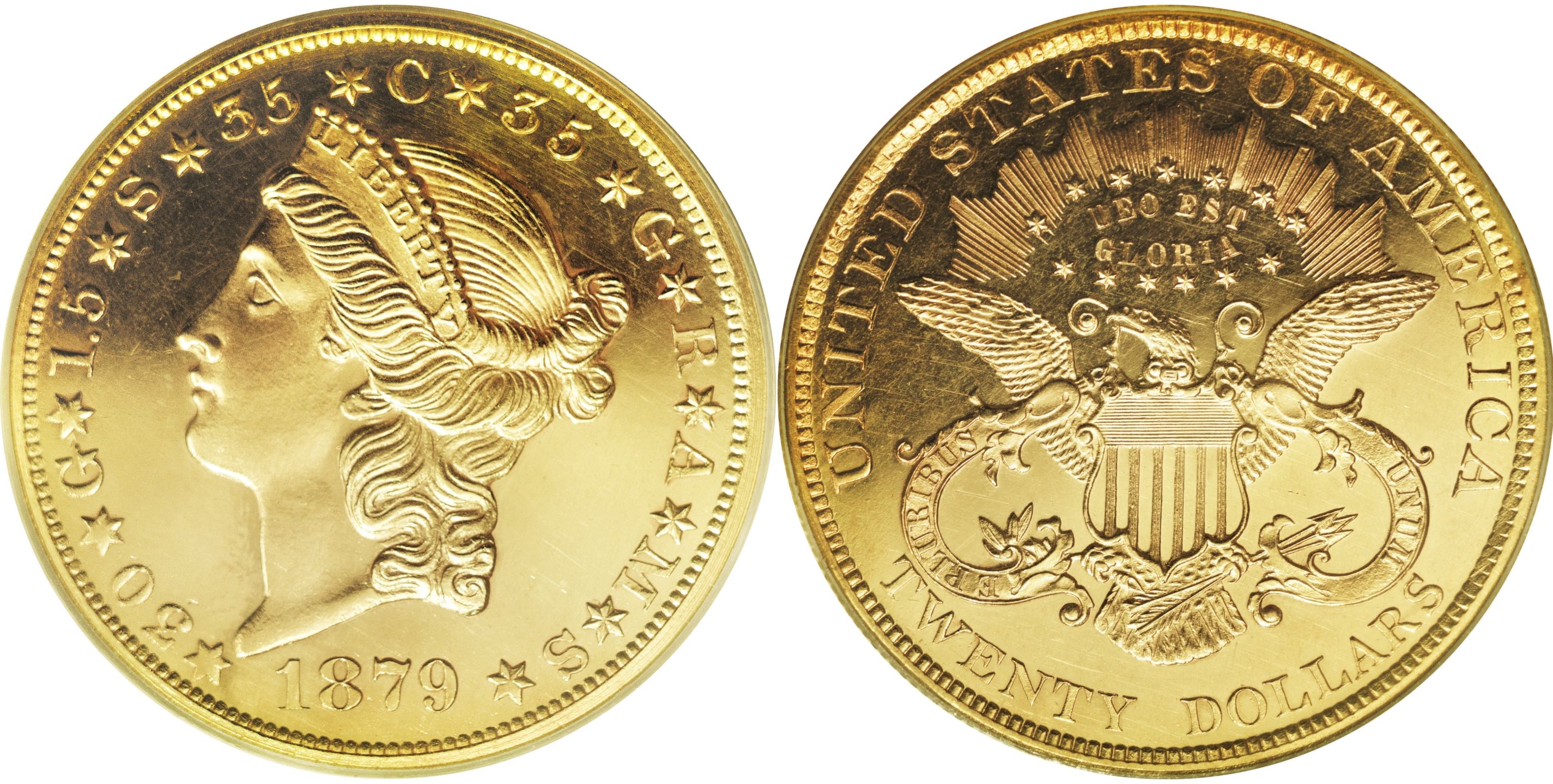
PCGS PR62
Image courtesy of Heritage Numismatic Auctions
- PCGS #:
- 62022
- Designer:
- James Barton Longacre
- Edge:
- Reeded
- Diameter:
- 34.00 millimeters
- Weight:
- 35.00 grams
- Mintage:
- N/A
- Mint:
- Philadelphia
- Metal:
- 86% Gold, 4% Silver, 10% Copper
- Auction Record:
- $862,500 • PR62 • 01-01-2007 • Heritage Auctions
The 1879 "Quintuple Stella," J-1643
The Quintuple Stella (J-1643, PCGS #62022) is a pattern coin struck by the United States Mint during a multi-year experiment to determine the viability of adopting metric coinage for international and domestic trade. These tests were carried out at the urging of Dr. William Wheeler Hubbell, a Philadelphia-born patent attorney and inventor. Hubbell advocated for the adoption of his patented alloys, specifically "goloid" (a silver-heavy blend) and "metric gold," which he urged Congress to adopt.
Hubbell had big dreams for his new alloys, but they were misplaced. Europe, which had adopted the Latin Monetary Union standard in 1865, followed a strict bimetallic system based on the French franc; Hubbell’s blended-metal coins would not have worked within this framework. Domestically, Hubbell saw his alloys as a salve for the negative consequences of the Coinage Act of 1873. Because the metals were difficult to part, he believed the coins would be less susceptible to the fluctuations of the bullion market. Unfortunately for Hubbell, he frequently complained that the Mint failed to faithfully recreate the alloys to his exact specifications, and the project ultimately failed to win Congressional support due to the severe counterfeiting risks the blended metals presented.
Despite its ultimate failure, the metric gold plan initially won the enthusiastic endorsement of the House Committee on Coinage, Weights, and Measures, headed by Alexander Stephens of Georgia. While Hubbell’s metric coinage proved to be a doomed cause, it was certainly not the most infamous one Stephens had supported; prior to returning to Congress, he had served as the Vice President of the Confederate States of America.
The inscription found on the Quintuple Stella reveals the anticipated composition. The 35 gram gold coin was to be composed of 30 grams of gold, 1.5 grams of silver, and 3.5 grams of copper. In their official report, the committee praised the new alloy's striking properties and "rich orange color," noting its "superiority for practical use, as it flows with a sharper and more distinct finish into the dies." Hubbell further promoted the coin as being superior to standard gold for its metric weight, superior ring, resiliency to wear, and immunity to value loss during international exchange. Believing Latin was a better international language than English, Hubbell instructed that IN GOD WE TRUST be replaced with the motto DEO EST GLORIA ("God is the Glory") on the reverse.
For the obverse, existing double eagle hubs were used, with a new composition inscription punched around the border. The initial die erroneously read 35 C for the copper weight, but the missing decimal point was quickly corrected to 3.5 C for the Judd-1643 and Judd-1644 strikings (#62023).
The Mint employed various processes to prepare the planchets for production, ensuring it would not face further criticism from Hubbell. The visual results were striking; in April 1879, the American Journal of Numismatics noted that the new pattern was "said to be one of the most beautiful coins ever executed." This is an interesting sentiment, considering the design is simply a rehash of the circulating Longacre Liberty Head Double Eagle.
The Quintuple Stella is forever linked to the four-dollar gold pattern, the Stella. The Stella was struck in limited numbers across two styles in 1879 and 1880 before it, too, was abandoned. For the $20 pattern, official records indicate that just three pieces were struck in February 1879. Today, however, five examples are known: four remain in private hands, and one resides in the National Numismatic Collection at the Smithsonian Institution.
* * *