1866 $1 Motto (Regular Strike)
Series: Liberty Seated Dollars 1840-1873
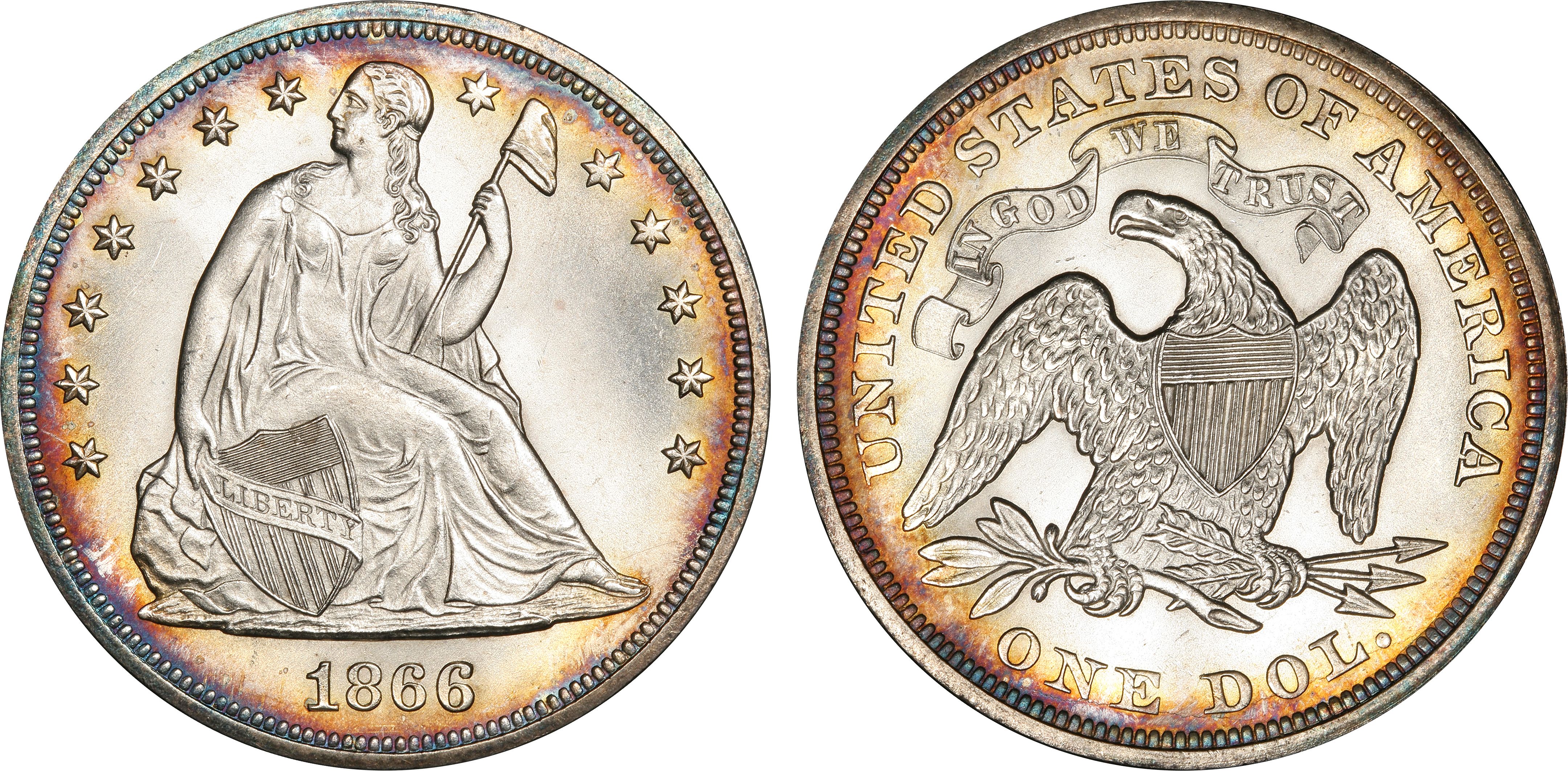
PCGS MS67

PCGS MS66+

PCGS MS65
- PCGS #:
- 6959
- Designer:
- Christian Gobrecht
- Edge:
- Reeded
- Diameter:
- 38.10 millimeters
- Weight:
- 26.73 grams
- Mintage:
- 48,900
- Mint:
- Philadelphia
- Metal:
- 90% Silver, 10% Copper
- Auction Record:
- $150,000 • MS67 • 12-21-2020 • Stack's Bowers
Rarity and Survival Estimates Learn More
| Survival Estimate | |
|---|---|
| All Grades | 1,500 |
| 60 or Better | 100 |
| 65 or Better | 10 |
| Numismatic Rarity | |
|---|---|
| All Grades | R-4.8 |
| 60 or Better | R-8.0 |
| 65 or Better | R-9.5 |
| Relative Rarity By Type All Specs in this Type | |
|---|---|
| All Grades | 9 / 15 TIE |
| 60 or Better | 10 / 15 |
| 65 or Better | 10 / 15 |
| Relative Rarity By Series All Specs in this Series | |
|---|---|
| All Grades | 21 / 45 TIE |
| 60 or Better | 28 / 45 TIE |
| 65 or Better | 29 / 45 |
Condition Census What Is This?
|
#1 PCGS MS67
As NGC MS67. “The Millennium Sale,” Bowers and Merena, August 2000. As PCGS MS67 #21572796. “Legend Collection of Mint State Seated Dollars”; Dell Loy Hansen; "D.L. Hansen 19th Century Type Set with Gold (1800-1899)" (PCGS Set Registry). Bright centers with toned edges. Faint toning spot on shield. |
|
#1 PCGS MS67
Steve Contursi, March 2004; Stack’s Bowers, December 18, 2020, Lot 2263 – $150,000. Golden peripheral toning on obverse; blue-green toning on reverse. Thin horizontal scratches in the fields flanking Liberty. Tick on Liberty’s forearm. Diagnostic die crack across stars 9 and 10. |
|
#3 PCGS MS66+
“The D. Brent Pogue Collection, Part VII,” Stack’s Bowers, March 20, 2020, Lot 7306 – $132,000. Pale gold centers, with orange and purple toning along the periphery. |
| #4 PCGS MS66 |
| #4 PCGS MS66 |
| #4 PCGS MS66 |
|
#7 PCGS MS65
“The Frog Run Collection,” American Numismatic Rarities, November 30, 2004, Lot 1554 – $43,125; Legend Numismatics, April 2011; "The Eugene H. Gardner Collection, Part II," Heritage Auctions, October 27, 2014, Lot 98598 – $79,312.50; "Nic's 1866 Philly Mint Set" (PCGS Set Registry). All over peach toning. On the reverse, there is a tick under the eagle’s right wing. |
| #7 PCGS MS65 |
The Civil War Ends But Financial Hardship Endures
Despite the final battle taking place at Palmito Ranch in Cameron County, Texas, on May 12 and 13, 1865, the formal conclusion of the American Civil War did not occur until August 20, 1866. On that day, President Andrew Johnson signed an official proclamation declaring that the "insurrection is at an end."
With much of the South in ruins, the nation’s economic recovery varied significantly by region. While the federal government’s policy of Reconstruction was met with open hostility—and frequent violence—in the South, its key pillars (the 13th, 14th, and 15th Amendments) sought to abolish slavery and extend the franchise and protections of citizenship to African American men. Economically, the country remained mired in debt, having borrowed more than $2.7 billion to prosecute the war. Surprisingly, the government maintained a balanced budget, and by the end of the century, this debt had been whittled down to $1.9 billion.
The 1866 Liberty Seated Dollar
The year 1866 marked the first time the new national motto, "In God We Trust," appeared on the silver dollar. The phrase was first introduced on the two-cent piece in 1864, reflecting the deep religious sentiment felt by many as the Civil War dragged on. Treasury Secretary Salmon P. Chase approved the motto’s placement after receiving a letter from M.R. Watkinson, a Baptist preacher from Ridleyville, Pennsylvania.
In a letter to Chase dated November 13, 1861, Watkinson wrote:
"You are probably a Christian. What if our Republic were now shattered beyond reconstruction? Would not the antiquaries of succeeding centuries rightly reason from our past that we were a heathen nation? What I propose is that instead of the goddess of liberty we shall have next inside the 13 stars a ring inscribed with the words PERPETUAL UNION; within the ring the all seeing eye, crowned with a halo; beneath this eye the American flag, bearing in its field stars equal to the number of the States united; in the folds of the bars the words GOD, LIBERTY, LAW."
Chase was so moved that he wrote a letter to James Pollock, Director of the Mint, on November 20, 1861:
"Dear sir, No nation can be strong except in the strength of God, or safe except in His defense. The trust of our people in God should be declared on our national coins.
You will cause a device to be prepared without unnecessary delay with a motto expressing in the fewest and tersest words possible this national recognition."
It took three years for the Treasury Department to settle on "In God We Trust," and public reaction was overwhelmingly positive. Consequently, on March 3, 1865, Congress enacted legislation authorizing—but not mandating—the use of the motto on "gold, silver, and other coins."
Due to their small size, the dime and the quarter eagle did not receive the motto until 1916 and 1908, respectively. The gold dollar and the three-dollar gold coin never featured the motto, while the half eagle, eagle, and double eagle all adopted it in 1866.
Nearly all 1866 Liberty Seated Dollars were struck with the motto. Two proofs, however, are known to have been struck without it. These 1866 Liberty Seated Dollar "No Motto" Proofs (#87009) are among the great rarities of 19th-century American coinage.
As a circulating coin, Americans found little domestic use for the Liberty Seated Dollar in 1866; instead, the denomination was struck primarily for use in international trade. The year’s total output of 48,900 business strikes was produced across five delivery dates, with the bulk of production occurring between May and August. Most of these coins have been lost to time or melted; today, it is estimated that fewer than 100 examples survive in Mint State, with the majority of those clustered in lower Uncirculated grades.
|
1866 Liberty Seated Dollar Production Dates |
|||
| January 30, 1866 | 6,700 struck | May 8, 1866 | 15,900 struck |
| June 21, 1866 | 6,600 struck | July 30, 1866 | 13,900 struck |
| August 24, 1866 | 5,800 struck | Uncertain Date | 725 Proofs |
| Total Mintage: | 48,900 coins | ||
The Philadelphia Mint was the only branch to strike silver dollars in 1866, though two obverse and six reverse dies were shipped to San Francisco. In hindsight, the Mint’s engraving staff needn't have bothered; the San Francisco Mint would not strike silver dollars again until 1870, when it produced an estimated 15 specimens.
Collecting the 1866 Liberty Seated Dollar
The PCGS Population Report indicates that more than 400 coins have been certified. Nearly half, however, resulted in no-grades—a clear indication that a large share of surviving 1866 Liberty Seated Dollars exist in an impaired state. Nearly 20% of all graded coins fall within the P–XF range, leaving the majority of the remainder in About Uncirculated (AU) condition.
When tracking public appearances of the highest-graded coins in our holders, an information gap exists for several specimens. The three MS66 pieces, for instance, show no auction appearances since one example was featured in Sotheby’s 1999 sale of the John and Rebecca Moores Collection. Furthermore, all three of these were certified between 1991 and 1998, and cross checking them against the CAC database reveals nothing. It is possible these coins have been tucked away in long-term collections or perhaps "cracked out" and re-holdered. Given the infrequency with which these low-mintage Liberty Seated Dollars appear at auction, it may take years to resolve these mysteries.
* * *