1852 $1 Original (Proof)
Series: Liberty Seated Dollars 1836-1873
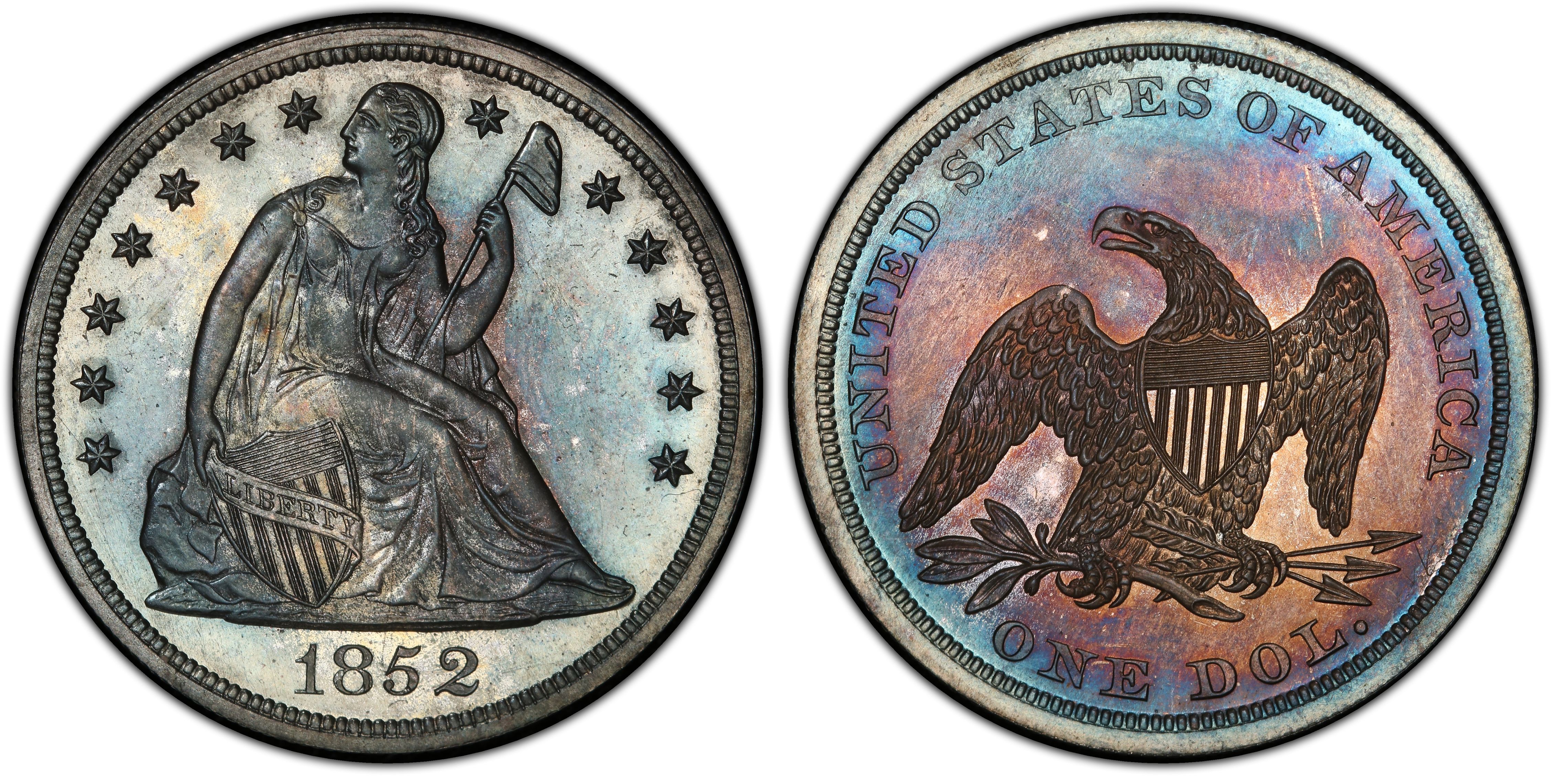
PCGS PR65
- PCGS #:
- 6994
- Designer:
- Christian Gobrecht
- Edge:
- Reeded
- Diameter:
- 38.10 millimeters
- Weight:
- 26.73 grams
- Mintage:
- 3
- Mint:
- Philadelphia
- Metal:
- 90% Silver, 10% Copper
- Auction Record:
- $129,250 • PR65 • 01-25-2018 • Legend Rare Coin Auctions
Rarity and Survival Estimates Learn More
| Survival Estimate | |
|---|---|
| All Grades | 3 |
| 60 or Better | 3 |
| 65 or Better | 1 |
| Numismatic Rarity | |
|---|---|
| All Grades | R-9.8 |
| 60 or Better | R-9.8 |
| 65 or Better | R-10.0 |
| Relative Rarity By Type All Specs in this Type | |
|---|---|
| All Grades | 1 / 27 |
| 60 or Better | 1 / 27 |
| 65 or Better | 1 / 27 TIE |
| Relative Rarity By Series All Specs in this Series | |
|---|---|
| All Grades | 1 / 38 |
| 60 or Better | 1 / 38 |
| 65 or Better | 1 / 38 TIE |
Condition Census What Is This?
|
#1 PR65 PCGS grade
Virginia Cabinet - Heritage 4/2015:5149, $70,500 - Heritage 6/2016:464, not sold - Heritage 1/2017:5696, $96,937.50 (cert-matched) - “RCW” Collection (PCGS Set Registry) |
|
#2 PR62 estimated grade
J.P. Morgan Collection (?-1908) - American Numismatic Society Collection (1908-date) |
The 1852 "Original" Silver Dollar Proof is a rather confusing item. Walter Breen, in the 1989 edition of his Encyclopedia of United States and Colonial Proof Coins: 1722-1989, lists three die pairs for Original 1852 Silver Dollars, all with the same obverse combined with three different reverses. His first die pair (B-1) combines what appears to be the same dies that were used on circulation strikes. If this is true, this would be a correct use of the term "Original," but it also means that all Proof 1853 Silver Dollars, whether Original or Restrike, were made from the circulation strike obverse that had been proofed In his second "Original" die pair (B-2), Breen reports the reverse die used on Proofs from 1840-1849. On his third "Original" die pair (B-3), he reports a reverse with a diagonal line slanting down (WNW through ESE on the compass) through the first five white stripes. 1852 "Restrike" Dollars combine the same obverse with an 1858-59 reverse.
In 1993, Q. David Bowers listed six different Proof reverses for 1852 Silver Dollars, comprising three Originals and three Restrikes.
To confuse the situation further, the 1852 Reverse of 1840-49 Proof (known by a single example in the collection of the American Numismatic Society) is also called an "Original."
Clearly further investigation is needed to clear up this picture. John Dannreuther is hard at work on a monumental reference book on Proof coins, and we await his conclusions.