1850-O G$1 (Regular Strike)
Series: Liberty Gold Dollars 1849-1889
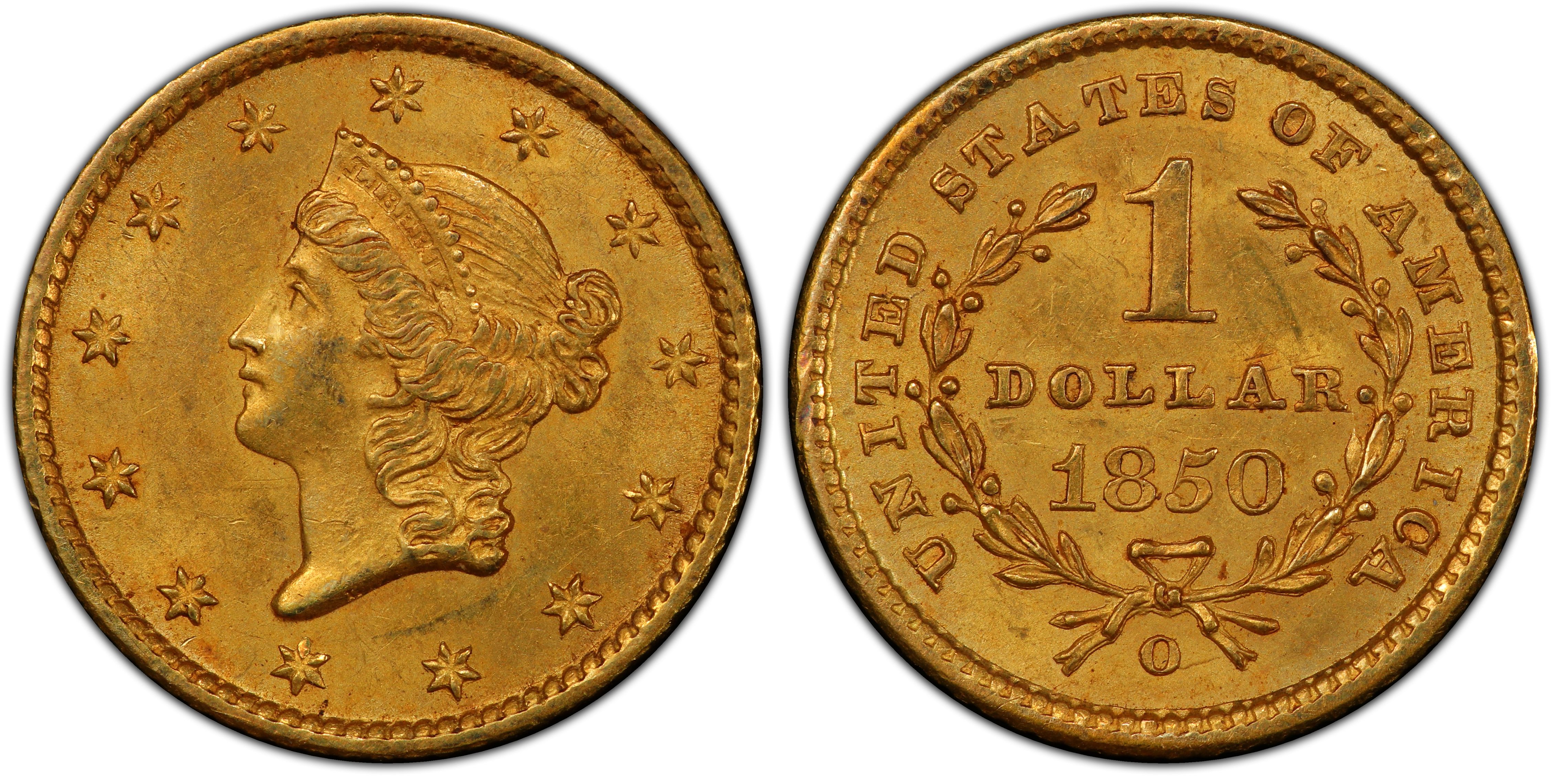
PCGS MS63+

PCGS MS63

PCGS MS63
- PCGS #:
- 7512
- Designer:
- James Barton Longacre
- Edge:
- Reeded
- Diameter:
- 12.70 millimeters
- Weight:
- 1.70 grams
- Mintage:
- 14,000
- Mint:
- New Orleans
- Metal:
- 90% Gold, 10% Copper
- Auction Record:
- $18,000 • MS63+ • 08-23-2024 • Stack's Bowers
Major Varieties
- 1850-O G$1
Go To Grade
Current Auctions - PCGS Graded
Current Auctions - NGC Graded
For Sale Now at Collectors Corner - PCGS Graded
For Sale Now at Collectors Corner - NGC Graded
Rarity and Survival Estimates Learn More
| Survival Estimate | |
|---|---|
| All Grades | 200 |
| 60 or Better | 20 |
| 65 or Better | |
| Numismatic Rarity | |
|---|---|
| All Grades | R-7.0 |
| 60 or Better | R-9.1 |
| 65 or Better | R-10.1 |
| Relative Rarity By Type All Specs in this Type | |
|---|---|
| All Grades | 11 / 26 TIE |
| 60 or Better | 10 / 26 TIE |
| 65 or Better | 1 / 26 |
| Relative Rarity By Series All Specs in this Series | |
|---|---|
| All Grades | 31 / 81 TIE |
| 60 or Better | 22 / 81 TIE |
| 65 or Better | 1 / 81 |
Condition Census What Is This?
| #1 MS64 PCGS grade |
| #1 MS64 PCGS grade |
| #3 MS63 PCGS grade |
| #3 MS63 PCGS grade |
| #3 MS63 PCGS grade |
| #3 MS63 PCGS grade |
| #3 MS63 PCGS grade |
| #3 MS63 PCGS grade |
| #3 MS63 PCGS grade |
| #3 MS63 PCGS grade |
David Akers (1975/88):
Vert much underrated in all grades, and actually comparable in rarity to the 1850-C and 1850-D, although it brings substantially less when offered for sale. Far and away the rarest O Mint gold dollar.
Doug Winter:
The 1850-O is easily the scarcest of the five Type One New Orleans gold dollars. It is the only issue that is hard to locate in the lower uncirculated grades and it is quite rare above MS62.
Strike: The 1850-O is generally one of the better struck New Orleans gold dollars. It is usually seen with sharp central details and very strong details on the borders, including full denticles and radial lines in the stars. The date and mintmark are typically full as well.
Surfaces: This is the hardest date of the denomination to find with nice surfaces. Most examples are very heavily abraded in the fields, especially the left obverse. Some display small mint-made defects.
Luster: On original uncleaned examples the luster is very frosty with a texture that is much different than on the 1849-O. Most of the 1850-O gold dollars I have seen have been dipped at one time and pieces with fully original surfaces should command a large premium above typical examples.
Coloration: The natural coloration for this issue is deep green-gold although some show natural light orange-gold or mustard-yellow color. It is very hard to find an example with attractive original color.
Eye Appeal: The 1850-O gold dollar is a hard coin to find with good eye appeal. Lower grade examples are often found with overly-abraded surfaces, while higher grade pieces have often been dipped. Locating a pleasing piece should prove quite challenging for the collector.
Die Characteristics: All examples have a few small raised patches of die rust on the neck of Liberty. These may not be visible on lower grade coins.
Major Varieties: There is only one variety known;
Variety One: The 8 in the date is directly below the first L in DOLLAR, while the mintmark is small and it tilts slightly to the right.
Strike: The 1850-O is generally one of the better struck New Orleans gold dollars. It is usually seen with sharp central details and very strong details on the borders, including full denticles and radial lines in the stars. The date and mintmark are typically full as well.
Surfaces: This is the hardest date of the denomination to find with nice surfaces. Most examples are very heavily abraded in the fields, especially the left obverse. Some display small mint-made defects.
Luster: On original uncleaned examples the luster is very frosty with a texture that is much different than on the 1849-O. Most of the 1850-O gold dollars I have seen have been dipped at one time and pieces with fully original surfaces should command a large premium above typical examples.
Coloration: The natural coloration for this issue is deep green-gold although some show natural light orange-gold or mustard-yellow color. It is very hard to find an example with attractive original color.
Eye Appeal: The 1850-O gold dollar is a hard coin to find with good eye appeal. Lower grade examples are often found with overly-abraded surfaces, while higher grade pieces have often been dipped. Locating a pleasing piece should prove quite challenging for the collector.
Die Characteristics: All examples have a few small raised patches of die rust on the neck of Liberty. These may not be visible on lower grade coins.
Major Varieties: There is only one variety known;
Variety One: The 8 in the date is directly below the first L in DOLLAR, while the mintmark is small and it tilts slightly to the right.