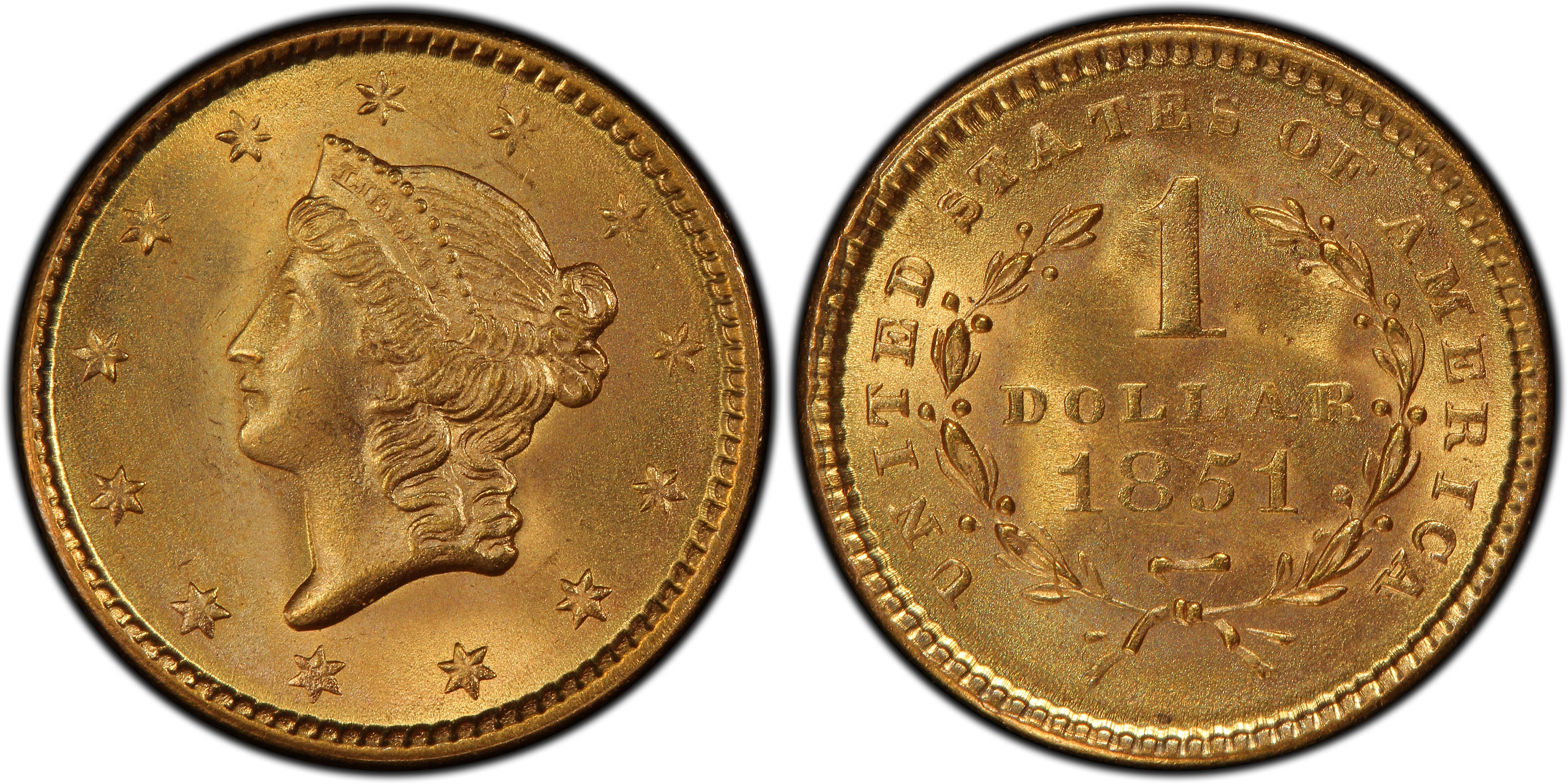
1851 G$1 (Regular Strike)
Series: Liberty Gold Dollars 1849-1889
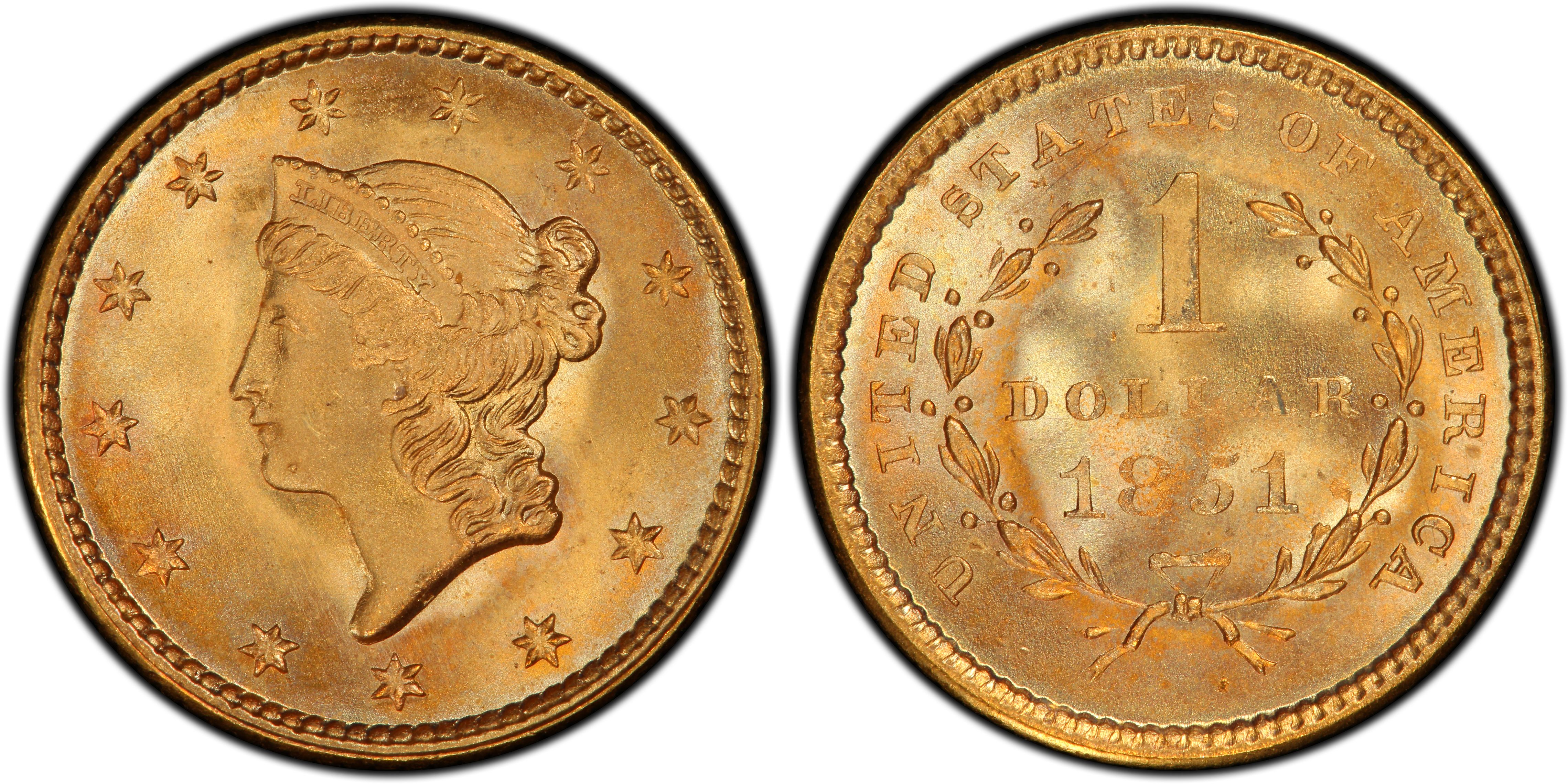
PCGS MS68+

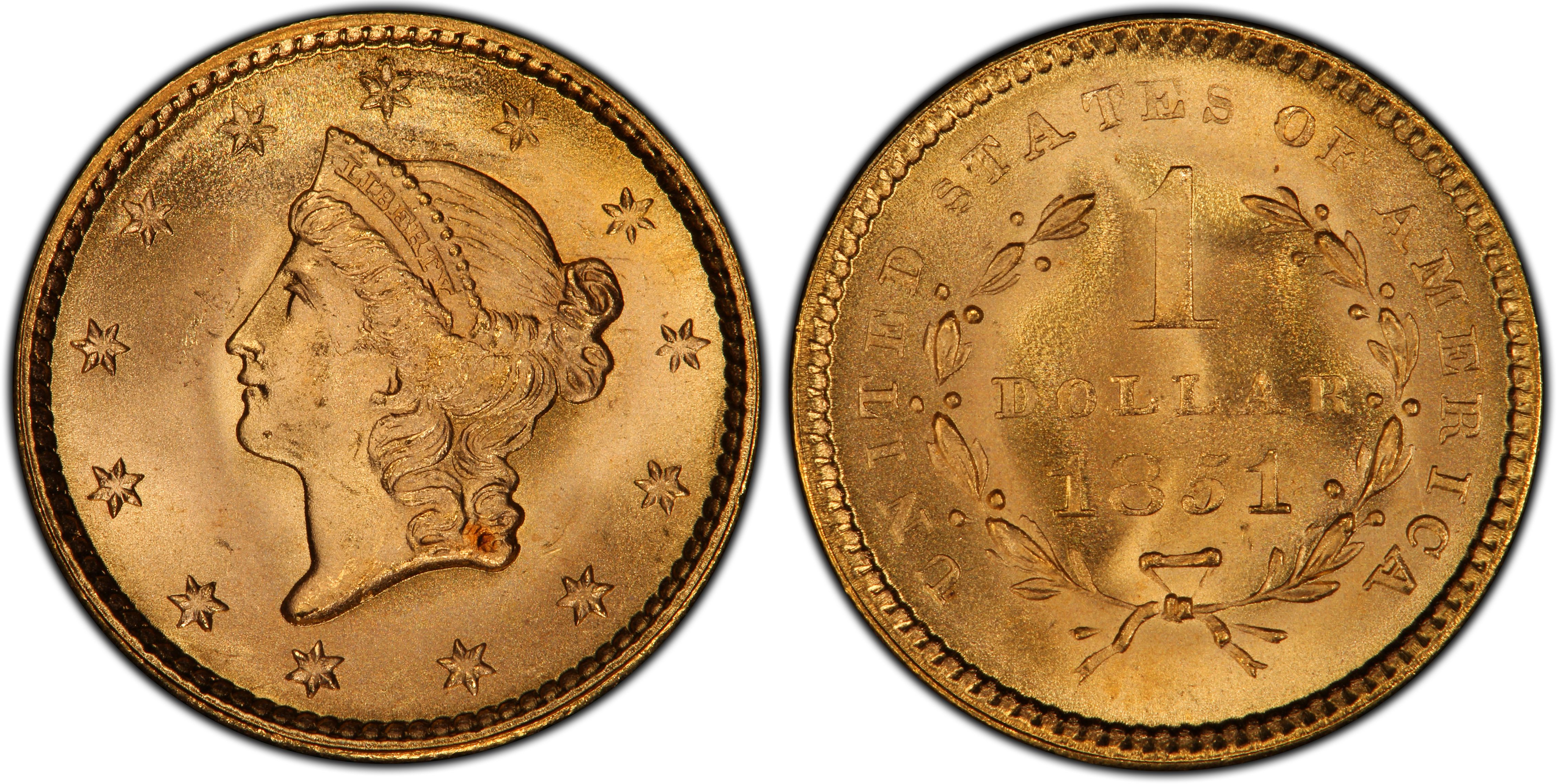
PCGS MS67+

PCGS MS67
- PCGS #:
- 7513
- Designer:
- James Barton Longacre
- Edge:
- Reeded
- Diameter:
- 12.70 millimeters
- Weight:
- 1.70 grams
- Mintage:
- 3,317,671
- Mint:
- Philadelphia
- Metal:
- 90% Gold, 10% Copper
- Auction Record:
- $108,000 • MS68+ • 02-25-2021 • Heritage Auctions
Major Varieties
- 1851 G$1
Rarity and Survival Estimates Learn More
| Survival Estimate | |
|---|---|
| All Grades | 6,000 |
| 60 or Better | 2,500 |
| 65 or Better | 125 |
| Numismatic Rarity | |
|---|---|
| All Grades | R-3.8 |
| 60 or Better | R-4.5 |
| 65 or Better | R-7.7 |
| Relative Rarity By Type All Specs in this Type | |
|---|---|
| All Grades | 25 / 26 |
| 60 or Better | 23 / 26 TIE |
| 65 or Better | 17 / 26 |
| Relative Rarity By Series All Specs in this Series | |
|---|---|
| All Grades | 78 / 81 TIE |
| 60 or Better | 74 / 81 TIE |
| 65 or Better | 48 / 81 TIE |
Condition Census What Is This?
|
#1 PCGS MS68+
David W. Akers. As PCGS MS68. Stack’s Bowers, August 13, 2011, Lot 7579 – $63,250. Pop two, with none finer, when offered. As PCGS MS68 #24463214. “The Duckor Family Collection of Gold Dollars,” Heritage Auctions, August 12, 2015, Lot 4241 – $94,000. As PCGS MS68+ #40276027. “The Bob R. Simpson Collection, Part IV,” Heritage Auctions, February 23, 2021, Lot 3082 – $108,000. Top Pop: Pop 1 when offered. Small “pimple” on the chin. Reverse berries missing stems. Minor tick at the tip of the coronet. Three light streaks (as struck) between the stars at 12 and 1 o’clock. Diagonal planchet void at the star at 2 o’clock. Reverse exhibits a tiny planchet void below TA and two minute hits to the left of the digit "1." Thin vertical scratch on the "1." Doug Winter described this specimen as the finest known in 2015. Plate coin for this profile. |
| #2 PCGS MS68 |
|
#3 Est. MS67+
As PCGS MS67+ #25785891. Dell Loy Hansen. As CACG MS67+ #872545106. Frosty. Copper orange toning spot to touching the left of "L" of LIBERTY. Another similar toning spot on between an inner berry and leaf on the left side of the wreath. Faint planchet push below truncation. |
 #4 PCGS MS67
|
|
#4 PCGS MS67
As NGC MS67 #302057-002. "The Richard Jewell Collection," American Numismatic Rarities, March 8, 2005, Lot 518 - Passed; "The Madison Collection," Heritage Auctions, January 10, 2008, Lot 3041 - $16,100; "The Larry H. Miller Collection," Stack's Bowers, December 17, 2020, Lot 1110 - $10,200. As PCGS MS67 #41084354. Splashes of blue-gold toning. Planchet laminations near the bottom border. |
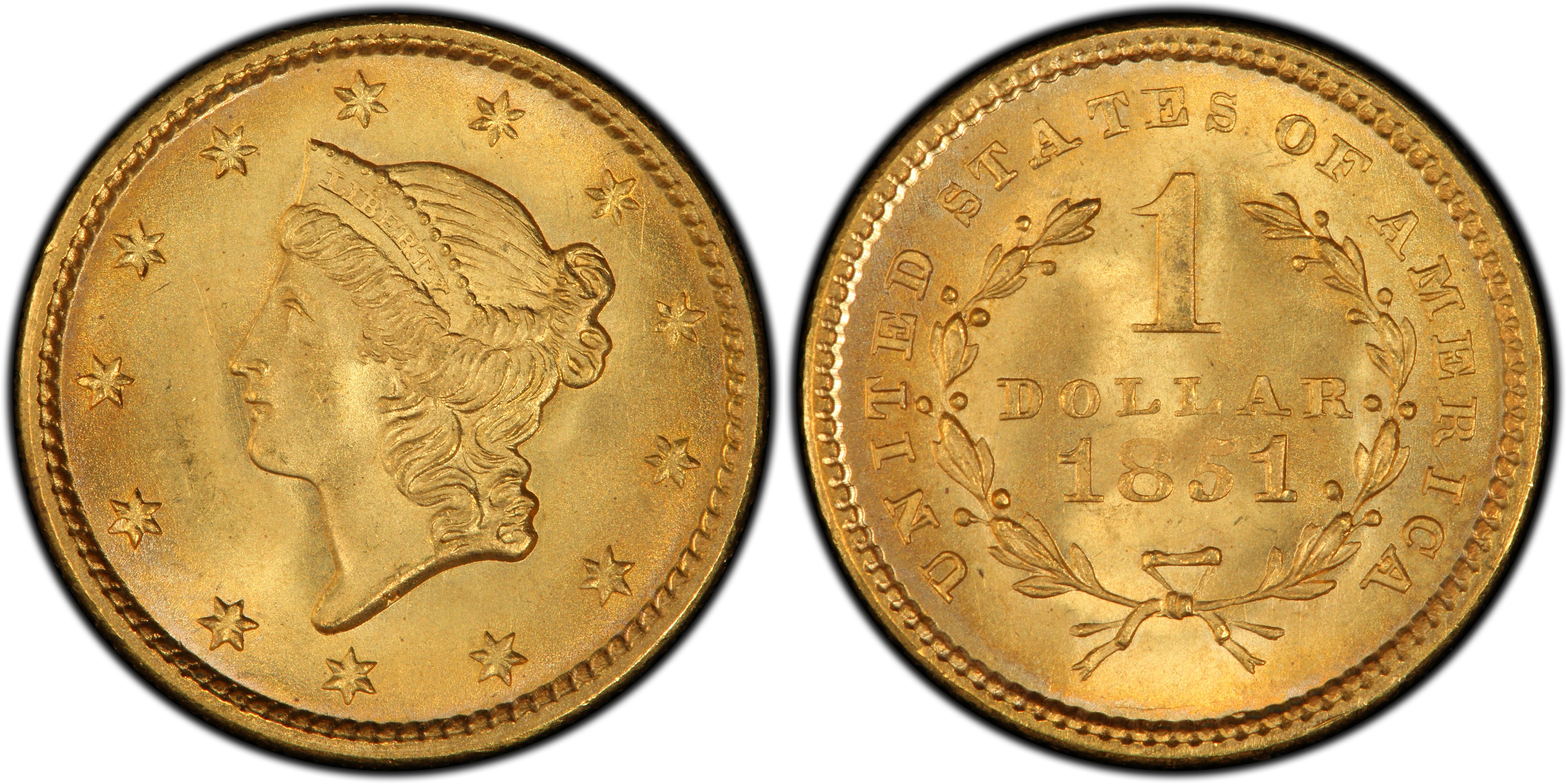
 #4 PCGS MS67
As PCGS MS67 #05904747. “The Oliver Collection,” Heritage Auctions, August 12, 2011, Lot 7405 – $17,250. As PCGS MS67 #25563194. Small “pimple” on chin. Berries missing stems. Tiny hit above star at 5 o’clock. Orange discoloration at the back of the bust truncation. On the reverse, there is a small copper spot under O of OF. |
 #4 PCGS MS67
Stack’s Bowers, March 28, 2011, Lot 6164 – $20,125. Small diagonal mark to the right of the star at 10 o’clock. On the reverse, there is a thin lintmark between RI. Small scuffs on 1. Small tick below U. |
|
#4 PCGS MS67
"The Mikkelly Coins - CAC Collection" (PCGS Set Registry). |
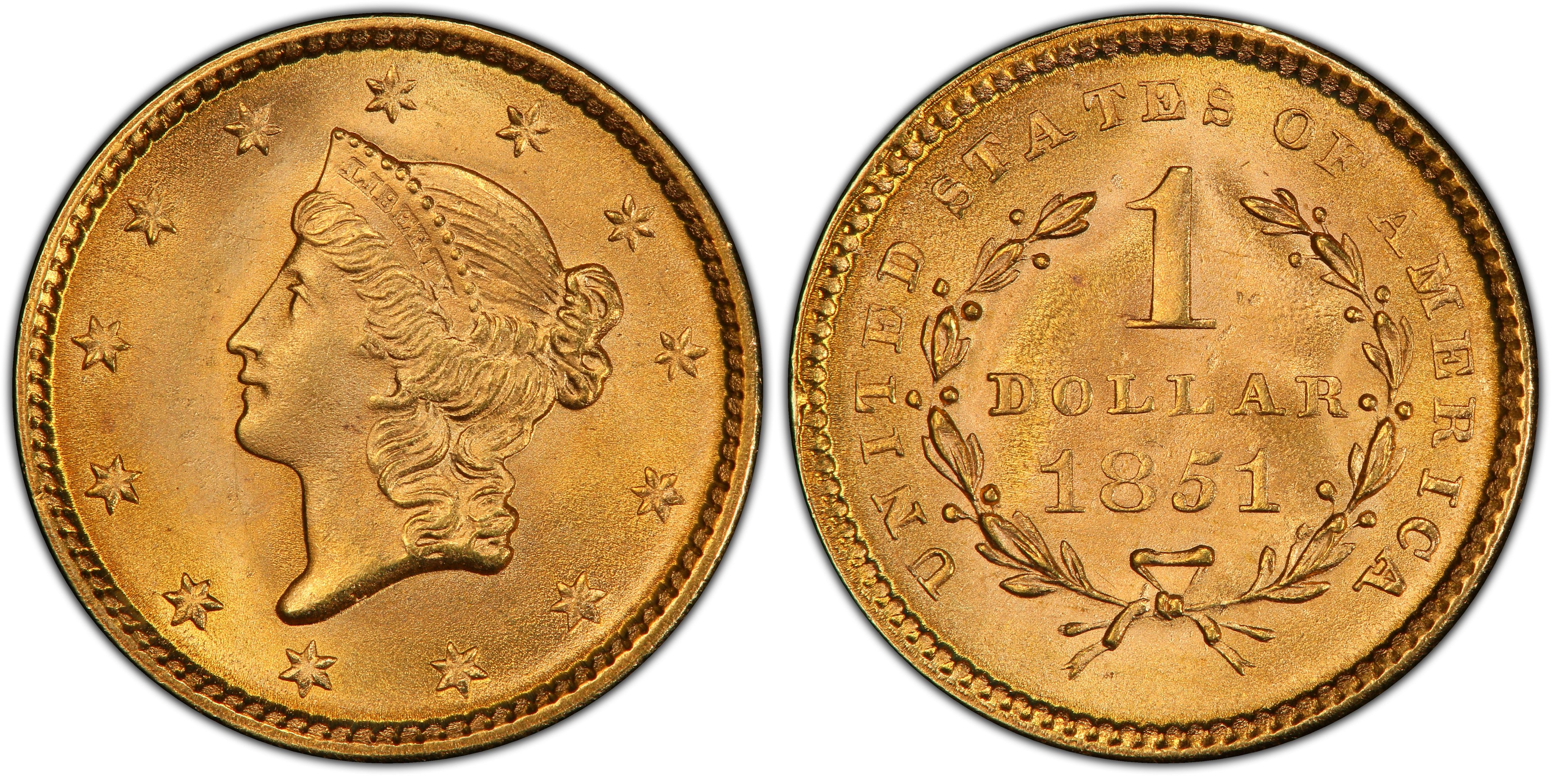 #4 PCGS MS67
|
 #4 PCGS MS67
|
| #4 PCGS MS67 |
| #4 PCGS MS67 |
| #4 PCGS MS67 |
| #4 PCGS MS67 |
The 1851 Gold Dollar
The Gold Dollar was introduced in 1849 as a coin that would circulate freely in commerce, providing an avenue for everyday Americans to utilize the flood of gold traveling east from the California gold fields. Conceived alongside the $20 Double Eagle, the two coins presented a study in contrasts: the diminutive gold dollar was more portable than the standard silver dollar, while the $20 piece provided a powerful instrument for institutional payments and transfers.
Gold Dollars struck from 1849 to 1854 are known as Type 1 Gold Dollars. They measure 13 mm in diameter and weigh 1.672 grams. Designed by United States Mint Chief Engraver James Barton Longacre, the coin features a portrait of Liberty on the obverse and a wreath—along with the denomination and statutory inscriptions—on the reverse.
From a collector’s perspective, the Type 1 series offers coins that fall into three tranches: common, semi-rare, and ultra-rare. The most famous of these is the ultra-rare 1849-C Open Wreath (#7506), of which only five are known. Conversely, the 1851 Gold Dollar (#7513) falls into the common bracket. The Philadelphia Mint struck 3,317,671 examples in 1851, the second-highest mintage of the type.
While many survive in grades of PCGS MS64 and below, the grade most frequently reported in the PCGS Population Report is PCGS MS62, followed by PCGS MS63. Patient collectors may have multiple opportunities each year to acquire a Gem in MS65, but connoisseurs must out-compete all others for the chance to add one of the handful of known Superb Gem MS67 or finer coins to their cabinets.
Regarding this elite subset of surviving specimens, the PCGS MS68+ from the Akers, Duckor, and Simpson collections is technically the finest example known, besting a single coin graded MS69 by NGC.
Although it required many dies to strike over three million coins, a common feature on many condition census examples is a raised “pimple” on the chin. Many also show evidence of die lapping on the reverse, where fine details—such as the stems leading to the berries or the thinner areas of the ribbon—have been effaced. The consistency of these traits suggests these coins may have been saved together many years ago.
* * *