1858-D G$1 (Regular Strike)
Series: Liberty Gold Dollars 1849-1889
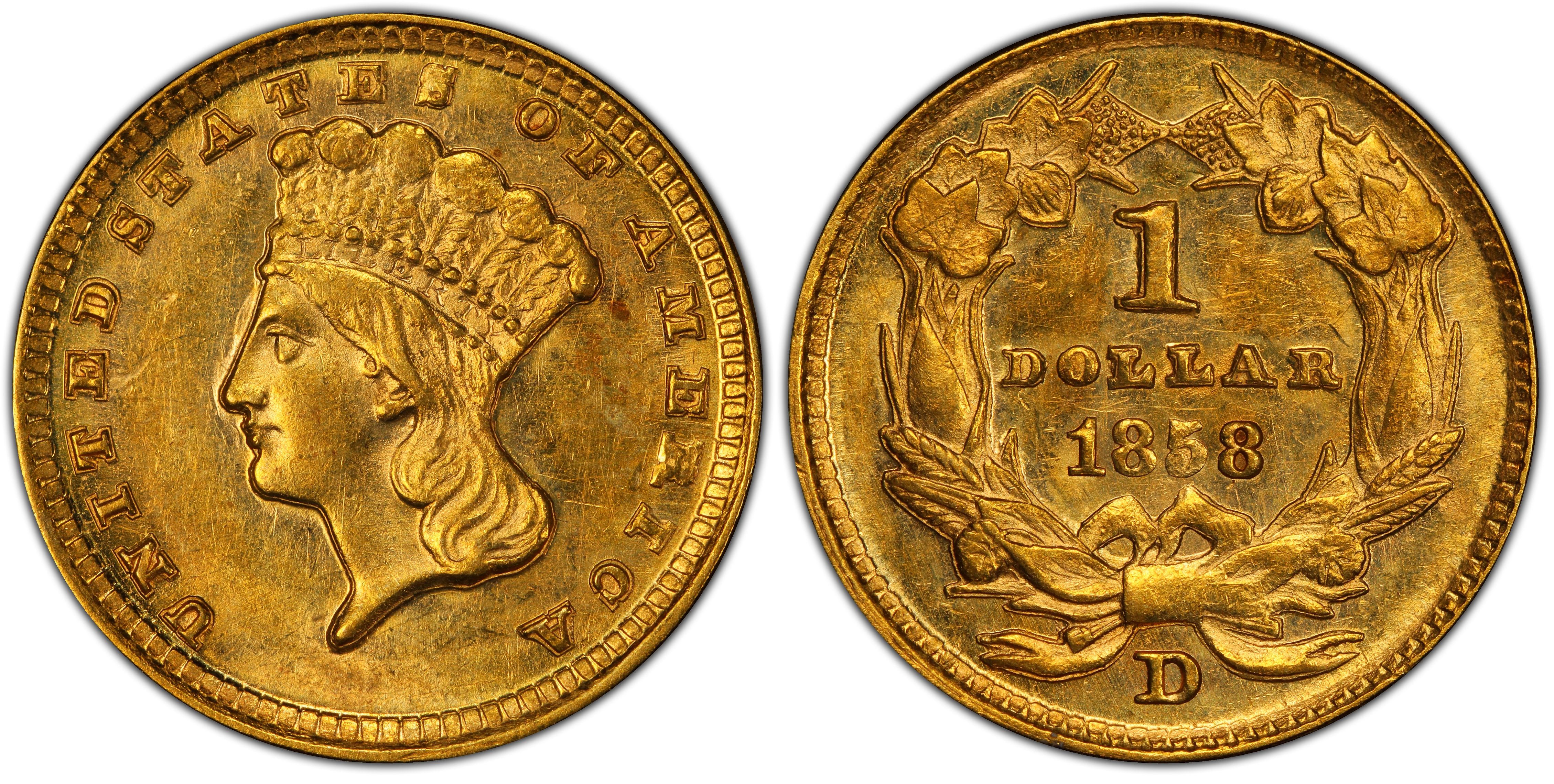
PCGS MS63
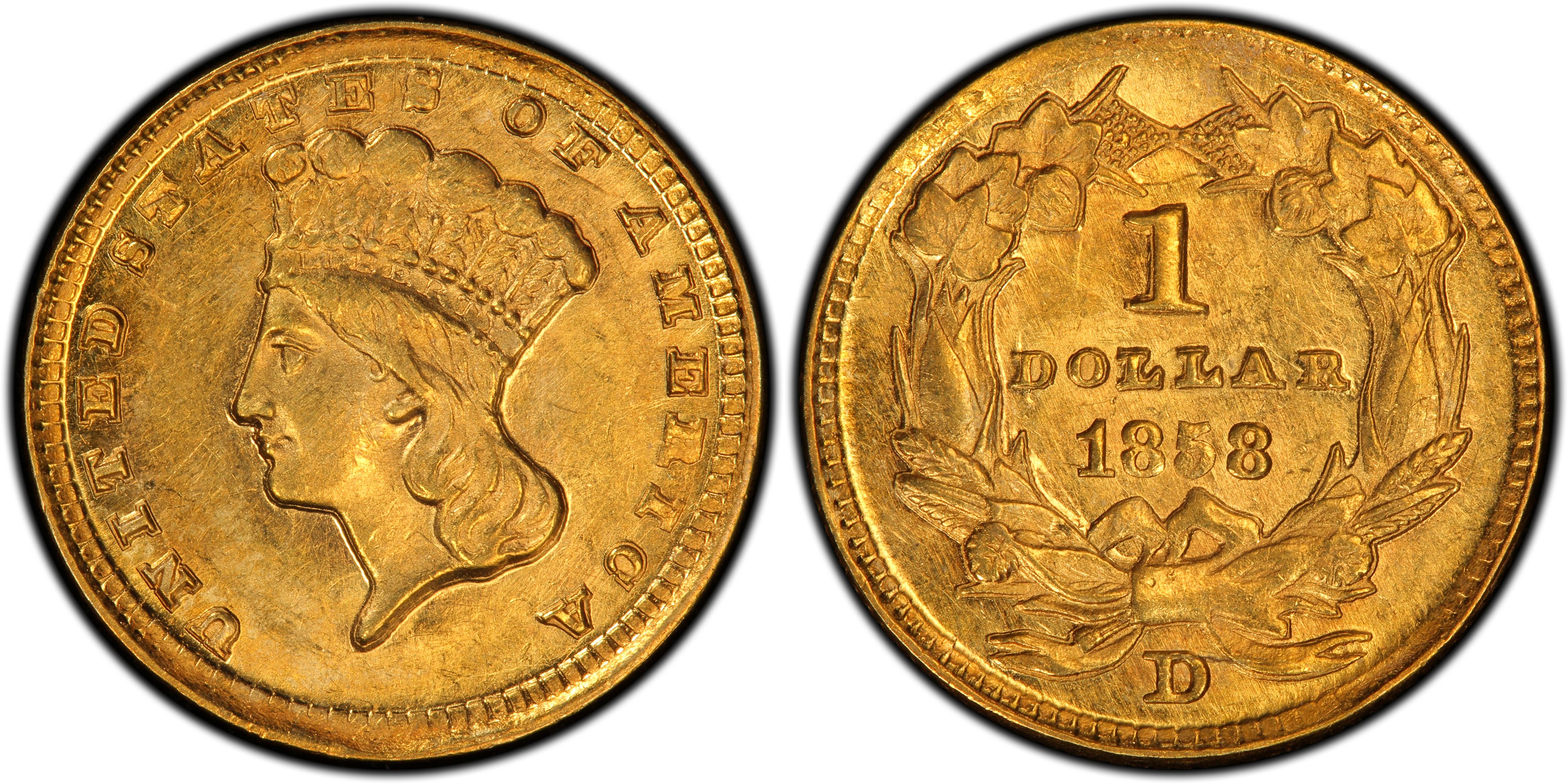
PCGS MS62+
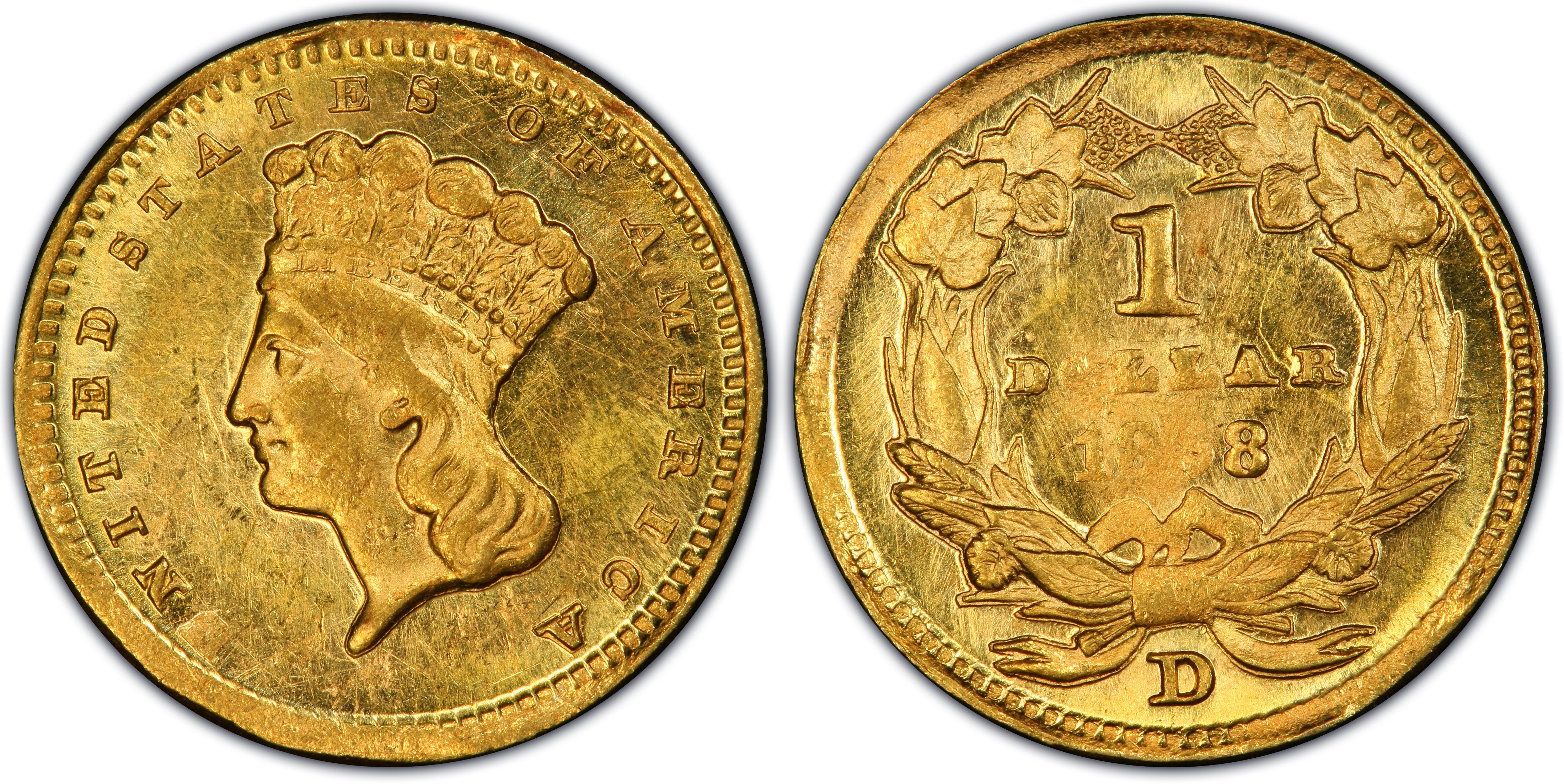
PCGS MS62
- PCGS #:
- 7549
- Designer:
- James Barton Longacre
- Edge:
- Reeded
- Diameter:
- 14.30 millimeters
- Weight:
- 1.70 grams
- Mintage:
- 3,477
- Mint:
- Dahlonega
- Metal:
- 90% Gold, 10% Copper
- Auction Record:
- $74,750 • MS66 • 04-06-2006 • Heritage Auctions
Major Varieties
- 1858-D G$1
Rarity and Survival Estimates Learn More
| Survival Estimate | |
|---|---|
| All Grades | 175 |
| 60 or Better | 15 |
| 65 or Better | 2 |
| Numismatic Rarity | |
|---|---|
| All Grades | R-7.2 |
| 60 or Better | R-9.3 |
| 65 or Better | R-9.9 |
| Relative Rarity By Type All Specs in this Type | |
|---|---|
| All Grades | 15 / 49 TIE |
| 60 or Better | 9 / 49 TIE |
| 65 or Better | 3 / 49 TIE |
| Relative Rarity By Series All Specs in this Series | |
|---|---|
| All Grades | 25 / 81 TIE |
| 60 or Better | 17 / 81 TIE |
| 65 or Better | 4 / 81 TIE |
Condition Census What Is This?
|
#1 PCGS MS65
"The McNally Collection"; "The Montgomery Collection," Numismatic Americana Sales and Corporate Advisers (NASCA), February 1976, Lot 581; "Auction '84," Stack's, July 25, 1984, Lot 1304 - $5,755. As NGC MS62. "The Harry W. Bass, Jr. Collection," Mid-American Rare Coin Auctions, August 1991, Lot 618 - $10,175. As PCGS MS62. Bowers and Merena, October 1999, Lot 126 - $17,260. As PCGS MS63 #3515574. Heritage Auctions, March 2000, Lot 454 - $17,825. As PCGS MS65. |
| #1 PCGS MS65 |
|
#1 Est. MS65
"Auction '88," David W. Akers, Lot 1345 - $15,400. As PCGS MS64. "Auction '90," David W. Akers, August 11, 1990, Lot 1825 - $33,000; Jeffrey Fisher. As NGC MS66 #302714-011: "The Duke’s Creek Collection of Dahlonega Gold (Fisher),” Heritage Auctions, April 7, 2006, Lot 1490 – $74,750. Small diagonal mark to the immediate right of the expected planchet void. "R" of AMERICA completely flat. |
| #4 PCGS MS64 |
| #5 PCGS MS63 |
| #5 PCGS MS63 |
| #5 PCGS MS63 |
|
#5 PCGS MS63
American Numismatic Rarities, August 2006, Lot 1163 - $20,700. |
| #5 PCGS MS63 |
| #5 PCGS MS63 |
|
#7 Est. MS63
As PCGS MS63 #44808397. As CACG MS63 #521355958. Dell Loy Hansen. |
1858-D Gold Dollar
The Dahlonega Mint struck only 3,477 Gold Dollars in 1858. All were produced from a single pair of dies (Winter 10-M). While the issue is often plagued by weak strikes, and a signature planchet void located under the "E" of UNITED, it remains one of the most accessible Dahlonega Type Three Gold Dollars for collectors.
Technical Characteristics
(per Doug Winter)
Strike: The overall strike quality of the 1858-D is a testament to poor quality control.
- Obverse: Strike Generally weak on the bonnet tips, the hair near the ear/eye, and the lower curls. Lettering is often thick or doubled.
- Reverse: Strike Sharper than the obverse. The upper wreath is bold, though the bow area remains weak.
- The Date: The "18" is typically clear, but the "58" is notoriously faint, sometimes appearing nearly invisible.
Surfaces: Many coins exhibit "ghost" images caused by the dies striking one another in the absence of a planchet. Additionally, foreign material likely became affixed to the obverse die, resulting in a characteristic, irregularly shaped planchet void located just below the "ED" in UNITED. Beyond this, the surface quality of the 1858-D Gold Dollar is often poor.
Luster: High-grade examples possess a pleasing frosty texture. However, many mid-grade coins have been "dipped" or cleaned, dulling their original sheen.
Coloration: Original, uncleaned pieces range from bright yellow-gold to deep orange-gold. This is the easiest Dahlonega Type Three to find with original color, though they are becoming increasingly rare on the market.
Eye Appeal: Of the "attainable" trio— 1857-D (#7546), 1858-D, and 1859-D (#7553)—the 1858-D boasts the best overall eye appeal.
A Mystery at the Market's Upper End
In 1975, expert David Akers estimated a surviving population of only 70 pieces. Modern consensus has since more than doubled that figure to roughly 150–175 survivors. While the majority of specimens in PCGS holders grade AU or better, the issue is likely far scarcer than the raw population data suggests.
Case in point: an internal review of our Condition Census data reveals two distinct categories of coins—those that have not traded at public auction (some having been graded 25–30 years ago) and those that have. While a high-resolution image of a coin from a 2012 trade is no guarantee the coin remains in that same holder today, it does confirm the existence of that discrete specimen. This allows us to compare it against other coins appearing on the market both before and after.
In this instance, the ratio of "ghost coins" to traced specimens is so high that it suggests the 1858-D is much scarcer at the upper end than is generally realized. In his 2023 revision of Gold Coins of the Dahlonega Mint 1838–1861, Doug Winter enumerates just three coins graded between PCGS MS63 and MS65:
- The Jeffrey Fisher "Duke’s Creek" coin.
- The Harry W. Bass, Jr. specimen (disposed of in 1991). Note: Neither of these has appeared at auction since 2006.
- A third coin sold in a February 1999 Heritage sale, then graded NGC MS65 and later crossed to PCGS MS65.
The discrepancy arises here: the two coins currently in the PCGS census at this level were graded before that 1999 Heritage sale. While the Hansen coin is an obvious candidate for the census, that specimen was graded PCGS MS63, leaving the high-end population shrouded in mystery.
Vintage Market Snippet:
The existence of several high-grade (MS-62+) specimens suggests a small "hoard" may have once existed. According to Winter, these coins share a distinct look: golden-orange toning, strong strikes, and "billowing" luster.
Expert Observation: The existence of several high-grade (MS-62+) specimens suggests a small "hoard" may have once existed. These coins share a distinct look: golden-orange toning, strong strikes, and "billowing" luster.