1861-D G$1 (Regular Strike)
Series: Liberty Gold Dollars 1849-1889
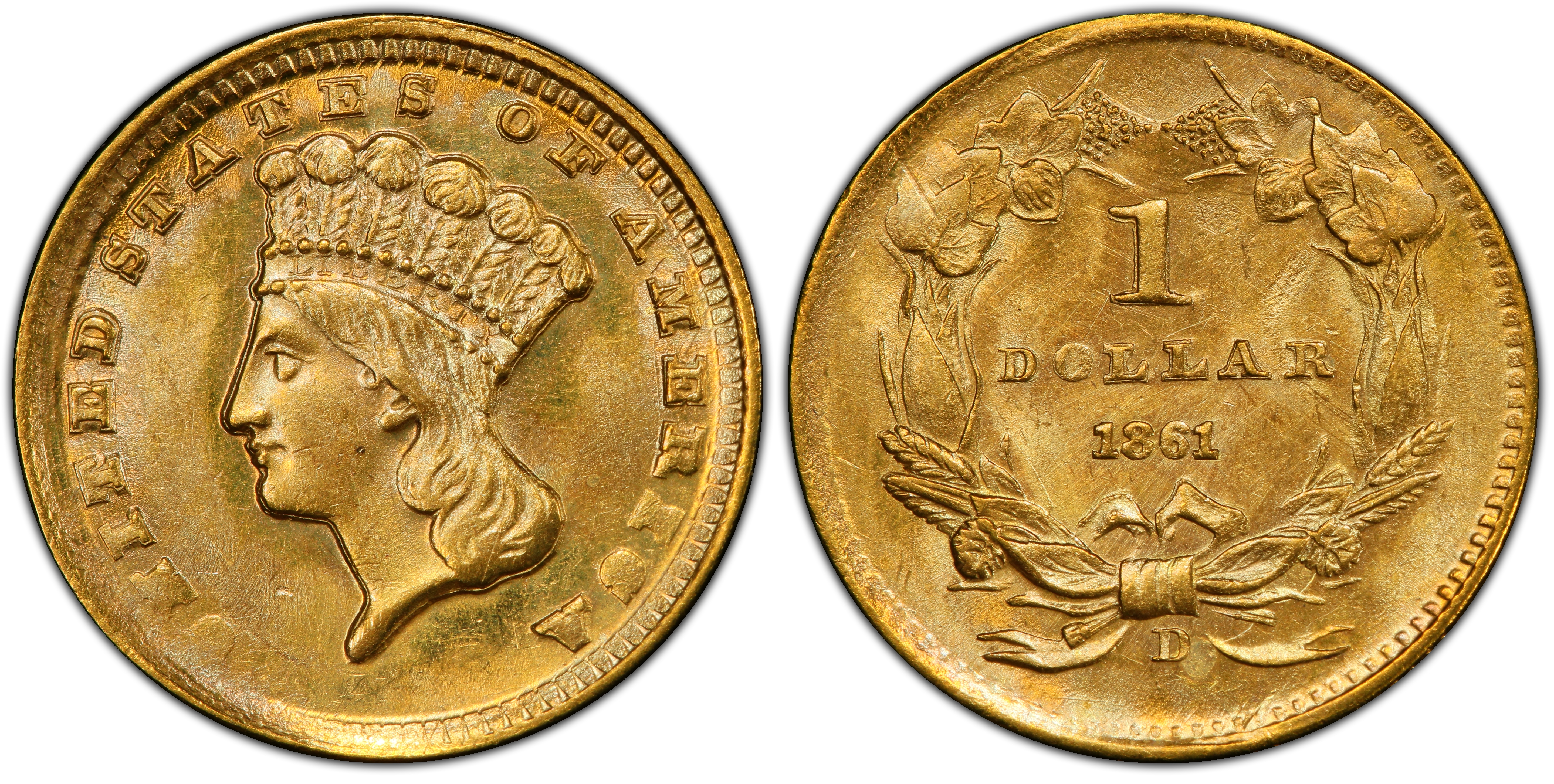
PCGS MS64+

PCGS MS62+

PCGS MS61
- PCGS #:
- 7559
- Designer:
- James Barton Longacre
- Edge:
- Reeded
- Diameter:
- 14.30 millimeters
- Weight:
- 1.70 grams
- Mintage:
- 1,000
- Mint:
- Dahlonega
- Metal:
- 90% Gold, 10% Copper
- Auction Record:
- $180,000 • MS64+ • 09-17-2020 • Heritage Auctions
Major Varieties
- 1861-D G$1
Rarity and Survival Estimates Learn More
| Survival Estimate | |
|---|---|
| All Grades | 75 |
| 60 or Better | 15 |
| 65 or Better | 1 |
| Numismatic Rarity | |
|---|---|
| All Grades | R-8.2 |
| 60 or Better | R-9.3 |
| 65 or Better | R-10.0 |
| Relative Rarity By Type All Specs in this Type | |
|---|---|
| All Grades | 1 / 49 TIE |
| 60 or Better | 9 / 49 TIE |
| 65 or Better | 1 / 49 TIE |
| Relative Rarity By Series All Specs in this Series | |
|---|---|
| All Grades | 2 / 81 TIE |
| 60 or Better | 17 / 81 TIE |
| 65 or Better | 1 / 81 TIE |
Condition Census What Is This?
|
#1 PCGS MS64+
Dr. Philip Weinstein; Anthony Terranova; Stack’s; “The Leon Farmer Collection”; Hancock and Harwell; As NGC MS65 #302712-009. Jeffrey Fisher; "The Duke’s Creek Collection of Dahlonega Gold (Fisher),” Heritage Auctions, April 7, 2006, Lot 1493 – $138,000; “The Madison Collection,” Heritage Auctions, January 10, 2008, Lot 3050 – $149,500. As PCGS MS64+ #40323807. “The Bob R. Simpson Collection, Part I,” Heritage Auctions, September 17, 2020, Lot 10114 – $180,000; Dell Loy Hansen; "The D.L. Hansen Dahlonega Complete Type" (PCGS Set Registry). Toned. Shallow tick below the chin. Struck with clashed dies. |
|
#2 PCGS MS64
"The Grant Pierce Collection"; "The R.L. Miles Collection," Stack's, May 1965, "The Theodore Ullmer Collection," Stack's October 1968; Stack's, May 1974, Lot 343; Hancock and Harwell to Arthur Montgomery; "The Arthur Montgomery Collection"; "Auction '84," Stack's, Lot 1307; Mid-American Rare Coin Auctions, January 1987, Lot 1810 - Passed; "The George Elliot Collection"; Stack's, March 2000, Lot 455; Private Collection. |
|
#3 PCGS MS63
I.M. Bates, June 1895; John M. Clapp; “The John M. Clapp Collection,” Stack’s, Clapp Collection to Louis El. Eliasberg, Sr., en bloc via sale, 1942; “The Louis E. Eliasberg, Sr. Collection,” Bowers and Ruddy, October 1982, Lot 49; Sotheby’s, June 1996, Lot 1; Tangible Investments of America; Hancock and Harwell; “The Duke’s Creek Collection”; Bob Harwell and Jeff Garrett; Doug Winter, August 2000; “The Green Pond Collection,” Heritage Auctions, January 7, 2004, Lot 1014 – $86,250; Heritage Auctions, May 3, 2023, Lot 3184 – $180,000. Legend is well struck for the issue, UN remain flat, but IC is has better elevation and detail than is typical. |
|
#3 PCGS MS63
As NGC MS64 #5075626-001. “The Freedom Collection,” Heritage Auctions, January 2007, Lot 2263. As PCGS MS63 CAC #25035240. “The James O. Sykes Collection,” Stack’s Bowers, August 25, 2022, Lot 6016 – $180,000. Small patch of planchet roughness to the left of the right cotton ball. Faint die crack visible along NITED and on the lower left of the reverse.Thin scratch through C of AMERICA. UN and ICA flatly. struck. |
| #3 PCGS MS63 |
| #3 PCGS MS63 |
| #3 PCGS MS63 |
| #3 PCGS MS63 |
The Confederate Seizure of the Dahlonega Mint and the 1861-D Gold Dollar
While the 1856-D Gold Dollar (#7543) is rarer in Mint State, and the two issues are generally equivalent in circulated rarity, the 1861-D (#7559) remains the most coveted issue in the Gold Dollar series. It is typically the second most valuable coin, surpassed only by the practically unobtainable 1849-C Open Wreath variety (#7506), of which only five examples are known. The true premium of the 1861-D lies not just in its scarcity, but in its unique story: it is the coin's historical provenance as the sole U.S. issue struck entirely under Confederate authority that cements its status as a great Key Date coin.
The final chapter of the U.S. Branch Mint at Dahlonega, Georgia, is closely tied to the start of the Civil War. Though the Treasury Department withheld additional bullion, the Philadelphia Mint managed to ship two pairs of coining dies to Dahlonega. These arrived on January 7, 1861. Just two weeks later, however, the State of Georgia officially seceded from the Union.
Under orders from Governor Joseph E. Brown, state officials seized the branch’s building, equipment, and materiel, overriding proposals from local Unionists to secure the mint. The formal surrender occurred on April 8, 1861, when rebel Confederate troops officially occupied the facility. Superintendent George Kellogg was forced to comply, noting in a letter to President Lincoln that “Georgia has turned all public property … of the United States over to the Confederate States Government.”
Confederate Coining and the Unique 1861-D Dollar
Despite few records from this period, the previous staff remained and continued coining operations under Confederate control until the mint’s closure in June 1861. During this brief time, they struck approximately $3,000 (face value) in gold coins, split between Gold Dollars and 1861-D Liberty Head Half Eagles (#8290).
Crucially, 1,597 half eagles had been struck before the Confederate takeover. However, no gold dollars were struck before April. This means the 1861-D Gold Dollar is the only circulating U.S. coin struck exclusively by Confederate authorities.
Experts estimate the mintage figure for the Gold Dollar was between 1,000 and 1,500 coins. PCGS estimates 1,000, while The Guide Book of United States Coins estimates a mintage of 1,250. These varying assumptions are based on the number of surviving examples and the certainty that a many of these historical coins were saved by locals as souvenirs.
Rarity and Survival
The 1861-D Gold Dollar is a rare coin in all grades. However, it exhibits an unusual survival profile: it appears that more than half of the known specimens grade About Uncirculated-50 (AU50) or better, and as many as a dozen different pieces exist in Mint State. This high survival rate in better grades, as gold coin expert Doug Winter writes is "greater than normal for an issue with this small a mintage." This fact strongly suggests the existence of a small hoard, which confirms that the coin was saved as a special souvenir by locals who recognized its historical importance. For this reason, Mint State 1861-D Gold Dollars are considered among the most important and desirable Dahlonega issues.
Production Quality and Characteristics
(per Doug Winter)
All 1861-D Gold Dollars were struck from a single die pair (Variety 12-Q) in May 1861. The use of a leftover 1860-D obverse die and the Rebels' widely noted lack of minting expertise made for a poorly produced, crude, and primitive issue compared to a contemporary Philadelphia product.
Strike and Surfaces
- Strike: On all known examples, the U in UNITED is very faint and the N is quite weak, a defect created by a “profound weakness” in the old die. The IC in AMERICA is sometimes weak, and Liberty’s hair and the plumes always show weakness. The milling is sharp from 12:00 to 6:00 on the obverse, but weak on the left side. Clashmarks are sometimes visible at the center of both the obverse and reverse.
- Surfaces: The quality of the planchets used was low, resulting in below-average surfaces. Many examples feature splits, cracks, or other defects, and most are grainy below and around the head of Liberty.
Luster and Coloration
- Luster: Despite the crude production, higher grade pieces often display a surprisingly thick, frosty luster.
- Coloration: Original, uncleaned pieces display coloration ranging from rich yellow-gold to orange-gold to deep green-gold. As is common with popular issues, totally original pieces are rare, highly coveted, and command a substantial premium.
The End of the Dahlonega Mint
The Dahlonega Mint was officially closed in June 1861. Two months later, on August 24, 1861, it was converted into an assay office. Consequently, the 1861-D Gold Dollar was also the last coinage struck at the Georgia facility.
* * *