1840-D $2.50 (Regular Strike)
Series: Liberty Head $2 1/2 1840-1907
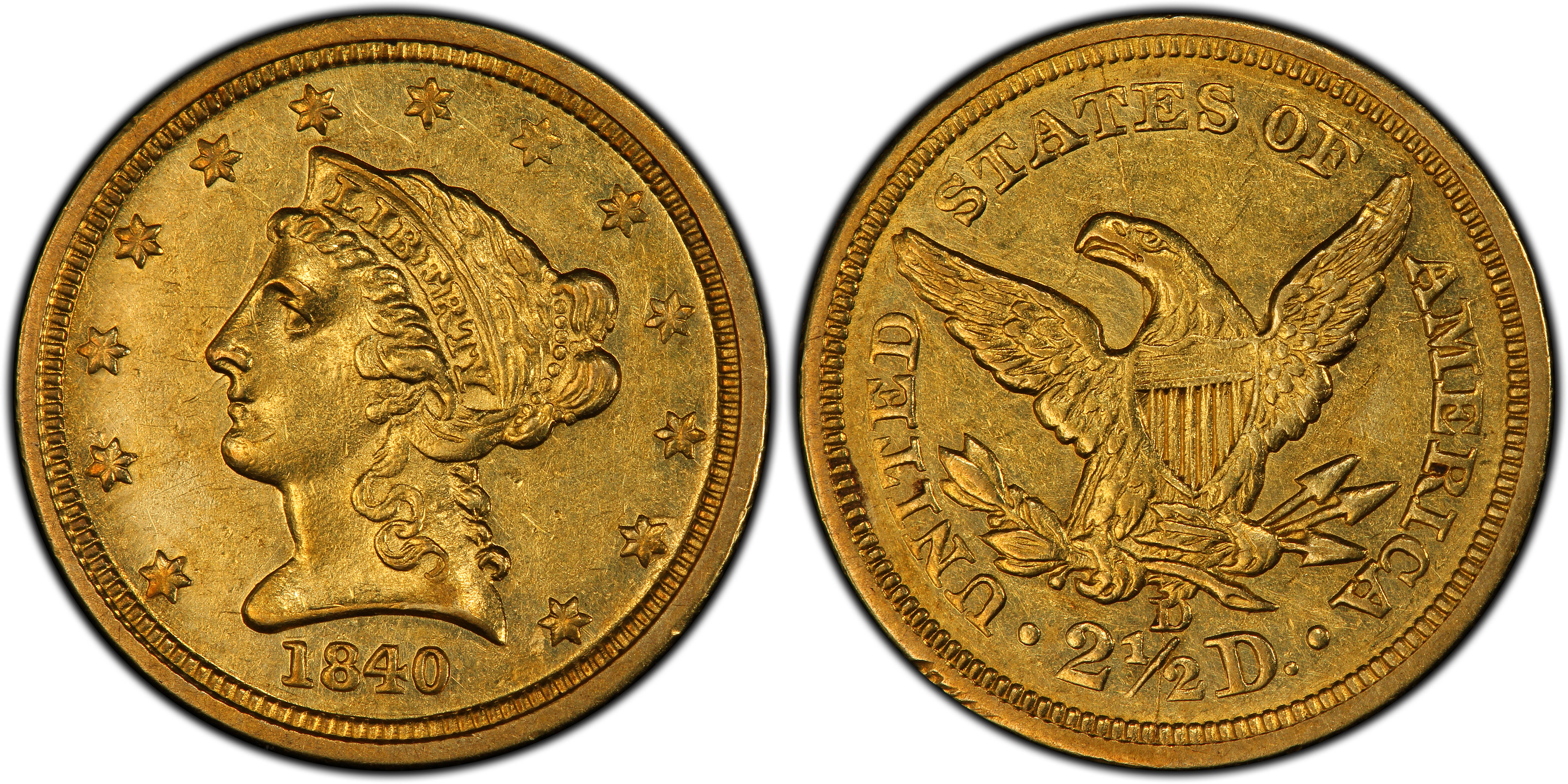
PCGS AU55

PCGS AU55

PCGS AU50
- PCGS #:
- 7719
- Designer:
- Christian Gobrecht
- Edge:
- Reeded
- Diameter:
- 18.00 millimeters
- Weight:
- 4.18 grams
- Mintage:
- 3,532
- Mint:
- Dahlonega
- Metal:
- 90% Gold, 10% Copper
- Auction Record:
- $144,000 • MS62 • 08-31-2022 • Stack's Bowers
Major Varieties
- 1840-D $2.50
Rarity and Survival Estimates Learn More
| Survival Estimate | |
|---|---|
| All Grades | 65 |
| 60 or Better | 1 |
| 65 or Better | |
| Numismatic Rarity | |
|---|---|
| All Grades | R-8.3 |
| 60 or Better | R-10.0 |
| 65 or Better | R-10.1 |
| Relative Rarity By Type All Specs in this Type | |
|---|---|
| All Grades | 15 / 147 TIE |
| 60 or Better | 1 / 147 TIE |
| 65 or Better | 1 / 147 |
| Relative Rarity By Series All Specs in this Series | |
|---|---|
| All Grades | 15 / 147 TIE |
| 60 or Better | 1 / 147 TIE |
| 65 or Better | 1 / 147 |
Condition Census What Is This?
|
#1 Est. MS61
New Netherlands, November 1956, Lot 219; “The Harold L. Bareford Collection of United States Gold Coins,” Stack’s, December 1978, Lot 86; Hancock and Harwell; Dr. Arthur Montgomery; As “Just a hairsbreadth from Uncirculated”. Stack’s, July 1984, Lot 1309; Georgia Collection; Hancock and Harwell; Leon Farmer; Hancock and Harwell; Around this time, graded PCGS MS60. Then, this example was the only coin certified in Mint State. As NGC MS62 #302712-018. “The Duke’s Creek Collection,” Heritage Auctions, April 2006, Lot 1495 – $74,750; Stellar Collection; “The John O. Sykes Collection,” Stack’s Bowers, August 25, 2022, Lot 6024 – $144,000. Winter 1-A. Struck with perfect obverse and reverse die. |
| #1 PCGS MS61 |
|
#3 PCGS AU58
Heritage Auctions, January 2006, Lot 3414 – $19,550; Stack’s, January 2009, Lot 902 – Passed; “The John O. Sykes Collection,” Stack’s Bowers, August 25, 2022, Lot 6025 – $45,600. Winter 1-B. Prominent diagonal die crack that bisects that obverse from the rim left of star 5 to the rim on the right of star 13. |
| #3 PCGS AU58 |
| #3 Est. AU58 |
|
#6 PCGS AU55
Private Collector, acquired in 2002; As NGC MS60 #4330656-001. Heritage Auctions, August 10, 2016, Lot 4265 – $28,200. As PCGS AU55 #25656163. Winter 1-A. On A long diagonal die crack bisects the obverse, while the reverse was struck with a shattered die. Tick on chin. Diagonal scrape to the right of star 2. Thin cluster of hits on cheek and nose. Distubred denticles on reverse below the numerator. Scraped 2. Pedigree research assisted by Heritage Auctions. |
|
#6 PCGS AU55
Heritage, January 9, 2009, Lot 5174 - Passed. |
| #6 PCGS AU55 |
| #6 PCGS AU55 |
Christian Gobrecht’s Liberty Head Quarter Eagle design debuted in 1840, replacing William Kneass's Classic Head type. As was true for the final issue of the preceding type, all four U.S. Mints were engaged in striking the new design. Of the four, the 1840-D is by far the scarcest, with a mintage of just 3,532 pieces. This output represents only about 10% of the 1840-O's mintage (33,580) and significantly lower than the 1840-P (18,859) and 1840-C (12,822) issues.
Dahlonega would go on to strike the quarter eagle denomination each year through 1859. In 1860, however, Dahlonega struck only Gold Dollars and Half Eagles. With the state in rebellion, Georgia seized the branch mint in January 1861, turning it over to Confederate control on April 8. A final issue of gold coins, struck using dies and bullion on hand, marked the end of the coining story of this important southern mint.
Technical Characteristics and Striking Quality
The 1840-D is technically characterized as one of the most poorly struck Dahlonega Quarter Eagles (Doug Winter). These coins are typically found well-worn and feature below-average surface quality, often displaying roughness and heavy marks.
- Strike: The obverse is usually stronger than the reverse, where the shield and the eagle’s right leg are almost always weakly struck, with detail lacking. The stars on the obverse are commonly flat.
- Die Cracks: A crucial and defining characteristic is the very extensive die cracks visible on both the obverse and reverse, which occurred early in the coining process. Winter views the continued use of these failing dies to produce the 3,532 coins as an "apt metaphor... for the struggle of the Dahlonega mint."
- Luster and Coloration: Higher-grade pieces typically exhibit dull, grainy luster. Circulated pieces retain no luster. Original coloration ranges from medium green-gold to a deeper coppery-orange.
- Originality: Most surviving examples have been cleaned or dipped at some point.
Die Varieties
Two primary die marriages, identified by Doug Winter, exist for the 1840-D:
- Winter 1-A (Common): The "D" mintmark leans slightly to the right and is partially embedded in the feather. This variety typically shows the prominent, extensive die cracks on both sides.
- Winter 1-B (Scarce): Features an upright "D" mintmark, with the top of the mintmark mostly covered by the arrow feathers. This variety is considerably scarcer; the discovery coin was identified in 1997. Specialists also use the distinct positions of the die cracks as a diagnostic tool.
Rarity and Survival
The 1840-D Liberty Head Quarter Eagle is considered one of the great rarities among Southern branch mint gold coins. It is extremely rare in Mint State, and PCGS reports fewer than 60 grading events for the issue, with the highest concentration of coins falling in the AU50 to AU55 range. Although forty years of professional certification has somewhat clarified matters, the situation could change if small caches or coins from old collections emerge.
The coin's Mint State census remains tight, with the highest-graded example being the renowned "Duke's Creek–Stellar" coin, certified at NGC MS62, which realized $144,000 in a 2022 auction. As of late 2024, only one Mint State coin is recorded at PCGS (PCGS MS61).