1811 $5 Small 5 (Regular Strike)
Series: Capped Bust $5 1807-1834
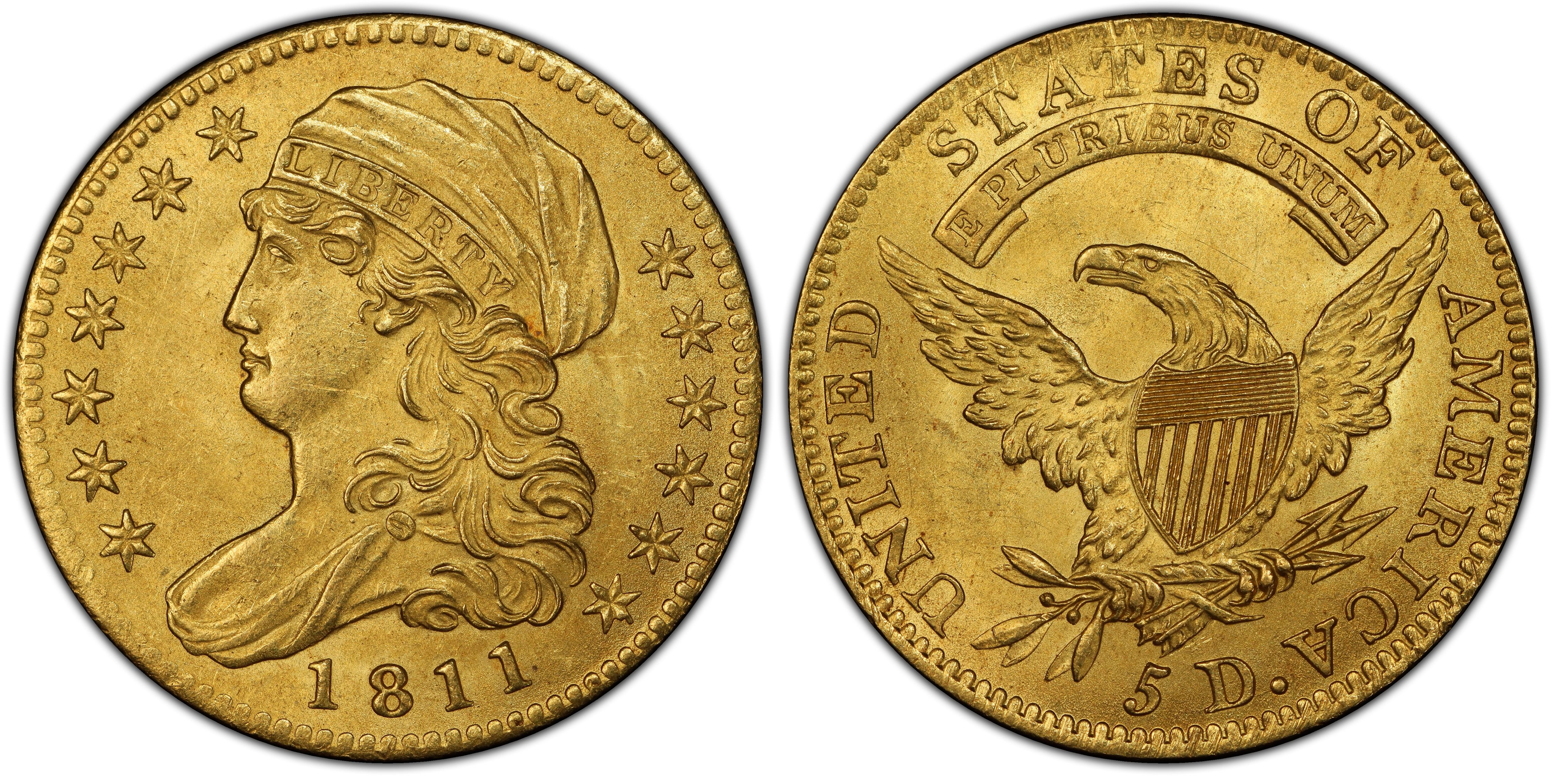
PCGS MS65+
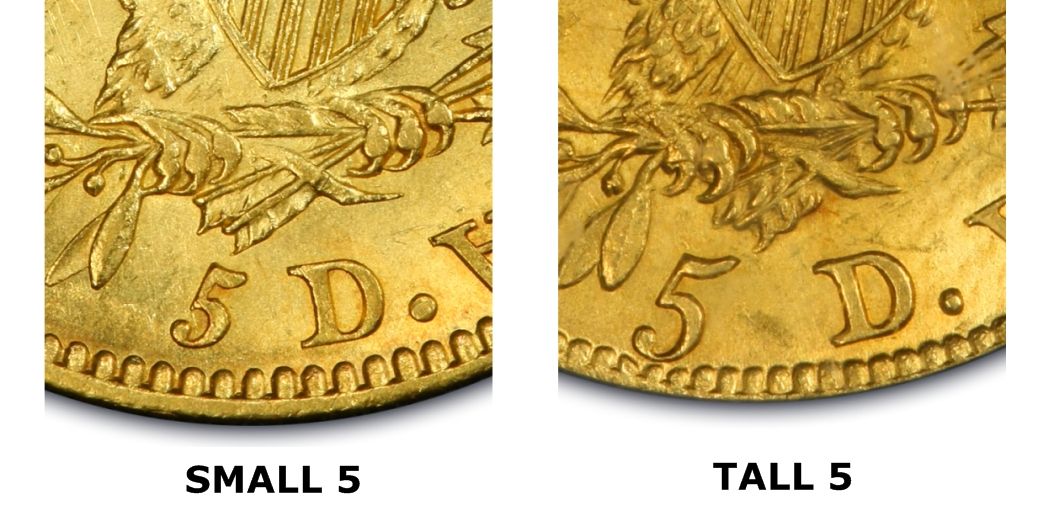
REVERSE COMPARISON

PCGS MS64+
- PCGS #:
- 8109
- Designer:
- John Reich
- Edge:
- Reeded
- Diameter:
- 25.00 millimeters
- Weight:
- 8.75 grams
- Mintage:
- 99,581
- Mint:
- Philadelphia
- Metal:
- 91.7% Gold, 8.3% Copper
- Auction Record:
- $66,000 • MS65 • 01-24-2021 • Heritage Auctions
Rarity and Survival Estimates Learn More
| Survival Estimate | |
|---|---|
| All Grades | 300 |
| 60 or Better | 125 |
| 65 or Better | 7 |
| Numismatic Rarity | |
|---|---|
| All Grades | R-6.4 |
| 60 or Better | R-7.7 |
| 65 or Better | R-9.6 |
| Relative Rarity By Type All Specs in this Type | |
|---|---|
| All Grades | 6 / 11 |
| 60 or Better | 6 / 11 |
| 65 or Better | 6 / 11 TIE |
| Relative Rarity By Series All Specs in this Series | |
|---|---|
| All Grades | 36 / 42 |
| 60 or Better | 35 / 42 |
| 65 or Better | 31 / 42 TIE |
Condition Census What Is This?
|
#1 PCGS MS65+
"The Harry W. Bass, Jr., Core Collection, Part I," Heritage Auctions, September 29, 2022, Lot 11048 - $151,200. BD-2. |
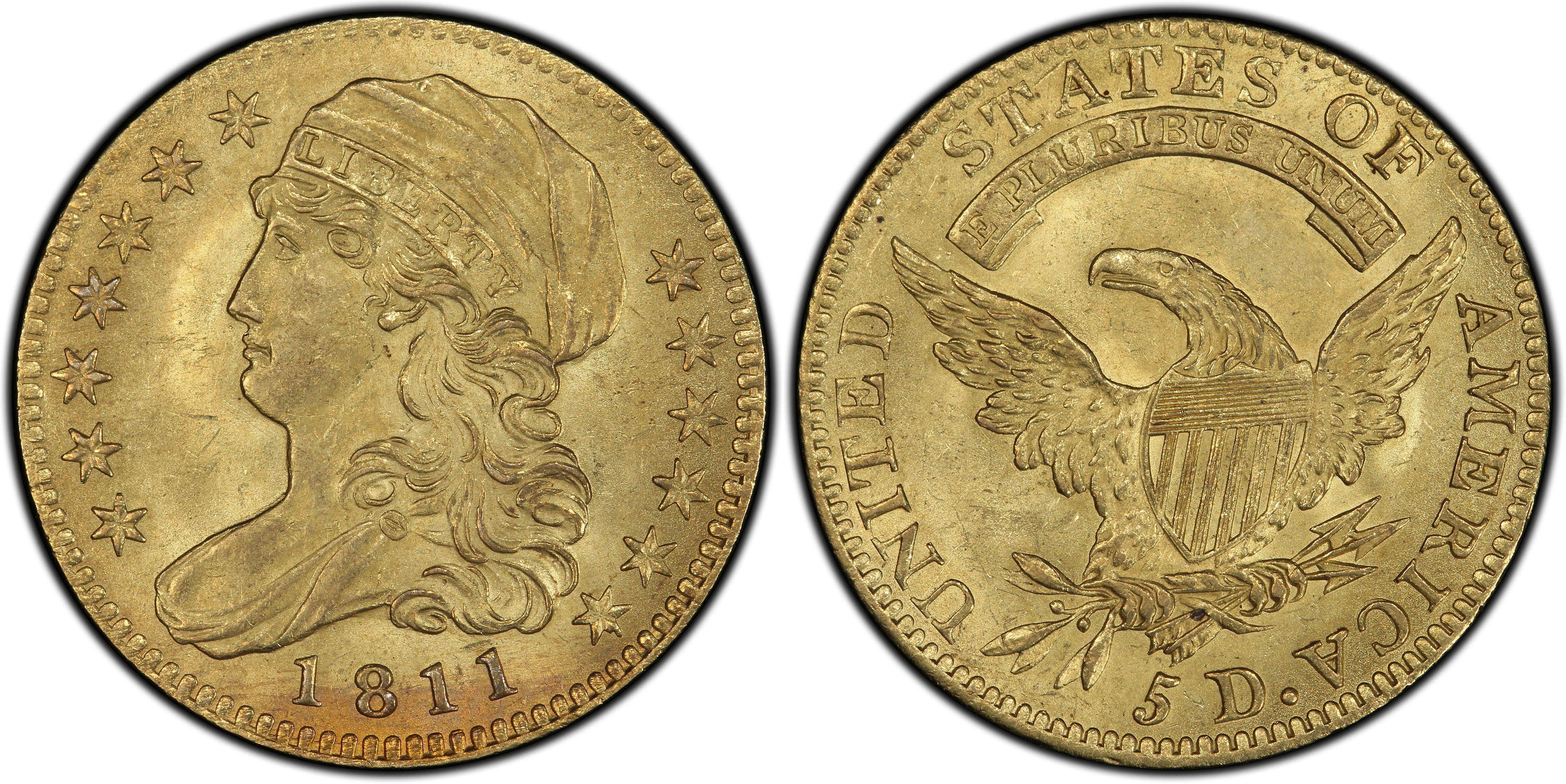 #2 PCGS MS64+
As PCGS MS64. Goldberg Auctioneers, September 12, 2006, Lot 1952 - $39,100. As PCGS MS64+ #32231625. "The McCoy Family Collection of U.S. Early Gold," Heritage Auctions, April 26, 2018, Lot 4344 - $46,201.20; Legend Rare Coin Auctions, November 15, 2018, Lot 320 - $52,875; "The Benedict Family Collection," Heritage Auctions, August 24, 2024, Lot 4058 - $52,800. BD-2. Die State d/a. |
 #2 PCGS MS64+
Stack's Bowers, July 27, 2013, Lot 4482 - $64,625; "Cody's Collection," Legend Rare Coin Auctions, December 16, 2021, Lot 284 - $61,687.50. BD-2. |
|
#2 PCGS MS64+
King Farouk. "The Palace Collections of Egypt," Sotheby's, February 1954, Lot 232 - £200. Sold as part of a nine coin lot along with 1807, 1808/7, 1808, 1809/8, 1809, 1810 Small Date (Small and Tall 5), and 1811 (Large 5 and Small 5)! (to) Bob Schermerhorn. As PCGS MS64+ #39425028. "The Maurice Storck Collection," Heritage Auctions, October 17, 2020, Lot 18363 - $46,800. BD-2. Die state d/a. |
 #2 PCGS MS64+
As "Uncirculated." Barney Bluestone, October 8, 1938, Lot. 1233 - $18.50. As "Brilliant Uncirculated, nearly choice." "The Floyd T. Starr Collection," Stack's, October 20, 1992, Lot 1198 - $11,000; Paul Nugget, sold privately in July 2001. Pogue Family. As PCGS MS64+ #31914893. "The D. Brent Pogue Collection, Part III," Stack's Bowers & Sotheby's, February 9, 2016, Lot 3142 - $39,950; Heritage Auctions, August 18, 2019, Lot 3868 - $46,800. BD-2. |
|
#2 PCGS MS64+
BD-2. |
The 1811 Capped Bust Left Half Eagle, Small 5
When Thomas Jefferson set aside his principles of strict constructionism to authorize the $15 million Louisiana Purchase from France, he envisioned a burgeoning American agrarian society. He hoped this vast expanse would prevent the United States from becoming a cramped, urbanized nation like those of Europe - at least for many generations to come.
The purchase triggered a wave of mass migration, though not from European immigrants, as the Napoleonic Wars rendered trans-Atlantic travel too perilous. Instead, the movement was internal. As pioneers pushed toward the frontier east of the Mississippi, they came into constant contact with Native American tribes. While this contact was not always as unilaterally violent as depicted in popular culture, the competition for land and resources posed an existential threat to the tribes. By 1811, these tensions escalated into the Battle of Tippecanoe (which would later become a battle cry for John Tyler's Presidential campagn in 1840), a precursor to the widespread bloodshed along the frontier during the War of 1812.
The Monetary Divide
While the nation expanded geographically, its currency remained localized. The Philadelphia Mint's primary service area was restricted to the metropolitan "triangle" of Philadelphia, New York City, and Baltimore. Metropolitan Use: The bulk of half dollars and gold coins were struck for banks and commercial entities, where they were largely held as reserves or used for international settlements. The Frontier Economy: This left the frontier starved for official U.S. tender. Pioneers were forced to rely on Spanish and French silver, barter systems, and private notes.
The necessity of using these foreign coins was so great that Spanish silver remained legal tender in the United States until 1857, when the Mint finally gained the capacity to strike sufficient stocks of silver and gold coinage to meet the needs of the entire country.
Collecting the Capped Bust Half Eagle Series
The Capped Bust Left Half Eagle is one of the most challenging series to collect in all of United States numismatics. The issue offers a complexity, tremendous rarity, and a classic design featuring an updated portrait of Liberty traditionally attributed to John Reich. A Bavarian-born immigrant, Reich was a talented engraver who first caught Thomas Jefferson’s attention with a beautifully executed portrait of the Founding Father, completed under the direction of Henry Voigt.
The Capped Bust design debuted in 1807, appearing first on the Capped Bust Half Dollar. The Capped Bust Quarter Eagle followed in 1808, with the Capped Bust Dime arriving in 1809. While collectors and researchers categorize these issues under the same name, there are distinct differences in the portraiture—enough that it would be inaccurate to say they share an identical design.
Design Characteristics
The Obverse
On the Capped Bust Left Half Eagle, Liberty’s portrait dominates the obverse, bordered by stars to the left and right with the date positioned below. Key features include:
- Pileus Cap: Liberty wears a highly detailed cap with a creased top folded downward.
- The Inscription: The word LIBERTY adorns a band at the base of the cap, extending almost the full length of her head.
- Tresses: Below the letter "Y," Liberty’s hair flows in a curved fashion, creating an elegant ridgeline where the portrait rises distinctly from the field. Individual strands are depicted, but the design implies even more detail than it shows.
- Bust: A clasp situated under strands of wavy hair gives form to Liberty's gown, while the edge is delineated by a border of 103 dentils.
The Reverse
The reverse features a more naturalistic heraldic eagle. Gone is the clouded glory of Robert Scot’s earlier design, replaced by an arched banner emblazoned with the national motto, E PLURIBUS UNUM. The denomination is clearly identified at the bottom as 5 D. - marking the first fime a value was explicitly included on the $5 gold piece.
Two Denomination Styles Emerge in 1810 & 1811
In 1810, two date sizes and three denomination styles created significant complexity for an issue that might otherwise be overlooked due to its relatively large mintage of 100,287 pieces. Of the four varieties, the two die marriages sharing the "Small 5" reverse die are rare, with the BD-3 Large Date, Small 5 (#8107) serving as the key variety for the year.
The 1811 Die Marriages
The 1811 issue also boasts a high mintage of nearly 100,000 pieces, comprising two primary die marriages:
BD-1 (Tall 5): This variety features the same reverse die used to strike the 1810 BD-1 Small Date, Tall 5 (#8106). Early strikes retain the thin die cracks that emerged during its later use in 1810. A subsequent repair was made to remove these cracks; however, later strikings exhibit heavy clash marks and the re-emergence of the die crack in the same region.
BD-2 (Small 5): While this issue uses the same "5" punch as the 1810 varieties, it is a distinct die. The obverse die is the same as that used on the BD-1 Tall 5 (#8110).
Die States and Clashing
The extensive clashing took a significant toll on the obverse die, which came into contact with the reverse die on multiple occasions. In later die states, heavy reclashing and die cracks are visible through the left wing and from stars 9 to 10. Judging by the various die states of the Small 5, one can reasonably surmise that remarriages occurred. While it is possible that repairs were made to improve the die's appearance, the evidence of shifting die states suggests that the dies were simply paired and repaired in a non-linear sequence.
The 1811 Capped Bust Half Eagle Tall 5 / Small 5 Scarcity Debate
Over the years, there has been ongoing debate regarding the relative scarcity of the 1811 Capped Bust Half Eagle Tall 5 (BD-1) versus the Small 5 (BD-2).
In his 1975 work, United States Gold Coins: An Analysis of Auction Records, David W. Akers claimed that the Tall 5 was only "moderately more rare than the Small 5 variety in all grades," but "twice as rare as the 1811 Small 5 in Mint State." Thirty years later, in their 2006 study Early U.S. Gold Coin Varieties: A Study of Die States, 1795–1834, John W. Dannreuther and Harry W. Bass, Jr. offered a different perspective, suggesting the Small 5 was actually "only marginally harder to find."
The PCGS Population Report however, does not support the Dannreuther-Bass view. Even when accounting for a small number of resubmissions, the disparity is stark: Small 5s outnumber Tall 5s by a 3:1 margin. This ratio holds firm even when focusing exclusively on Mint State coins. Curiously, this survival data is not yet reflected in auction prices realized. It may be time for specialist collectors and dealers to re-evaluate the market value of the Tall 5.
* * *