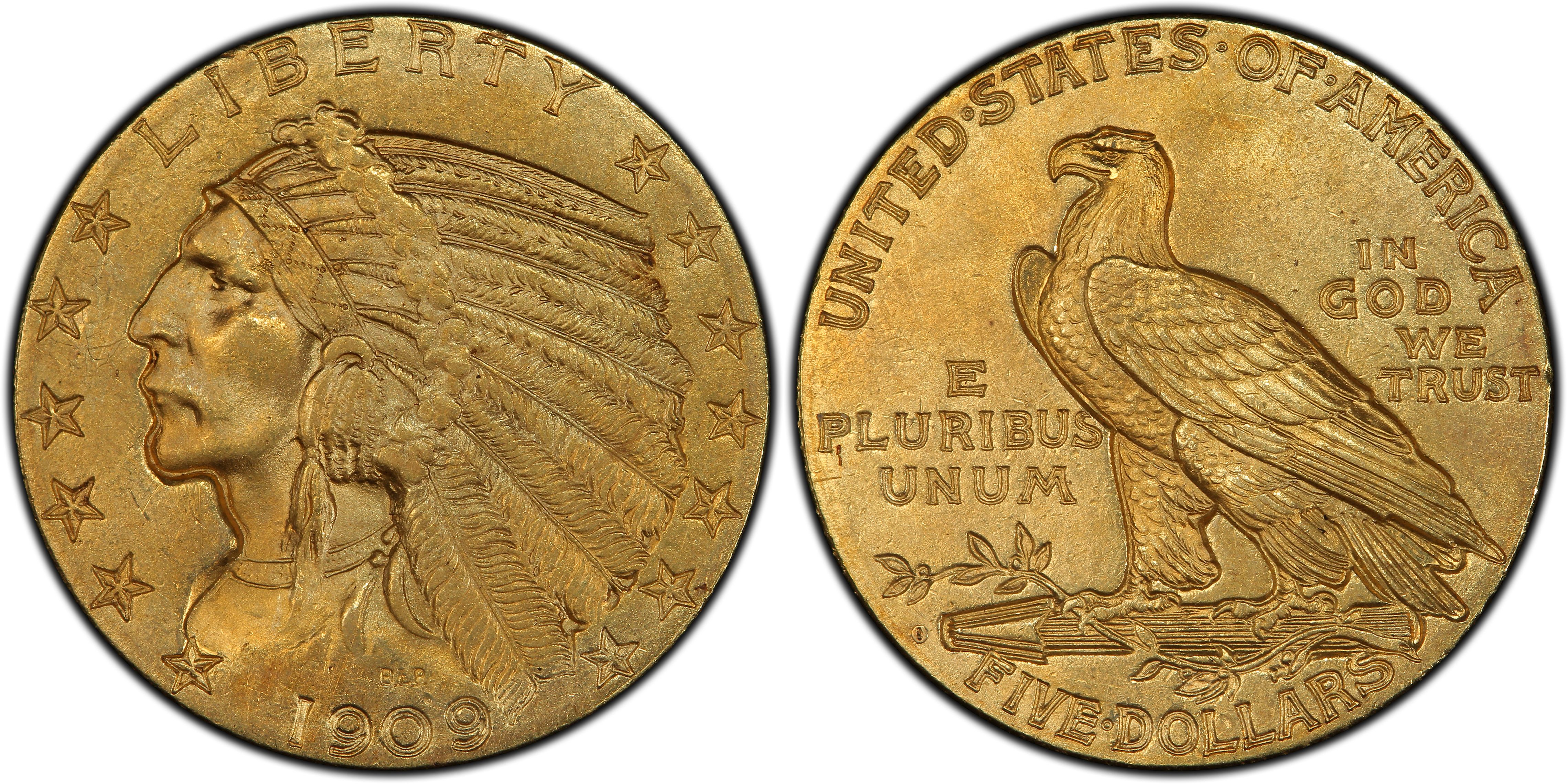
1909-O $5 (Regular Strike)
Series: Indian Head $5 1908-1929
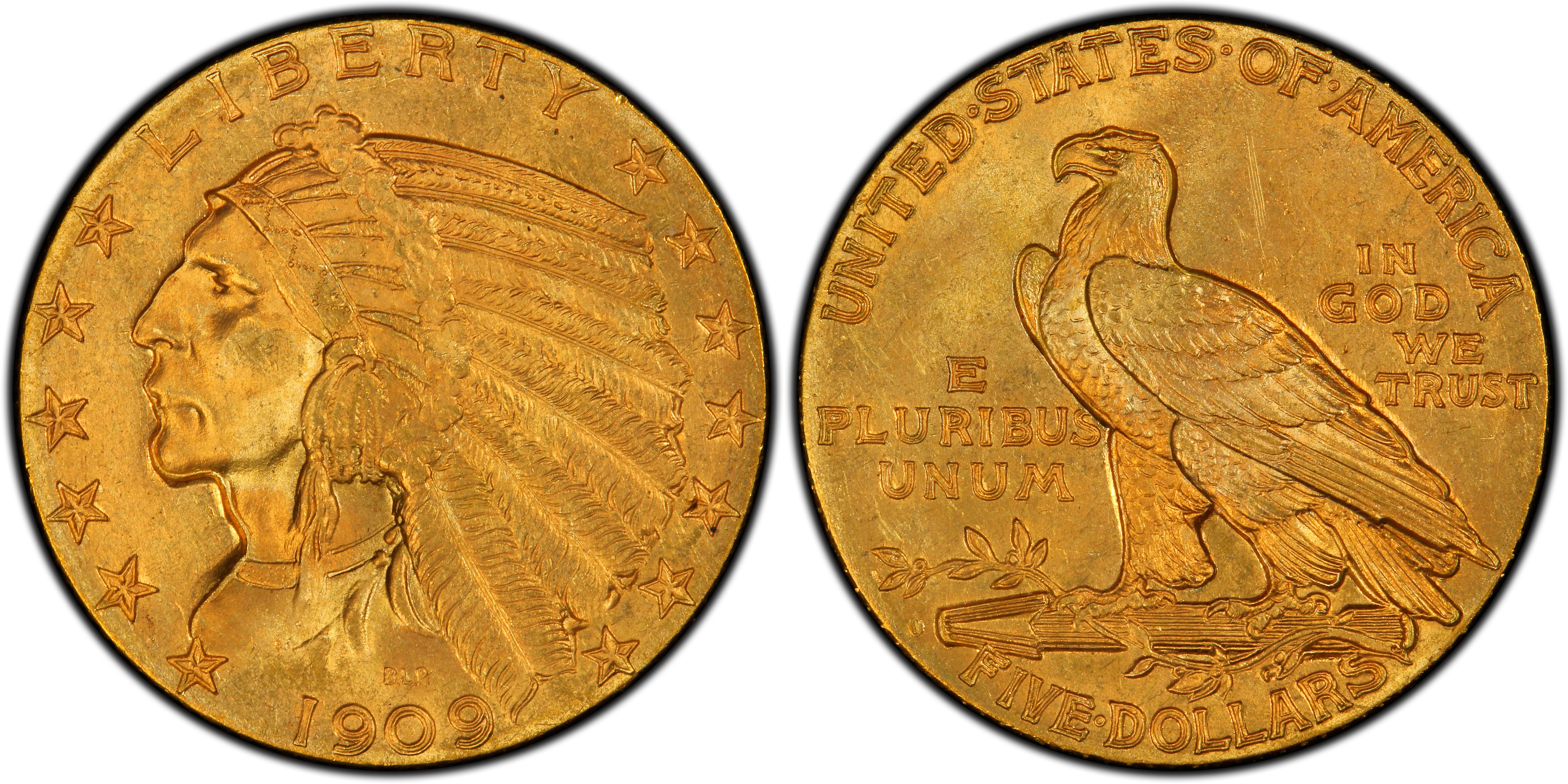
PCGS MS66
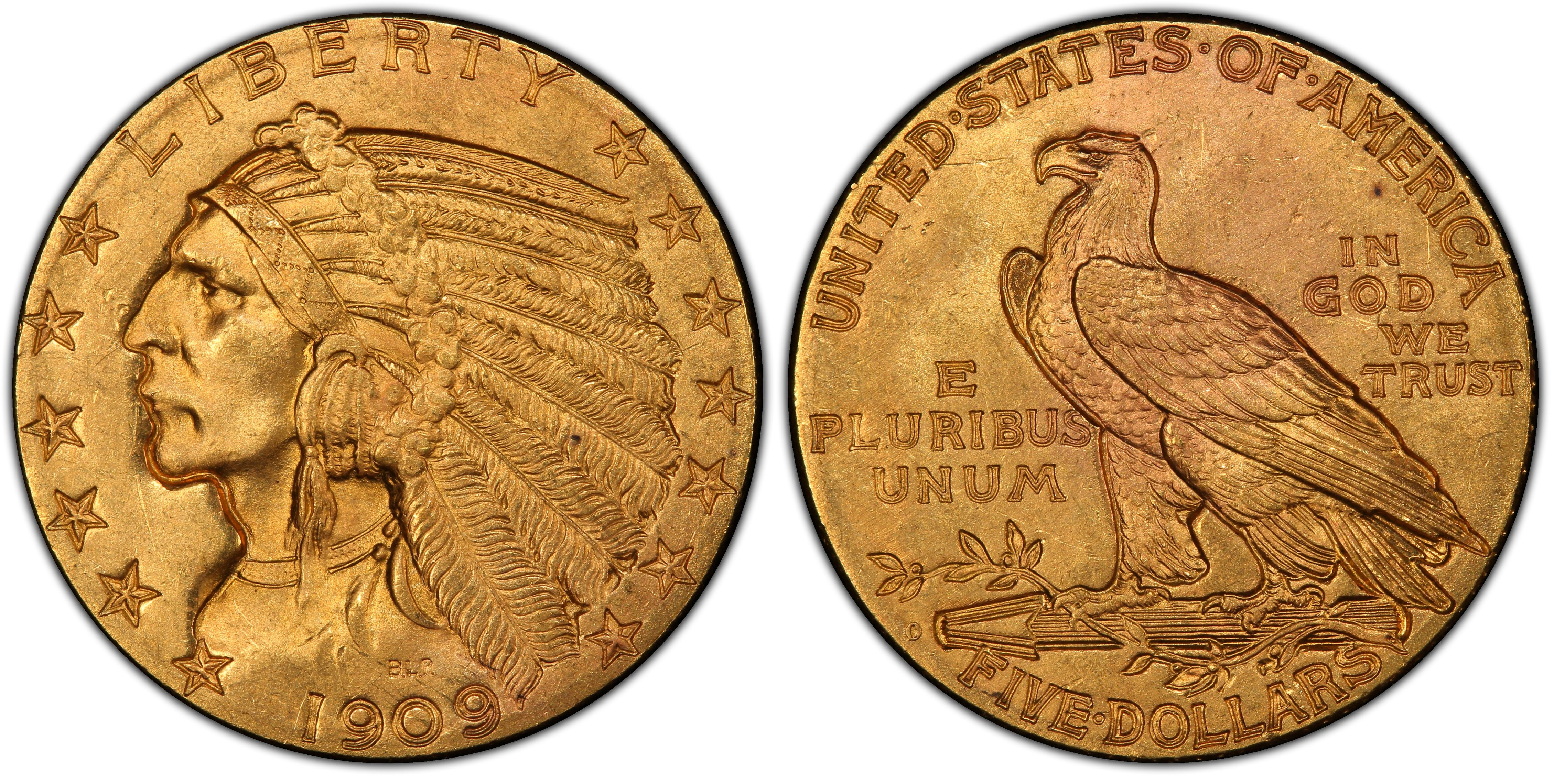
PCGS MS65+
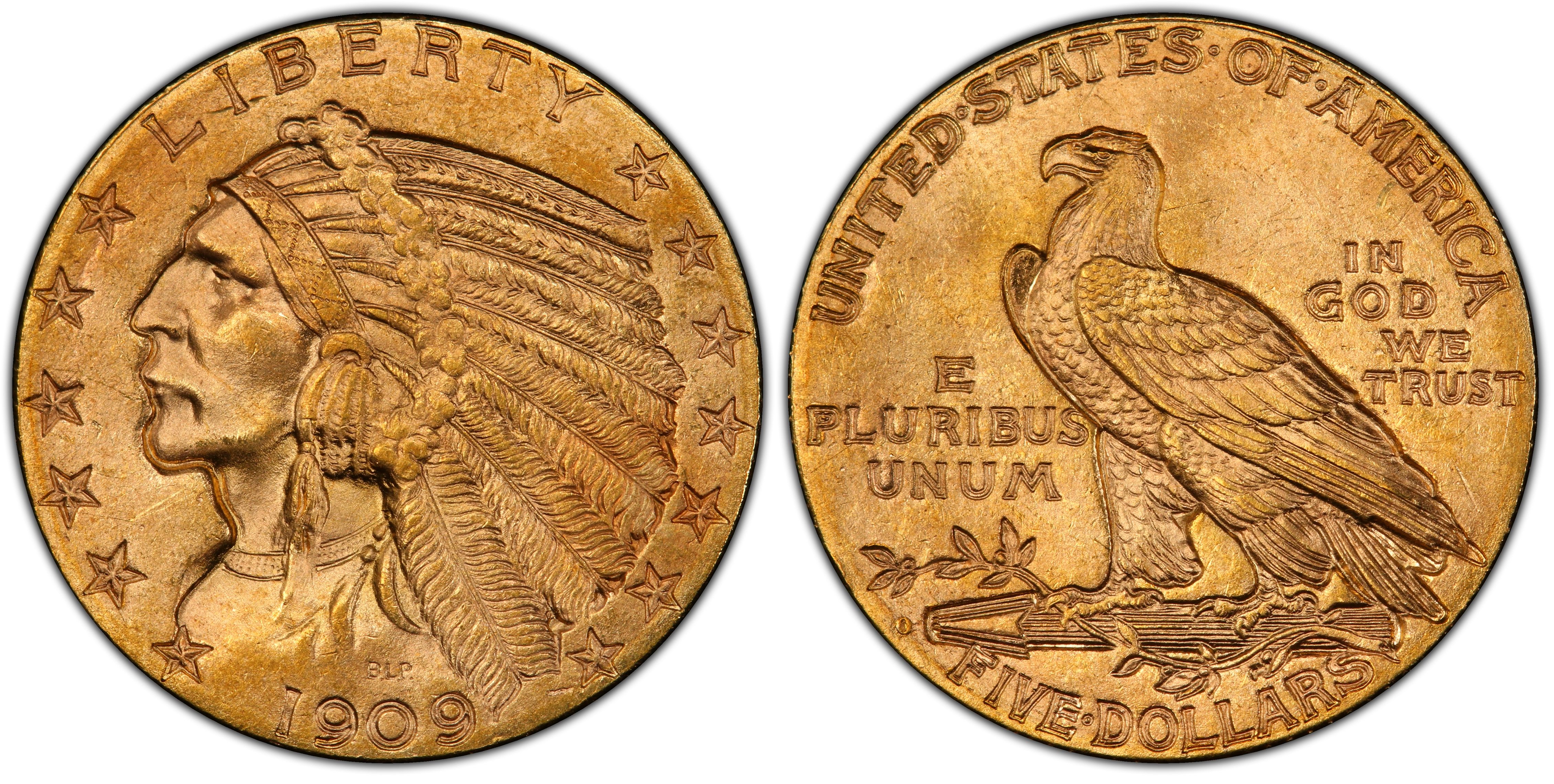
PCGS MS65
- PCGS #:
- 8515
- Designer:
- Bela Lyon Pratt
- Edge:
- Reeded
- Diameter:
- 21.60 millimeters
- Weight:
- 8.36 grams
- Mintage:
- 34,200
- Mint:
- New Orleans
- Metal:
- 90% Gold, 10% Copper
- Auction Record:
- $690,000 • MS66 • 01-05-2011 • Heritage Auctions
Major Varieties
- 1909-O $5
Rarity and Survival Estimates Learn More
| Survival Estimate | |
|---|---|
| All Grades | 1,416 |
| 60 or Better | 183 |
| 65 or Better | 3 |
| Numismatic Rarity | |
|---|---|
| All Grades | R-4.8 |
| 60 or Better | R-7.1 |
| 65 or Better | R-9.8 |
| Relative Rarity By Type All Specs in this Type | |
|---|---|
| All Grades | 2 / 24 |
| 60 or Better | 1 / 24 |
| 65 or Better | 4 / 24 TIE |
| Relative Rarity By Series All Specs in this Series | |
|---|---|
| All Grades | 2 / 24 |
| 60 or Better | 1 / 24 |
| 65 or Better | 4 / 24 TIE |
Condition Census What Is This?
|
#1 PCGS MS66
J.C. Mitchelson, June 1909; John H. Clapp; Clapp estate to Louis E. Eliasberg, Sr., en bloc via Stack's, 1942; "The Louis E. Eliasberg, Sr. Collection," Bowers & Ruddy, October 1982, Lot 623 - $30,800; David Hall & Gordon Wrubel; “Auction ‘83," Paramount, July 1983, Lot 404 - $46,750; Texas Collector; “Auction ‘89,” David W. Akers, July 1989, Lot 1405 - $71,500; "The Dr. Thaine Price Collection," David W. Akers May 1998, Lot 21 - $374,000; The Stellar Collection; "The Jim O'Neal Collection," Heritage Auctions, January 2011, Lot 5138 - $690,000; Heritage Auctions, January 2014, Lot 5468 - $646,250. |
|
#2 PCGS MS65+
"US Gold from a prominent midwestern family collection," Goldberg Auctioneers, June 2016, Lot 1589 - $517,000; "The HALFDOME Collection" (PCGS Set Registry). |
|
#2 Est. MS65+
The Josiah K. Lilly Collection; The National Numismatic Collection at the Smithsonian Institution. |
|
#4 PCGS MS65
Bowers & Ruddy, February 1978, Lot 1315; "Auction '79," RARCOA, July 1979, Lot 1279; Robert Kruthoffer; Paramount, September 1981, Lot 6; Dr. Steven Duckor; Jay Parrino; "Auction '90," David W. Akers, July 1990, Lot 1803; David Hall Rare Coins; Private Collector. |
|
#4 PCGS MS65
|
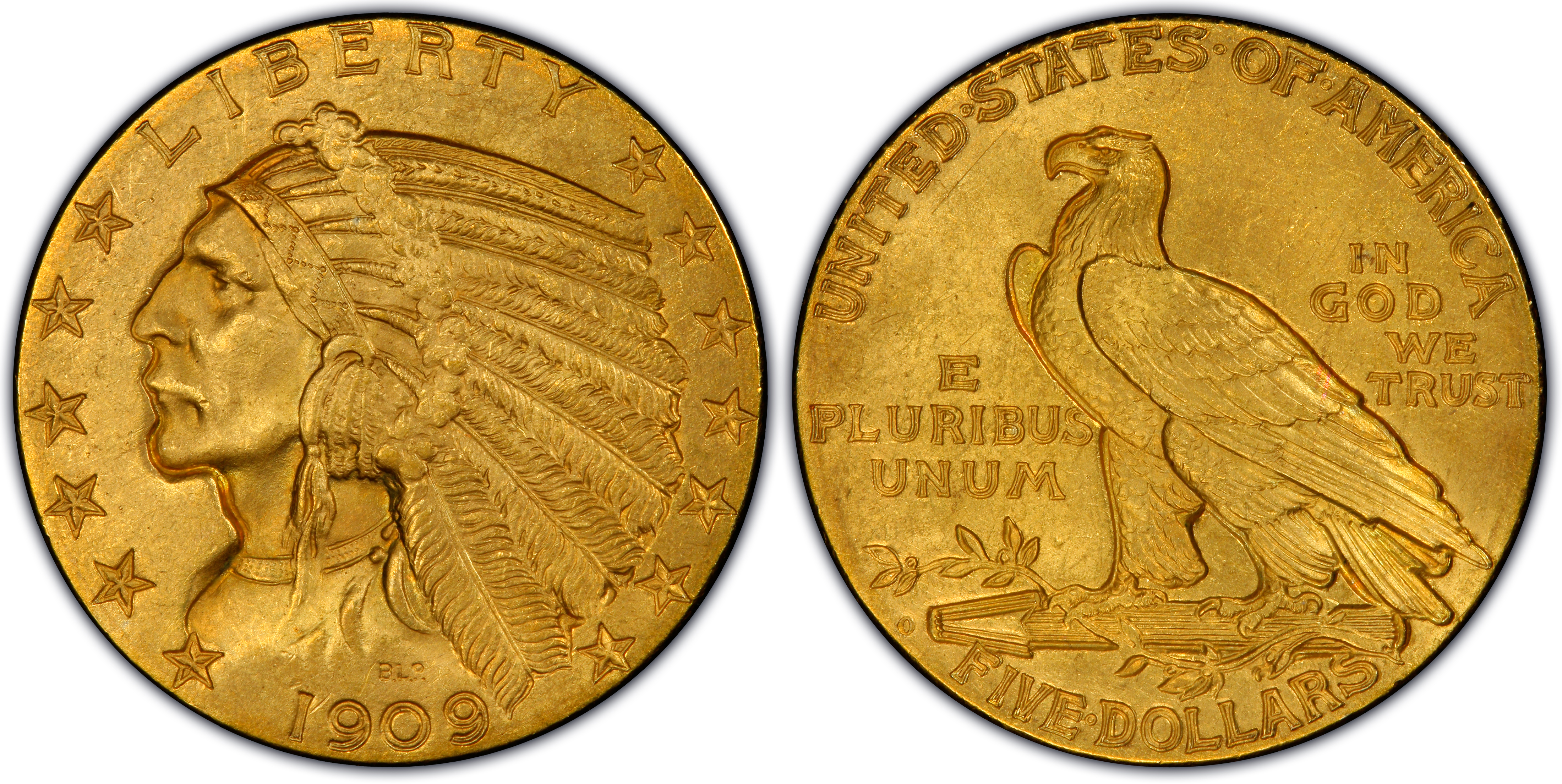 #6 PCGS MS64+
Bowers and Merena, March 2006, Lot 2331 - $175,375. As PCGS MS64+ #40276064. "The Bob R. Simpson Collection, Part III," Heritage Auctions, June 20, 2021, Lot 3045 - $240,000. |
 #7 PCGS MS64
"The Deer Grove Collection" (PCGS Set Registry). |
 #7 PCGS MS64
Heritage Auctions, September 15, 2024, Lot 3143 - $216,000. |
| #7 PCGS MS64 |
| #7 PCGS MS64 |
| #7 PCGS MS64 |
| #7 PCGS MS64 |
| #7 PCGS MS64 |
| #7 PCGS MS64 |
The 1909-O Indian Half Eagle
For more than a decade, rumors circulated among workers and government insiders that the New Orleans Mint was on the chopping block. The year 1909 would ultimately prove to be the branch mint's final year of coin production. The New Orleans Mint, one of the three original Southern branches that opened in 1838, was the only one to resume coinage operations after the Civil War. The Georgia and North Carolina gold rushes that precipitated the opening of the Dahlonega and Charlotte Mints had long since fizzled out. Furthermore, the "O" Mint was the only Southern branch ever tasked with striking silver coinage, which it did heavily in its early days by melting down foreign silver into domestic subsidiary coins. Following lengthy post-war repairs and a three-year stint as an Assay Office, it was the legislated demand for silver that finally brought the New Orleans Mint back online as a full-scale money factory in 1879.
The New Orleans Mint served not just as a money factory, but also as a massive coin depository. Because the public had little practical need for the 1.5 million silver dollars the law required the Treasury to strike each month, the facility stored the unwanted bags inside its heavy, steel-lined vaults.
The nation’s silver bullion stockpile, purchased under the Sherman Silver Purchase Act (July 14, 1890), was finally exhausted by 1904, and the mandatory monthly production of silver dollars ended with it. This depletion, coupled with the opening of the modern Denver Mint and the emergence of new minting technologies, rendered New Orleans redundant. On December 4, 1909, newly appointed Mint Director A. Piatt Andrew issued an order instructing the New Orleans facility to distribute its available supply of 1909 coinage into 1910, forbidding the striking of any new coins once that remaining inventory ran dry. The order to resume coinage never came.
The New Orleans Mint Also Struck Gold
During this post-Civil War period, the New Orleans Mint also struck gold coins, though only sporadically and in just three denominations. The 1879-O Liberty Head (#8990) was its sole post-war $20 Double Eagle issue, with a tiny mintage of only 2,325 pieces. Half Eagles were struck over the course of just four separate years; the 1909-O (#8515) represents the only New Orleans issue featuring Bela Lyon Pratt’s innovative incuse Indian design.
Ten-dollar gold eagles were coined more frequently, though production was still interrupted by multi-year intermissions. None were struck in the famous Saint-Gaudens design; the mint's only 20th-century $10 issues were the Liberty Heads of 1901 (#8748), 1903 (#8753), 1904 (#8756), and 1906 (#8761).
Collecting the 1909-O Indian Half Eagle
For a 20th-century absolute rarity that carries a PCGS Price Guide value between $750,000 and $1,000,000 for each of the four known Gems, the 1909-O Indian Half Eagle rarely commands the mainstream respect it deserves.
In the 5th edition of 100 Greatest U.S. Coins, authors Jeff Garrett and Ron Guth rank the ubiquitous "key date" 1909-S V.D.B. Lincoln Cent (BN #2426) at #27, yet the 1909-O $5 gold piece fails to make the list entirely. This oversight severely undersells the Bela Lyon Pratt series. Ultimately, a complete set can only be assembled by an advanced collector armed with patience, dauntless determination, and deep financial resources.
Strike, Luster, and Visual Characteristics
Despite the operational wind-down at the New Orleans Mint during its final year of coin production, the 1909-O possesses average-to-above average physical characteristics:
- Strike: The typical strike of a 1909-O is just a cut above average, though the "O" mintmark itself is frequently found doubled or weakly impressed.The reverse is typically sharper than the obverse.
- Coloration: Surfaces display a beautiful color palette, often ranging from a subtle greenish hue to a rich, warm orange-gold. Circulated pieces have often been cleaned and robbed of their original skin.
- Texture: Genuine Mint State examples regularly exhibit above-average luster paired with remarkably frosty, attractive surfaces.
Survival Rate
Coinage operations for the 1909-O Indian Half Eagle concluded abruptly on April 1, 1909, leaving a tiny total mintage of just 34,200 coins. The PCGS Population Report indicates that fewer than 2.5% of that original mintage is accounted for in certified holders today. Furthermore, an analysis of historical submission timelines for condition-census coins suggests that the current PCGS MS64 population may be significantly overstated due a lack of auction appearances for several examples that were graded 25-30 years ago.
Recent private dealer-to-dealer transactions reported to PCGS confirm the on-the-ground reality: this historic date is becoming increasingly difficult to source. The market is drying up rapidly, making the coin a ellusive even for collectors merely seeking a choice PCGS MS63 example.
* * *
There is one Superb Gem, the incredible Clapp-Eliasberg specimen. Gordon Wrubel and I bought this coin in the October, 1982 Eliasberg auction for $30,800. We sold it right away for a small profit. David Akers has handled this coin several times since and the price is, shall we say, somewhat higher than what Gordon and I paid in 1982!!!!!