1914-S $5 (Regular Strike)
Series: Indian Head $5 1908-1929
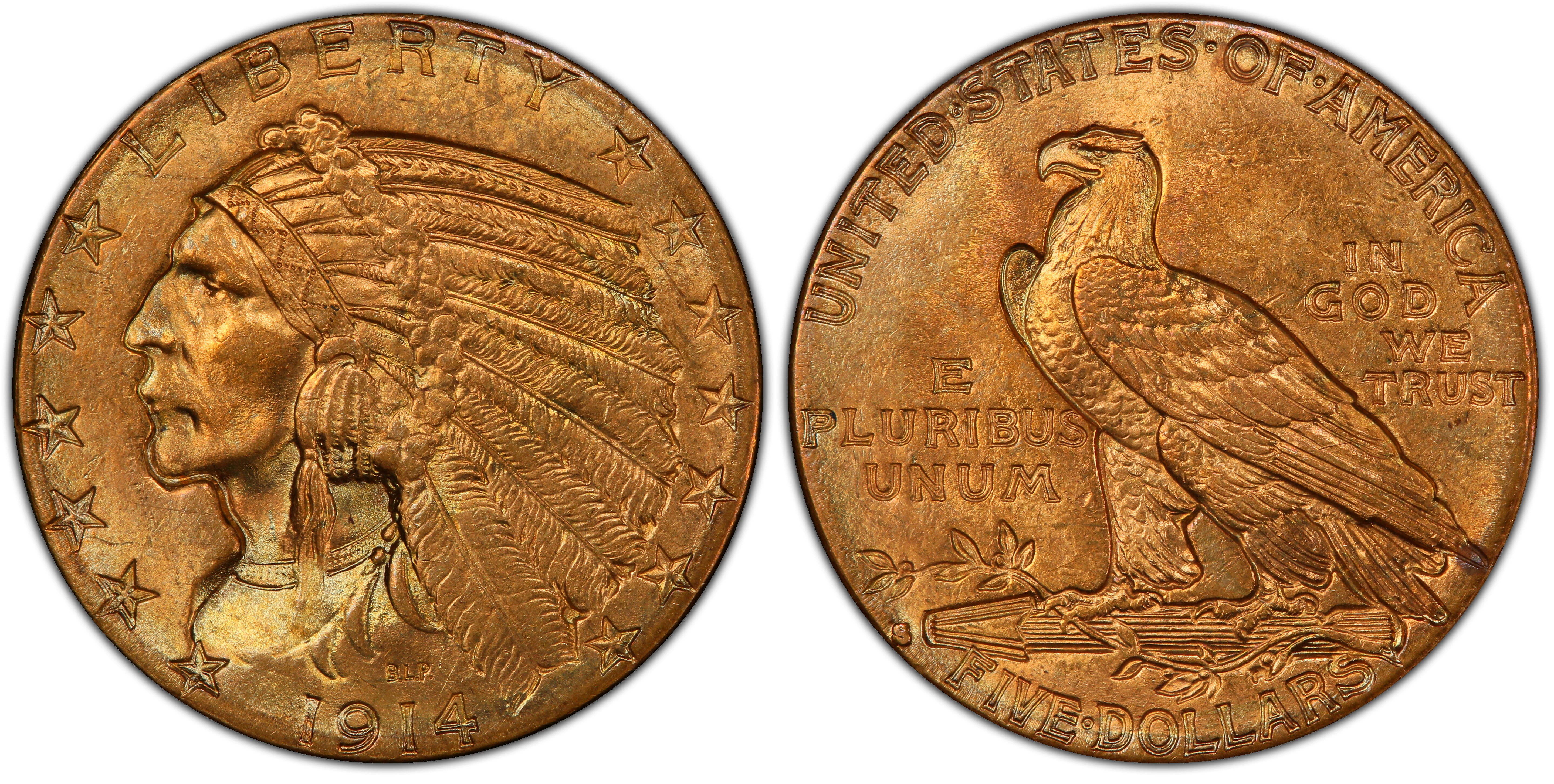
PCGS MS65+
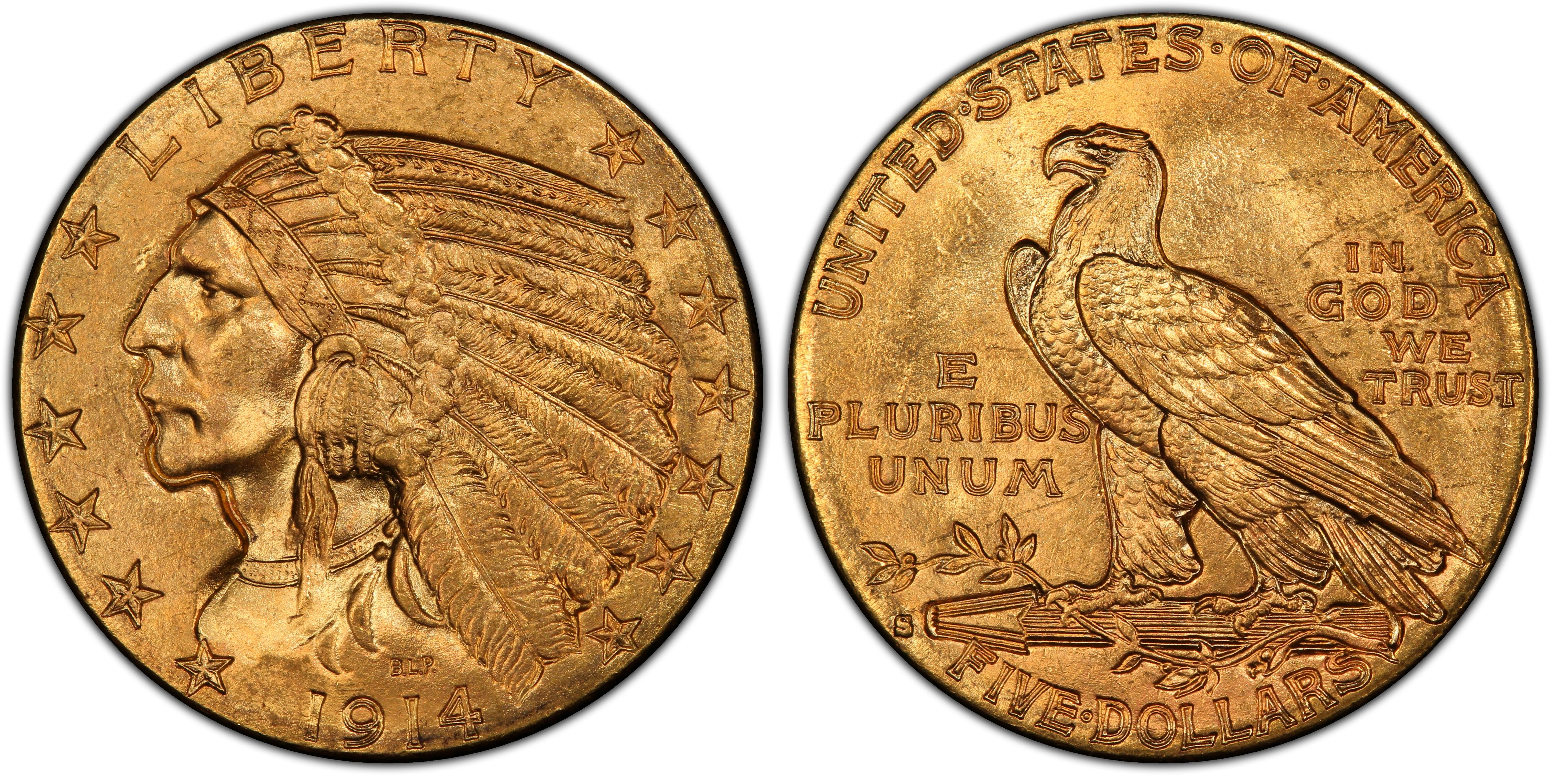
PCGS MS65

PCGS MS64+
- PCGS #:
- 8529
- Designer:
- Bela Lyon Pratt
- Edge:
- Reeded
- Diameter:
- 21.60 millimeters
- Weight:
- 8.36 grams
- Mintage:
- 263,000
- Mint:
- San Francisco
- Metal:
- 90% Gold, 10% Copper
- Auction Record:
- $180,000 • MS65+ • 01-24-2021 • Heritage Auctions
Major Varieties
- 1914-S $5
Rarity and Survival Estimates Learn More
| Survival Estimate | |
|---|---|
| All Grades | 3,750 |
| 60 or Better | 783 |
| 65 or Better | 1 |
| Numismatic Rarity | |
|---|---|
| All Grades | R-4.2 |
| 60 or Better | R-5.4 |
| 65 or Better | R-10.0 |
| Relative Rarity By Type All Specs in this Type | |
|---|---|
| All Grades | 10 / 24 TIE |
| 60 or Better | 10 / 24 |
| 65 or Better | 1 / 24 TIE |
| Relative Rarity By Series All Specs in this Series | |
|---|---|
| All Grades | 10 / 24 TIE |
| 60 or Better | 10 / 24 |
| 65 or Better | 1 / 24 TIE |
Condition Census What Is This?
|
#1 PCGS MS65+
"Auction '90," David W. Akers, August 1990, Lot 1817 - $44,000. As NGC MS65 #918889-005. Heritage Auctions, August 20, 2004, Lot 7399 - $63,250; Heritage Auctions, February 25, 2005, Lot 8708 - $80,500. As PCGS MS65+ #40276066. "The Bob R. Simpson Collection, Part III," Heritage Auctions, January 24, 2021, Lot 3046 - $180,000; "The Don Kutz California Collection," Heritage Auctions, Janaury 19, 2025, Lot 4716 - $120,000; Heritage Auctions, October 5, 2025, Lot 3138 - $132,000. |
|
#1 PCGS MS65
Goldberg Auctioneers, June 6, 2016, Lot 1603 - $146,875. |
|
#3 PCGS MS64+
"The Jim O'Neal Collection of $5 Indians," Heritage Auctions, January 6, 2011, Lot 5152 - $92,000. |
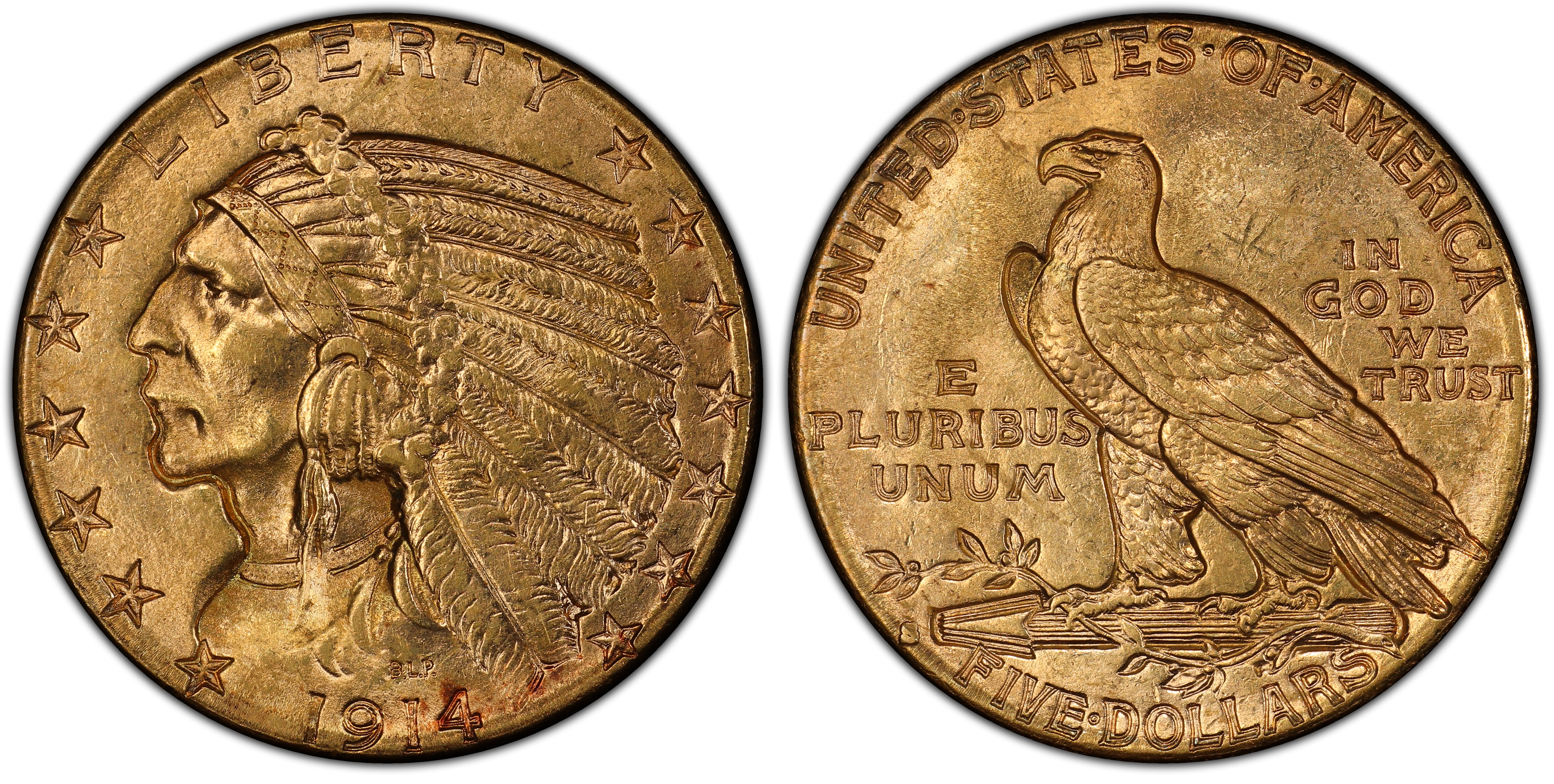 #4 PCGS MS64
"The Naples Collection" (PCGS Set Registry). |
| #4 PCGS MS64 |
| #4 PCGS MS64 |
| #4 PCGS MS64 |
| #4 PCGS MS64 |
| #4 PCGS MS64 |
The 1914-S Indian Half Eagle
Following Frank A. Leach’s retirement in late 1913, operations at the San Francisco Mint were handed over to his successor, Thaddeus W.H. Shanahan, in time for the 1914 production year. A commanding 6’6” attorney and rancher born in Sutter County in 1859, Shanahan was serving as a California state senator before receiving his federal appointment from President Woodrow Wilson.
Shanahan would later personally strike the historic first 1915-S Panama-Pacific Octagonal $50 gold piece (#7452), presenting it directly to the Exposition's president, Charles C. Moore. While the Mint handled significantly higher gold deposits in the 1910s than it had during the 1890s and 1900s, the total number of struck gold coins was actually in decline. This shift occurred because federal law allowed the Treasury to hold stamped, assayed bullion bars in its reserves rather than coining all incoming metal. In fiscal years 1913 and 1914, these gold bars accounted for more than half the total value of each year’s gold deposits.
As for the 1914-S Indian Half Eagle (#8529), the San Francisco Mint struck 263,000 pieces. Most entered circulation and perhaps only 1,000 to 1,500 survive in Mint State. Only the 1908-S (#8512), 1909-O (#8515), 1911-D (#8521), and the rare 1929 (#8533) have lower population numbers in the PCGS Population Report.
Collecting the 1914-S Indian Half Eagle
The incuse design and a severe paucity of well-preserved examples conspire to make the 1914-S Indian Half Eagle one of the scarcest 20th-century gold issues to secure in Gem condition. There is an old numismatic adage: "The obverse makes the coin, but the reverse can only hurt it." No United States coin series embodies this expression more perfectly than the Indian Half Eagle. Lacking a traditional raised rim, the flat fields effectively serve as the outermost border for the sunken, recessed design elements. The lone exception to this layout is the mintmark. On many San Francisco issues, the "S" was not punched into the die with enough force to achieve a sharp strike. Consequently, on the finished coin, the mintmark stands completely exposed to friction, while the flat fields bear the brunt of any surface contact.
This vulnerability leaves the vast open spaces flanking the Indian and the eagle highly susceptible to bagmarks. Ultimately, the upper reverse field becomes the "final boss fight" that any would-be Gem must survive to earn a coveted PCGS MS65 holder. To date, only two have ever managed the feat.
The reported population of PCGS MS64 examples warrants similar skepticism. Many of these coins were graded over thirty years ago and have long since vanished into private collections, while others sit in legacy PCGS holders with certification numbers that are no longer active. In all likelihood, this tough S-mint is significantly scarcer in Choice Mint State than public data suggests.
* * *