1868 50C, CAM (Proof)
Series: Liberty Seated Half Dollars 1839-1891
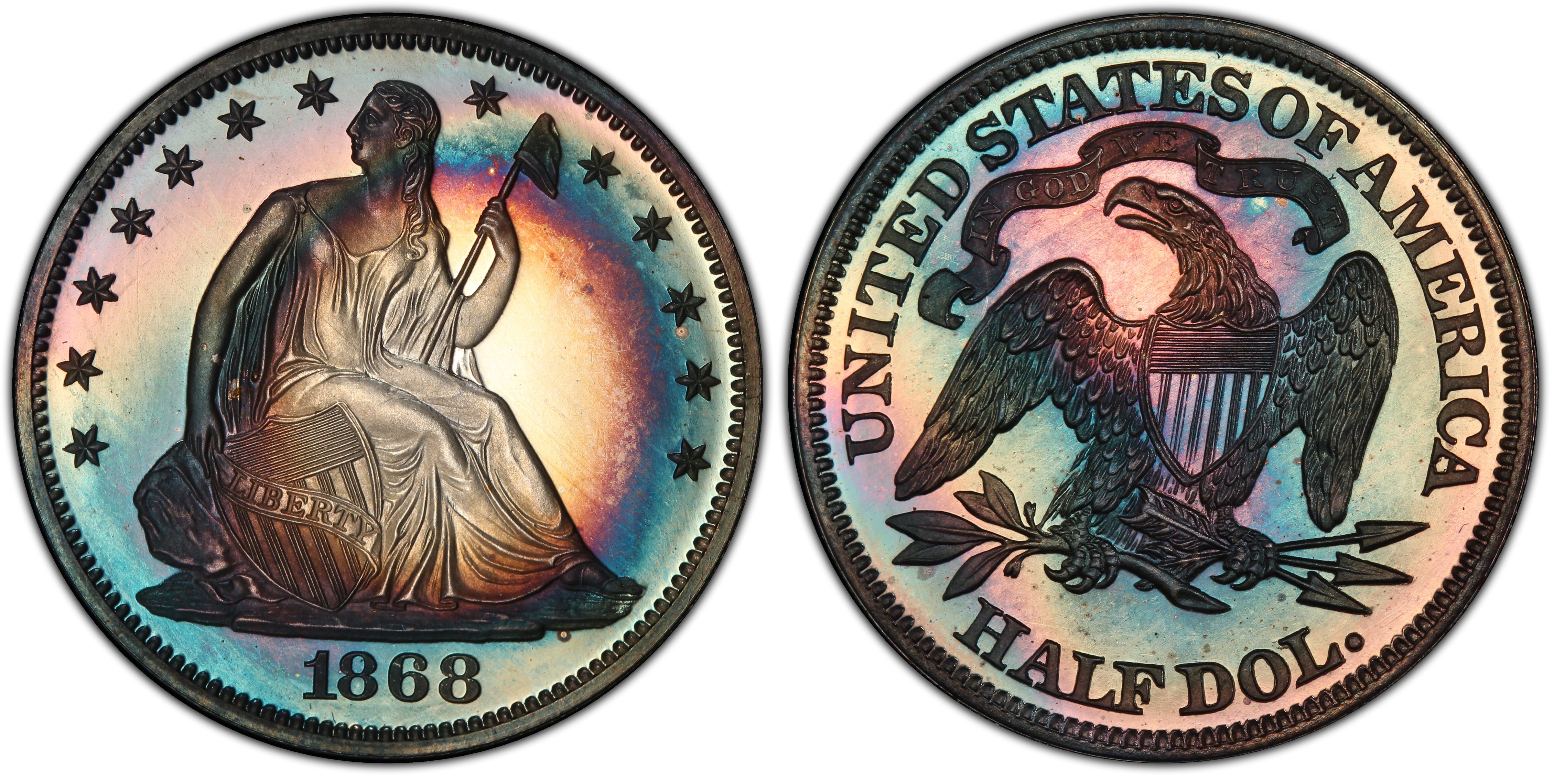
PCGS PR68CAM

PCGS PR66+CAM

PCGS PR66+CAM
- PCGS #:
- 86426
- Designer:
- Thomas Sully/Christian Gobrecht
- Edge:
- Reeded
- Diameter:
- 30.00 millimeters
- Weight:
- 12.40 grams
- Mintage:
- 600
- Mint:
- Philadelphia
- Metal:
- 90% Silver, 10% Copper
- Auction Record:
- $37,375 • PR67 • 08-11-2011 • Heritage Auctions
Condition Census What Is This?
|
#1 Est. PR68CAM
As NGC PF68 #174594-009. Superior, August 1992, Lot 336 - $14,300. Offered as part of an original 1868 Silver Proof Set; Heritage Auctions, June 1998, Lot 5806 - $26,450; American Numismatic Rarities, October 11, 2004, Lot 398 – $29,900; As NGC PF68 #174594-009. "The Eugene H. Gardner Collection, Part II," Heritage Auctions, October 27, 2014, Lot 98534 – $41,125. As PCGS PR68CAM #33085272. The Chrismore Collection; The D.L. Hansen Collection. |
|
#2 PCGS PR67CAM
“The Daryl J. Hayner Collection,” Heritage Auctions, August 12, 2011, Lot 7185 – $37,375; Legend Rare Coin Auctions, December 15, 2021, Lot 125 – $31,725; “The Warren Collection,” Heritage Auctions, May 5, 2022, Lot 3912 – $26,400. Obverse features rose and apricot hues, highlighted by vivid blue along the top edge. |
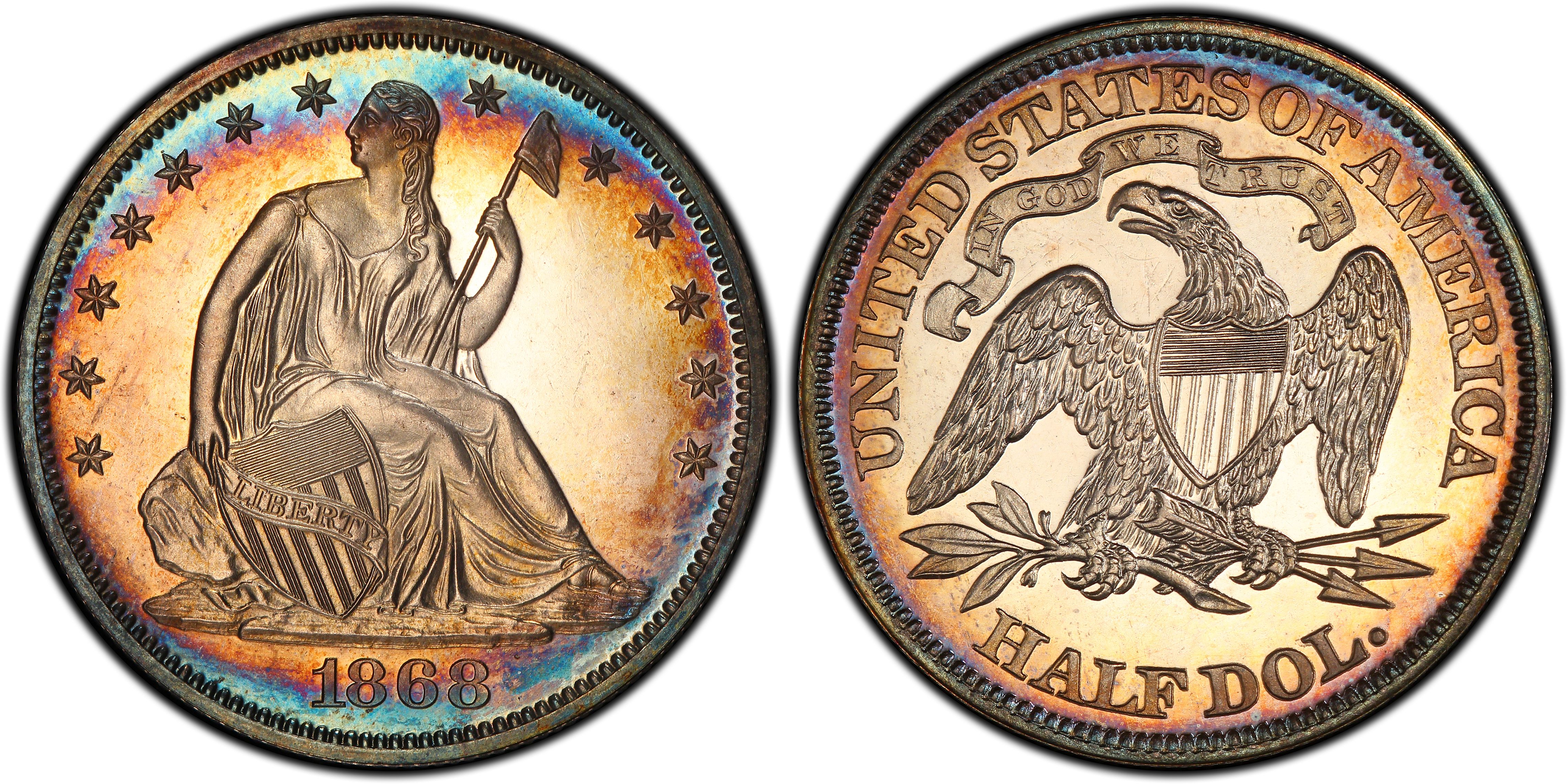 #3 Est. PCGS PR66+CAM
|
|
#3 PCGS PR66+CAM
|
|
#3 PCGS PR66+CAM
As PCGS PR66CAM #25643155. Bob R. Simpson; Legend Rare Coin Auctions, December 17, 2015, Lot 239 – $5,757.50; Legend Rare Coin Auctions, March 26, 2020, Lot 382 – $9,400. As PCGS PR66CAM #39007736. “The Boylston Collection, Part IV,” Legend Rare Coin Auctions, February 23, 2023, Lot 242 – $9,693.75. As PCGS PR66+CAM #47835597. Amber toning with darker toning at the top of the obverse and along the periphery of the reverse. |
|
#3 PCGS PR66CAM
As NGC PF67CAM #1551008-001. Heritage Auctions, January 3, 2007, Lot 989 – $12,650. As NGC PF67CAM #2137449-004. “The Slotkin Family Trust Collection,” Heritage Auctions, April 28, 2011, Lot 5165 – $17,250; “The Greensboro Collection, Part II,” Heritage Auctions, January 10, 2013, Lot 5685 – $14,100. As PCGS PR66CAM #27973387. Heritage Auctions, September 27, 2013, Lot 6453 – $17,625; “The Warren Collection,” Heritage Auctions, May 5, 2022, Lot 3911 – $9,000; Heritage Auctions, October 6, 2022, Lot 3056 – $8,400. |
| #3 PCGS PR66CAM |
 #4 PCGS PR66CAM
|
The 1868 Liberty Seated Half Dollar Proof
In the years immediately following the Civil War, large silver deposits remained scarce. Consequently, the Philadelphia Mint struck modest numbers of silver coins. This output was a far cry from the massive mintages triggered by the Specie Payment Resumption Act in the mid-1870s. Gold coinage saw similar restrictions in Philadelphia, though the San Francisco Mint received steady bullion deposits and churned out gold coins at a reliable pace. While the 1868 Philadelphia circulation mintage reached a moderate 417,600 pieces, the Proof edition was limited to just 600 coins. Typical for the era, most of these Proofs were delivered in five batches during the first half of the year:
| 1868 Liberty Seated Half Dollar Proof Deliveries | |||
| February 14, 1868 | 200 delivered | March 2, 1868 | 100 delivered |
| March 24, 1868 | 100 delivered | April 28, 1868 | 100 delivered |
| July 9, 1868 | 100 delivered | Total: 600 coins | |
Collecting the 1868 Liberty Seated Half Dollar Proof
As struck, the 1868 Liberty Seated Half Dollar (#6426) featured the brilliant, mirror-like finish typical of 19th-century Proofs. On Gem examples, these deep mirrors remain clearly visible beneath natural toning. Cameo-contrast specimens account for roughly one-sixth of the mintage. While most surviving pieces display standard toning, select examples feature exceptionally vibrant, eye-catching color.
Despite a low mintage and over 150 years of history, the 1868 Proof half dollar remains relatively affordable and far more plentiful in high grades than its business-strike counterpart. Proofs actually outnumber Mint State circulation strikes by 10 to 1, reflecting a broader trend among late 19th-century silver coins. At the time, collectors happily paid a small surcharge to order Proofs directly from the Mint. Decades passed before numismatists routinely differentiated between Proofs, business strikes, and mint marks in their cabinets.
* * *