1884 T$1 Trade, CAM (Proof)
Series: Trade Dollars 1873-1885
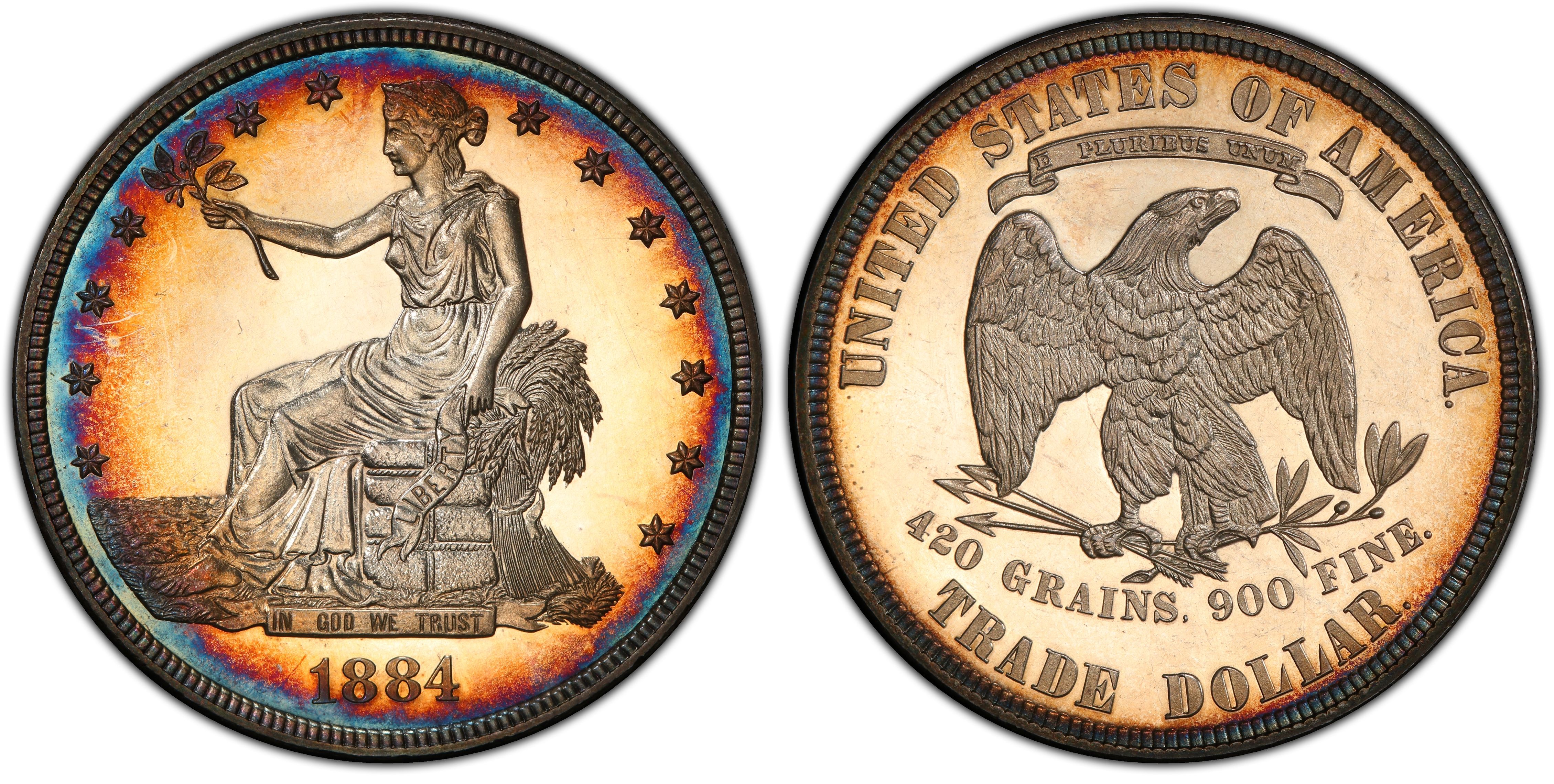
PCGS PR64+CAM

PCGS PR66CAM
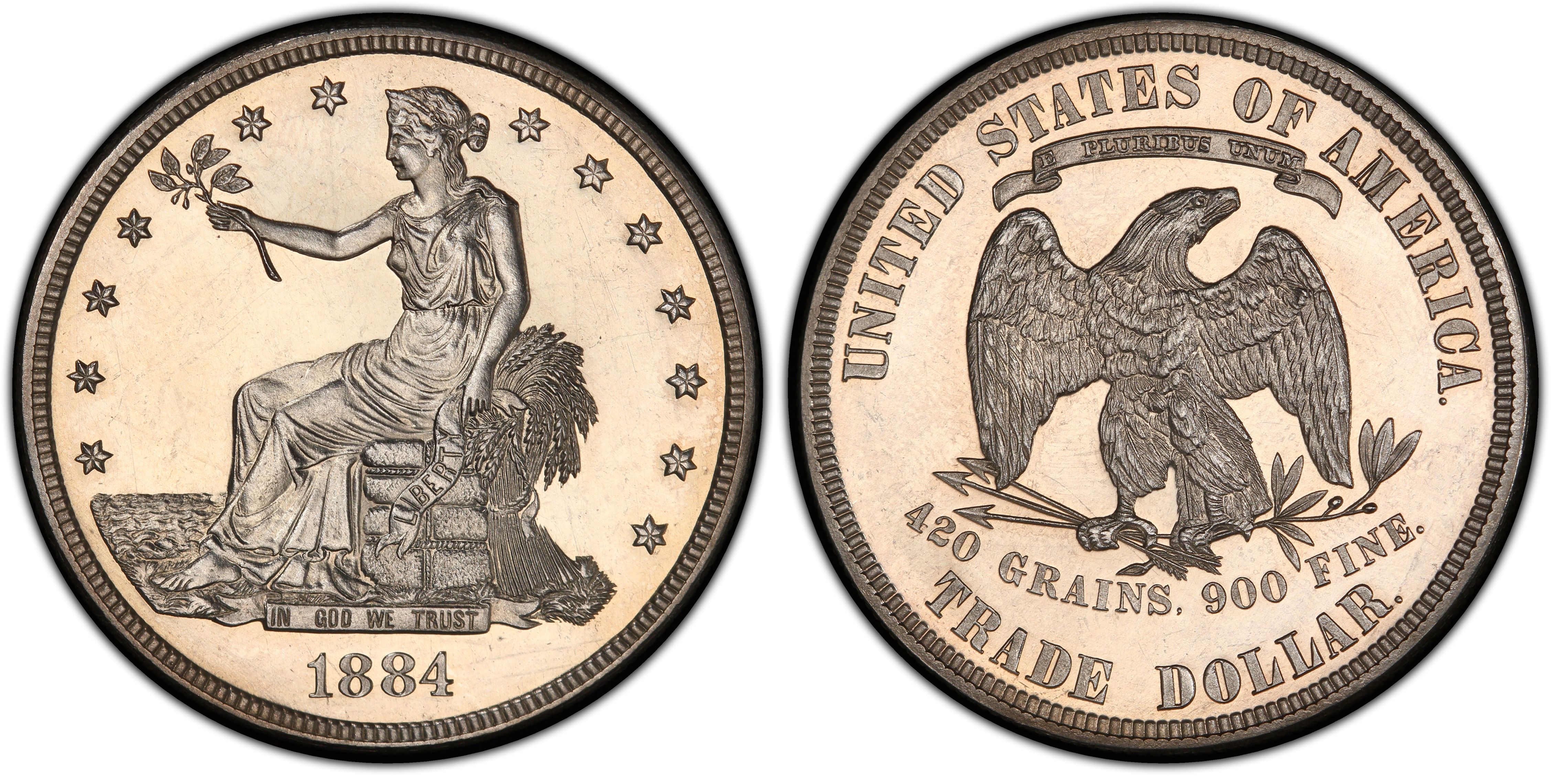
PCGS PR64CAM
- PCGS #:
- 87064
- Designer:
- William Barber
- Edge:
- Reeded
- Diameter:
- 38.10 millimeters
- Weight:
- 27.20 grams
- Mintage:
- 10
- Mint:
- Philadelphia
- Metal:
- 90% Silver, 10% Copper
- Auction Record:
- $552,000 • PR64+CAM • 03-25-2020 • Stack's Bowers
Rarity and Survival Estimates Learn More
| Survival Estimate | |
|---|---|
| All Grades | 8 |
| 60 or Better | 8 |
| 65 or Better | 3 |
| Numismatic Rarity | |
|---|---|
| All Grades | R-9.6 |
| 60 or Better | R-9.6 |
| 65 or Better | R-9.8 |
| Relative Rarity By Type All Specs in this Type | |
|---|---|
| All Grades | 2 / 2 |
| 60 or Better | 2 / 2 |
| 65 or Better | 2 / 2 |
| Relative Rarity By Series All Specs in this Series | |
|---|---|
| All Grades | 2 / 2 |
| 60 or Better | 2 / 2 |
| 65 or Better | 2 / 2 |
Condition Census What Is This?
|
#1 PCGS PR66CAM
The Granberg Specimen. Ex Philadelphia Mint Superintendent A. Loudon Snowden, 1884; (possibly) William K. Idler; Capt. John W. Haseltine and Stephen K. Nagy; H.O. Granberg, exhibited at the 1914 ANS Exhibition as part of a full set of Trade dollars; "The H.O. Granberg Collection," B. Max Mehl, July 1919, Lot 128 - $260; Virgil Brand; Armin Brand, sold September 1, 1942; unknown intermediaries, possibly Stack's in 1942; Louis E. Eliasberg, Sr.; "The Louis E. Eliasberg Collection, Part III," Bowers and Merena, April 1997, Lot 2353 - $396,000. As NGC PF66 #675308-009. Spectrum Numismatics; The Legend Collection (Bruce Morelan); John Albanese; Heritage Auctions, sold privately into the Greensboro Collection, January 2006 - $925,000; Heritage Auctions, January 10, 2019, Lot 4552 - $1,140.000. As PCGS PR66CAM #43707600. Golden-tan toning. Fingerprint on the reverse right field. |
|
#2 PCGS PR64+CAM
The Amon G. Carter Specimen. Ex Philadelphia Mint Superintendent A. Loudon Snowden, 1884; (possibly) William K. Idler; Capt. John W. Haseltine and Stephen K. Nagy; William H. Woodin, 1910 (presumably); Edgar H. Adams, advertised in the March 1915 issue of The Numismatist; Waldo C. Newcomer - $350; B. Max Mehl, 1931, on consignment but not sold; consigned from the Newcomer Collection to J.C. Morgenthau & Co.’s 348th Sale, May 1935, Lot 431 - $350; “Colonel” E.H.R. Green; Burdette G. Johnson, circa 1943; “Jack V. Roe Collection,” B. Max Mehl, June 1945, lot 627 – $665; possibly Percy A. Smith; per the July 1946 issue of The Numismatist, presumably consigned to the following; B. Max Mehl, May 1950, Lot 896 - $760; Amon Gamaliel Carter, Sr.; Amon G. Carter, Jr.; “The Amon G. Carter, Jr. Family Collection,” Stack’s, January 1984, Lot 440 – $45,100; “The E. Horatio Morgan Collection,” Stack’s Bowers, March 19, 2020, Lot 3215 – $552,000. Richly toned with golden centers and vivid blue and red toning along the periphery. |
|
#3 PCGS PR64CAM
The Atwater Specimen. Ex Philadelphia Mint Superintendent A. Loudon Snowden, 1884; unknown intermediaries; “The William Cutler Atwater Collection,” B. Max Mehl, June 1946, Lot 377 – $800; “The Will W. Neil Collection,” B. Max Mehl, June 1947, lot 296 – $551; “The Robert C. Pelletreau Collection,” Stack’s, March 1959, Lot 1054 – $3,300; Jerry Cohen; unknown intermediaries; Julian Leidman, Mike Brownlee and Hugh Sconyers; the three exhibited this coin and an 1885 Trade Dollar Proof at Stack’s bourse table at the 1974 ANA Convention; the 1884 and 1885 Trade Dollar Proofs sold immediately after to James Halperin; New England Rare Coin Galleries’ Fixed Price Lists of December 1974 and February 1975 at $75,000; New England Rare Coin Auctions’ 31st Annual New England Numismatic Association Convention Sale, November 1975, Lot 639 – $39,000; Mulford B. Simons, Jr.; Hanks and Associates, April 20, 1985, Lot 351; unknown intermediaries; RARCOA, August 1989, Lot 327; Jay Parrino; Superior, August 1990, Lot 1163; Jay Parrino; Superior, May 29, 1991, Lot 987; “The L.K. Rudolf Collection,” Stack’s, May 2003, Lot 2174 – $258,750; Bowers and Merena, May 2004, Lot 328 – $310,500; private collection; American Numismatic Rarities, August 2006, lot 855 – $400,000. Mehl used the same photograph from the Dunham catalog (1941) to illustrate subsequent sales: Olsen (1944); Roe (1945); Atwater (1946); Neil (1947); and Kern (1950). |
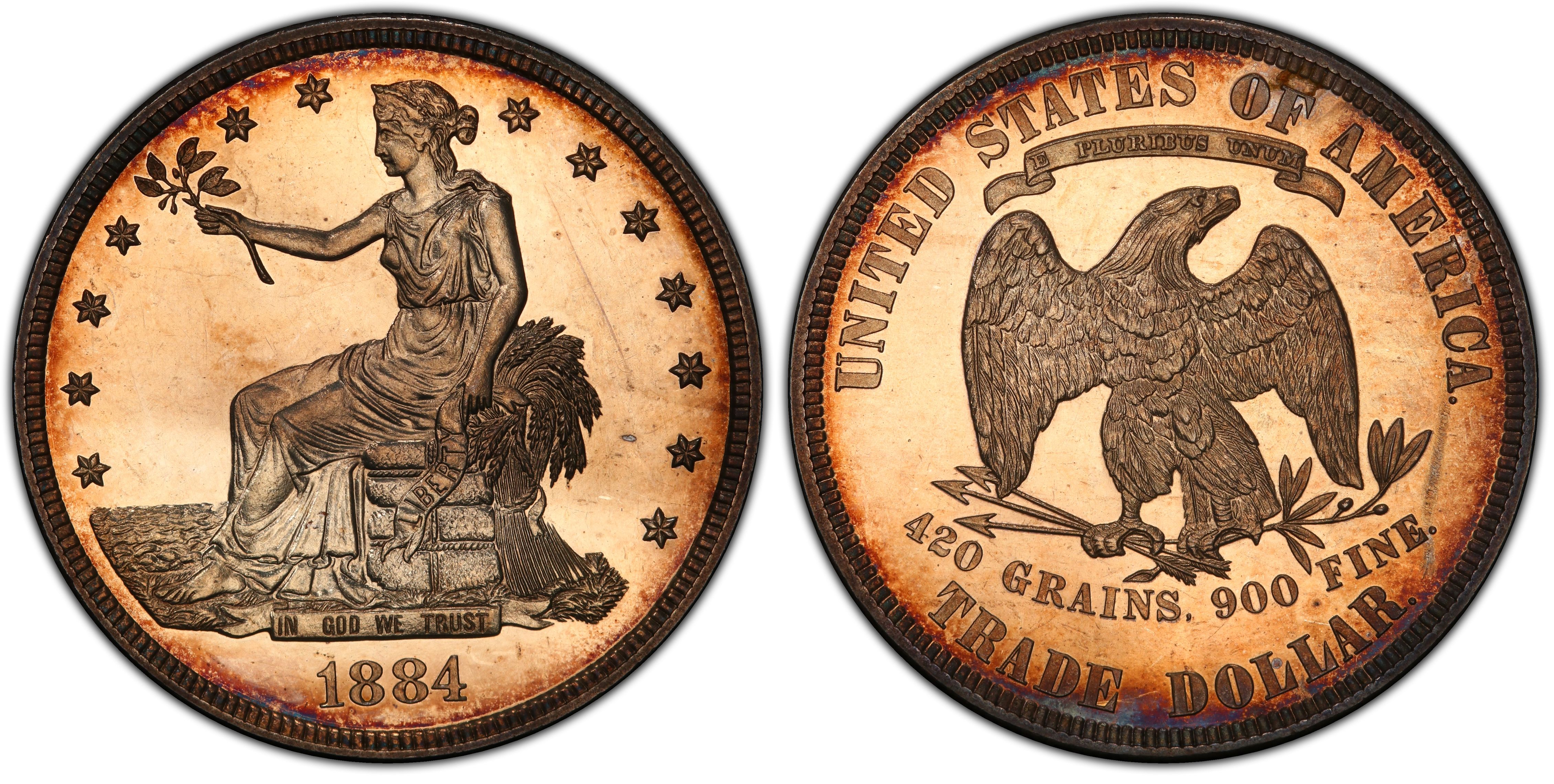 #4 PCGS PR63+CAM
The Sprinkle Specimen. Ex Philadelphia Mint Superintendent A. Loudon Snowden, 1884; (possibly) William K. Idler; Capt. John W. Haseltine and Stephen K. Nagy; “Colonel” E.H.R. Green; Burdette G. Johnson; James Kelly; Kelly to Frank F. Sprinkle, via private treaty, June 24, 1944 – $375; “The Frank F. Sprinkle Collection,” Stack’s, June 1988, Lot 106 - $61,600; Larry Whitlow; Dana Linett. As PCGS PR61. Early American Numismatics, October 1988, Lot 461; RARCOA, August 1990, Lot 845 – $46,200; Mark Chrans; Stack’s, March 2002, Lot 795 – $126,500; private collection; Kevin Lipton; Legend Numismatics; private collection. As NGC PR63. Bowers and Merena, January 2003, Lot 569 – $138,000. As PCGS PR63+CAM #40273617. “Important Selections of the Bob R. Simpson Collection, Part V,” Heritage Auctions, April 23, 2021, Lot 4151 – $480,000. |
The 1884 Trade Dollar Proof
Introduced in 1873, the Trade Dollar was designed for silver export at a time when Congress was shifting the United States toward a gold standard. While production grew steadily through 1877—primarily at the San Francisco Mint to facilitate Asian commerce—the tide turned in 1878. Over President Rutherford B. Hayes’s veto, the Bland-Allison Act mandated the return of the standard Silver Dollar for domestic use. This effectively ended the Trade Dollar's utility; from 1879 onward, the coin was struck exclusively in Proof format for collectors.
A Shadowy Provenance
Between 1879 and 1883, the Philadelphia Mint struck modest Proof runs ranging from 960 to 1,987 pieces. However, the 1884 Trade Dollar Proof (#7064; 10 struck) and 1885 Proof (#7065; 5 struck) remained entirely unknown to the contemporary numismatic community.
The eventual emergence of the 1884 and 1885 Trade Dollars is inextricably linked to John W. Haseltine and his business partner (and son-in-law) Stephen Nagy. The pair were notorious as the primary "fences" for clandestine Mint products—coins struck without official authorization or released through back-door channels. In 1908, they "discovered" the 1884 and 1885 proofs within the estate of William Idler, Haseltine’s father-in-law and a man with deep, informal ties to Philadelphia Mint officials.
When Capt. Haseltine first offered these coins for sale he met price resistance. The first one he offered was to a prominent dealer, who refused to pay $40 for it.
Still, not all were convinced that the 1884 Trade Dollars actually existed, or that honorable Mint officials would support a shadow market for Mint-made rarities. In the March 1884 issue of Numista, dealer (and frequent bomb-thrower) Éduoard Frossard wrote:
Our critic... insinuated that Trade Dollars have been quietly manufactured at the Mint during the present year; in other words, that notwithstanding the positive assertions of the Mint authorities to the contrary, a Trade Dollar with the date 1884 does exist.
We hold that the plain but positive statement of the Mint officers on this point should be considered conclusive evidence, and they say that no Trade Dollars have been issued in the Philadelphia Mint, nor in any Mint of the United States during the present year, or dated 1884.
To bolster his position, Frossard issued a bold cash challenge:
But as doubts on this point may still exist in the minds of those who heard the report, we are authorized to make the following offers: $100 cash each for any number of United States Trade Dollars of 1884, coined at the Philadelphia or other U.S. Mint; $25 cash down to any one who will show us such a dollar.
However, Frossard also acknowledged the specific methods by which rare patterns could escape official channels, shifting the blame away from Mint leadership:
It is time that absurd and untruthful if not slanderous statements about so-called 'deals' at the National Mint should cease. The present management has proved itself most honorable, impartial and just, and no one has unusual facilities to obtain pattern pieces and proof sets, all collectors in this respect being treated alike, i.e., what is obtainable by one at the Mint is obtainable by all.
It is true that certain dealers and collectors have lobbying friends in Washington, men who hang about the Coinage and Finance Committee rooms, also the Treasury department. These men are at times enable to secure pieces not issued to collectors at the Mint, but with this the Mint officers have nothing to do. They are required by law to furnish the Coinage Committee of Congress a certain number of specimens of the pattern pieces, assays [sic], and regular coinage of each year; what Congressman do with these is none of their concern. They are no more responsible for the action of these men than for the laws they frame.
A careful study of the subject led us long ago to the belief that all trumped up charges of favoritism in the distribution of pattern pieces made against the present Mint officers, were either purely malicious, or arose from a total ignorance of the duties of these officers and of the rights and privileges enjoyed by the legislative bodies at Washington.
The 1884 Trade Dollars did, in fact, exist. Regardless of how they escaped the Philadelphia "money factory," the surrounding publicity succeeded in whetting the appetites of collectors; before long, seven of the ten known specimens had changed hands at prices ranging from $150 to $400. In 1885, a final, even smaller batch of five Proof Trade Dollars would be struck.
This shadowy business model finally invited federal scrutiny in 1909. In a sting operation, agents intercepted a package Stephen Nagy had shipped to James Manning, the son of a former Treasury Secretary. The government seized 24 rare coins, alleging they were "stolen" property because no official record of their sale existed. However, the subsequent legal battle ended in a dismissal. The court ruled that since the government could not prove the coins were stolen rather than simply "gifted" or sold off-the-books by past officials, they were legal to own. This landmark victory effectively legitimized the collection of pattern coins and "experimental" strikes in the United States.
Mystery in the Archives
The sudden appearance of these dates led many to dismiss them as pièces de caprice—fantasy pieces struck on a whim. Yet, archival evidence suggests a more complex story. Researcher Carl W.A. Carlson found records of a single pair of 1884 Trade Dollar dies delivered to the coining department on January 3, 1884.
While Mint Director reports suggest a delivery to the Cash Room on January 19, it is believed an eleventh-hour order halted their sale. Philadelphia Mint Superintendent A. Loudon Snowden likely retained the ten known specimens.
One of the earliest private owners of an 1884 Trade Dollar Proof was William Hartman Woodin, who later became Franklin Delano Roosevelt's Treasury Secretary and famously secured the 1933 "numismatic carveout" during the gold confiscation.
In the 140-plus years since, the list of owners of the 1884 Trade Dollar has read like a "Who’s Who" of numismatic legends. Each of the ten coins has a distinct look and feel; most have been compromised in some way by handling or exposure to the elements. The most determined collectors will likely seek out one of two or three top-tier examples, claiming the particular one they are chasing is the finest. Others will settle for the opportunity of simply adding one to their cabinets. For the rest of us, a more available 1883 Trade Dollar Proof (#7063) is the closest we will come to owning these two late-date rarities.
Market Snippets
- The 1884 Trade Dollar is a pillar of American numismatics, ranked #78 in Garrett and Guth’s 100 Greatest U.S. Coins. It is rarer than both the 1907 Saint-Gaudens Double Eagle, Extremely High Relief, Lettered Edge Proof (#9131) and the 1894-S Barber Dime Branch Mint Proof (#4805), but is often overshadowed by its 1885 counterpart.
- At least three 1884 Trade Dollars are known to have "traded" hands for over a million dollars: two at public auction and one via private sale. In 2019, the Granberg specimen crossed the million-dollar threshold, realizing $1,140,000. This followed a high-profile private transaction in January 2018, when John Brush (DLRC) and Matt Kleinsteuber (NFC) purchased the "Dunham" specimen—the finest known Brilliant Proof example (PCGS PR67)—for more than $1,300,000. They subsequently placed the coin in the Dell Loy Hansen Collection in February of that year. Most recently, in January 2025, the Menjou specimen matched the Granberg price, selling at auction for $1,140,000.
* * *