1899 $20 (Proof)
Series: Liberty Head $20 1849-1907
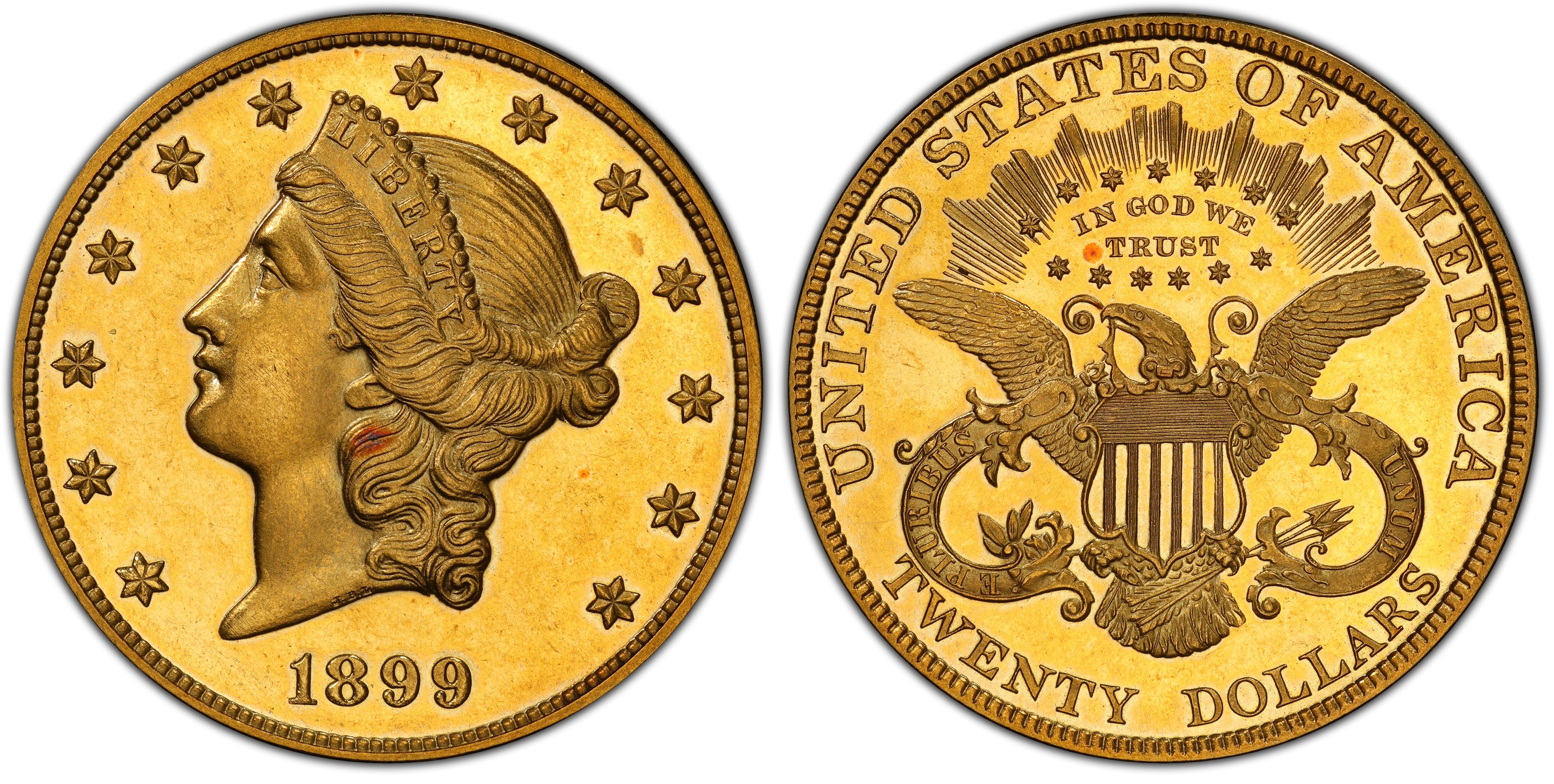
PCGS PR62

PCGS PR55
- PCGS #:
- 9115
- Designer:
- James Barton Longacre
- Edge:
- Reeded
- Diameter:
- 34.00 millimeters
- Weight:
- 33.40 grams
- Mintage:
- 84
- Mint:
- Philadelphia
- Metal:
- 90% Gold, 10% Copper
- Auction Record:
- $109,250 • GEM PR • 03-01-2005 • Stack's
Rarity and Survival Estimates Learn More
| Survival Estimate | |
|---|---|
| All Grades | 32 |
| 60 or Better | 31 |
| 65 or Better | 10 |
| Numismatic Rarity | |
|---|---|
| All Grades | R-8.8 |
| 60 or Better | R-8.8 |
| 65 or Better | R-9.5 |
| Relative Rarity By Type All Specs in this Type | |
|---|---|
| All Grades | 20 / 31 TIE |
| 60 or Better | 20 / 31 TIE |
| 65 or Better | 23 / 31 TIE |
| Relative Rarity By Series All Specs in this Series | |
|---|---|
| All Grades | 42 / 55 TIE |
| 60 or Better | 41 / 55 TIE |
| 65 or Better | 38 / 55 TIE |
The 1899 Liberty Head Double Eagle Proof
The Philadelphia Mint utilized a single die pair to strike just 84 1899 Liberty Head Double Eagle Proofs (Base #9115), of which an estimated 40 to 45 examples survive. In Walter Breen's Encyclopedia of United States and Colonial Proof Coins, 1722–1989 (1989), the author opines that approximately 80 pieces from the original mintage were struck specifically for inclusion in gold Proof Sets. Whether this assertion is accurate is of little consequence today, as those sets were broken up long ago.
Breen’s tenure as a numismatic sage and market analyst largely predated the modern "slab era," and while not all of his research has survived the scrutiny of contemporary scholarship, his insights into market behavior remain invaluable. These assertions are backed by his experience as a well-connected veteran of the coin show circuit and an auction cataloger for several of the era's leading firms. Though Proof gold may have been underappreciated in the 1950s, it is clear that collector sentiment has undergone a radical transformation in the decades since.
Collecting the 1899 Liberty Head Double Eagle Proof
The 1899 Liberty Head Double Eagle Proof was struck using a single die pair. As noted by John Dannreuther, die polishing on Liberty's face is typical for this issue. Under magnification, a small raised "anomaly" is visible beneath Liberty's ear; this feature was transferred from the hub and is present across multiple dies. All known examples exhibit a perfect obverse die state, though the intensity of the frost and the sharpness of the strike vary.
The reverse die was new for 1899 and appears in both perfect and lapped states. Examples struck from lapped dies show thinning or loss of detail in the eagle’s right tail feathers. Generally, the frost on 1899 Proofs is less intense than on issues from the preceding years - a disappointing trend that persisted through the early 1900s.
Refining Our Understanding of 19th-Century Proofs in the Slab Era
Coin certification provided collectors the opportunity to develop a newfound appreciation for these scarce 19th-century issues. Forty years of PCGS certification and the advent of high-resolution digital photography have provided a much clearer picture of the survival rates for coins like the 1899 $20 Proof. However, a review of current population data reveals an interesting quirk in the evolution of grading culture: most of the Condition Census examples designated as "Proof" (those without Cameo or Deep Cameo attributions) have likely been cracked out and resubmitted for regrading.
This is evidenced by the fact that 12 of the 18 records currently in our data as of May 6, 2026, represent coins graded in or before the year 2000. That figure increases to 14 if one includes submissions from 2006 and 2010. Furthermore, these specific records lack modern auction data, suggesting these coins have not appeared publicly in the online era.
Given this evidence, collectors and dealers should not assume that a "reserve" of ten or so coins exists in old Proof holders. A more accurate estimate suggests that 20 to 22 examples are currently in PCGS holders, with perhaps an equal number encapsulated by competing services.
* * *