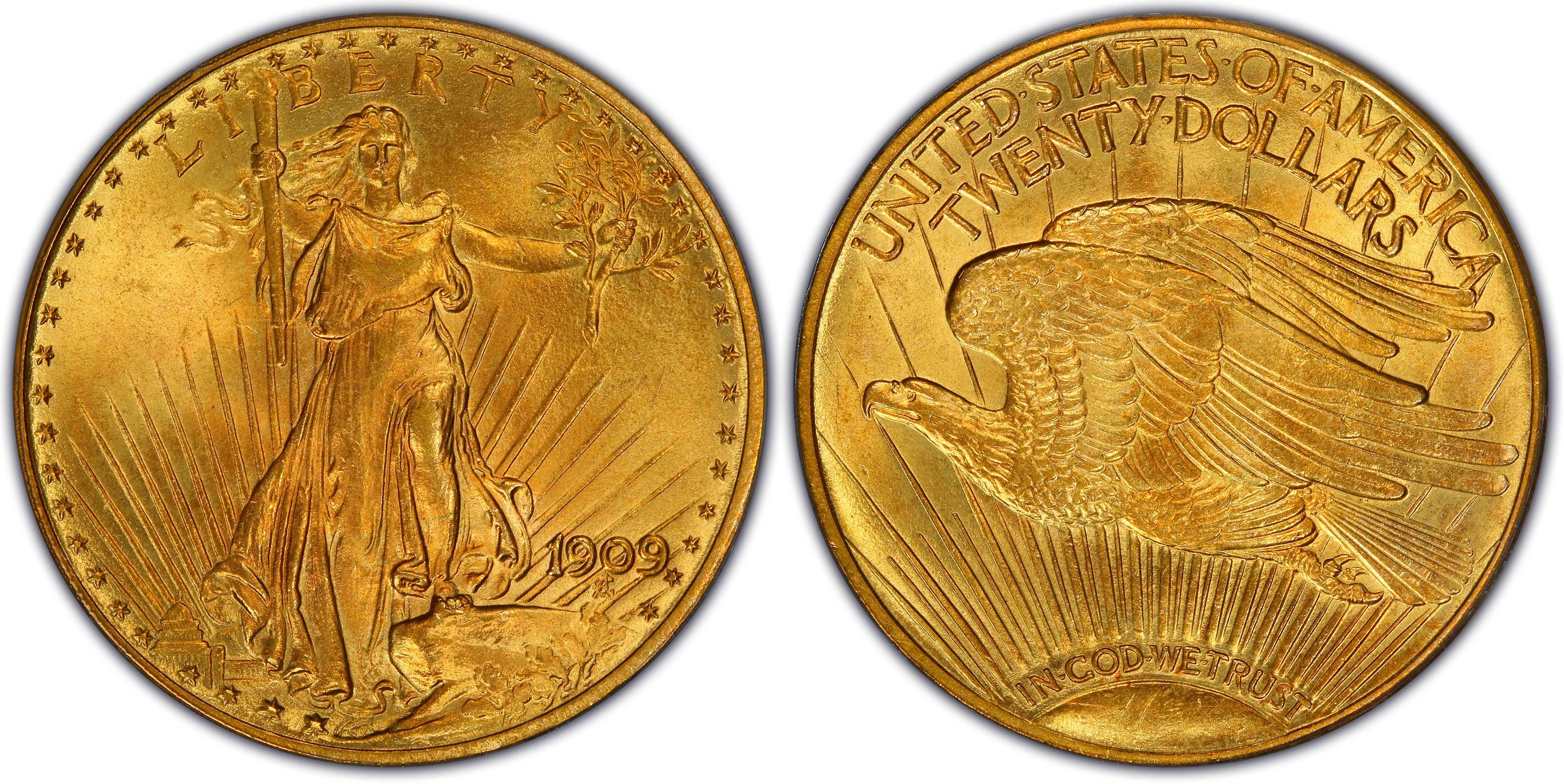
1909 $20 (Regular Strike)
Series: St. Gaudens $20 1907-1933

PCGS MS66+

PCGS MS66+
PCGS MS66+
- PCGS #:
- 9150
- Designer:
- Augustus Saint Gaudens
- Edge:
- Lettered
- Diameter:
- 34.00 millimeters
- Weight:
- 33.40 grams
- Mintage:
- 161,215
- Mint:
- Philadelphia
- Metal:
- 90% Gold, 10% Copper
- Auction Record:
- $312,000 • MS66 • 05-08-2022 • Heritage Auctions
Go To Grade
Current Auctions - PCGS Graded
Current Auctions - NGC Graded
For Sale Now at Collectors Corner - PCGS Graded
For Sale Now at Collectors Corner - NGC Graded
Rarity and Survival Estimates Learn More
| Survival Estimate | |
|---|---|
| All Grades | 9,833 |
| 60 or Better | 4,500 |
| 65 or Better | 50 |
| Numismatic Rarity | |
|---|---|
| All Grades | R-3.0 |
| 60 or Better | R-4.1 |
| 65 or Better | R-8.5 |
| Relative Rarity By Type All Specs in this Type | |
|---|---|
| All Grades | 22 / 49 |
| 60 or Better | 22 / 49 |
| 65 or Better | 20 / 49 TIE |
| Relative Rarity By Series All Specs in this Series | |
|---|---|
| All Grades | 24 / 54 |
| 60 or Better | 23 / 54 |
| 65 or Better | 20 / 54 TIE |
Condition Census What Is This?
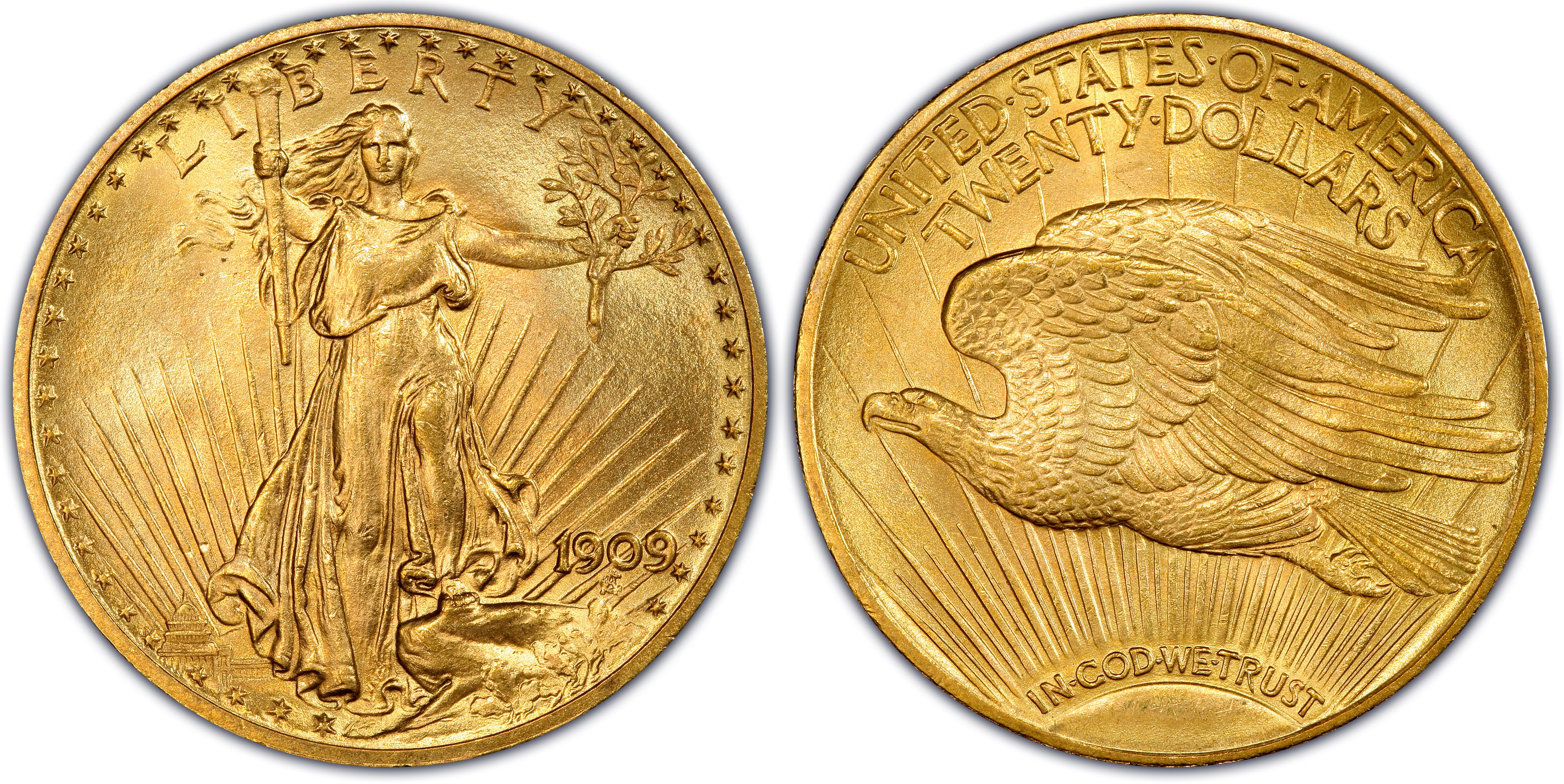
 #1 MS66+ PCGS grade
Jay Brahin Collection - John Kutasi Collection - Heritage 1/2007:3266, $74,750 - “Fox” Collection |
 #2 MS66 PCGS grade
David Akers - Dr. & Mrs. Steven L. Duckor Collection - Heritage 1/2012:4608, $74,750 - “Midsouthcoin” Collection (PCGS Set Registry) |
 #2 MS66 PCGS grade
Phillip H. Morse Collection - Heritage 11/2005:6561, $126,500 - Simpson Collection |
 #2 MS66 PCGS grade
|
 #2 MS66 PCGS grade
Heritage 9/2013:6911, $70,500 - “A&A Sainbts” Collection (PCGS Set Registry) |
 #2 MS66 PCGS grade
|
| #2 MS66 PCGS grade |
|
#8 MS65+ PCGS grade
“Fox” Collection |
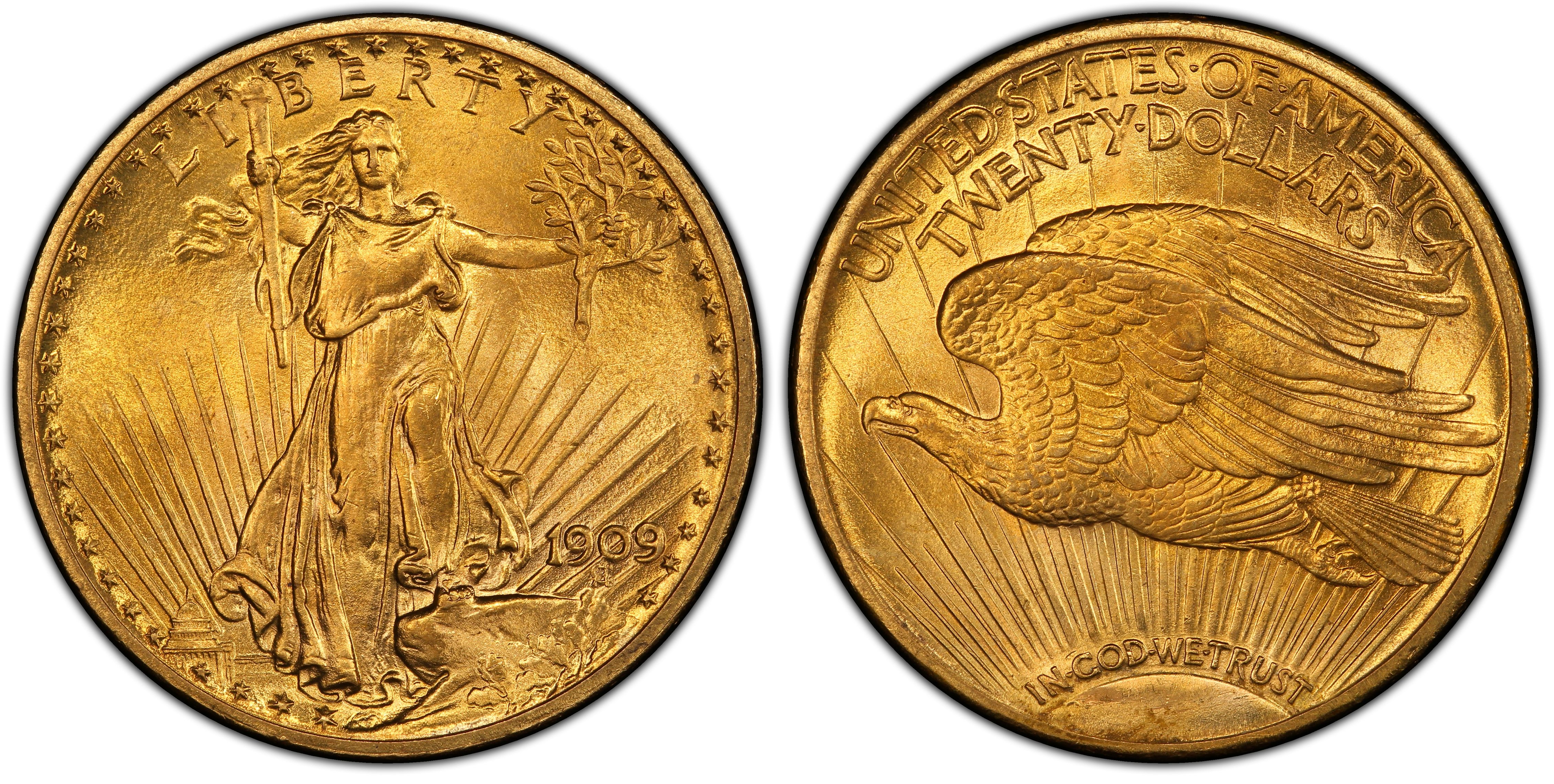 #9 MS65 PCGS grade
Heritage 9/2017:4089, $31,200 |
 #9 MS65 PCGS grade
|
David Akers (1975/88):
For years, the 1909 normal date was overshadowed by the popular 1909/8, but in the past decade or so the 1909 has come to be correctly recognized as the rarer of the two issues. Actually it is much more rare than the 1909/8 except possibly in gem condition where the two are of similar rarity. Unlike the 1909/8 which is often seen in VF or EF, the 1909 is normally available only in AU or Unc. This issue, along with the other early Philadelphia Mint issues from 1908 With Motto through 1915 (plus the 1920 as well), is very underrated in high grade. I have seen fewer Mint State examples of this issue than I have of any of the others, including the 1913, although there are a few more MS-64 or better quality examples in existence of this issue than there are of either the 1913 or the 1920. Nearly all of the known Mint State specimens of this issue are low quality, i.e. MS-60 to 62. Even in MS-63, the 1909 is a rarity, and above that level, especially in gem condition, the 1909 is one of the rarest issues of the entire series. A couple of superb quality Mint State pieces exist that are very nearly perfect, the nicest one I have seen trading hands in the 1980 bull market for a reported $30,000 plus. This specimen and the few others I have seen have a strong resemblance to a satin finish Proof, albeit with a bit less lustre. Dr. Thaine Price owns one of the nicest frosty ones I have seen, a solid MS-65 coin, and a prominent Eastern collector owns another of similar quality.
The 1909 is always very sharply struck. Some specimens are frosty; others have a definite satiny texture. A few of the high-grade ones look very similar to the Proofs of this year. Lustre is nearly always very good, especially on the satiny ones, and the color is typically a light to medium yellow or greenish yellow gold. There are also some examples that have a very appealing light to medium orange gold color.
The 1909 is always very sharply struck. Some specimens are frosty; others have a definite satiny texture. A few of the high-grade ones look very similar to the Proofs of this year. Lustre is nearly always very good, especially on the satiny ones, and the color is typically a light to medium yellow or greenish yellow gold. There are also some examples that have a very appealing light to medium orange gold color.