2023-P 25C Bessie Coleman (Regular Strike)
Series: American Women Quarters (2022 - 2025)

PCGS MS67
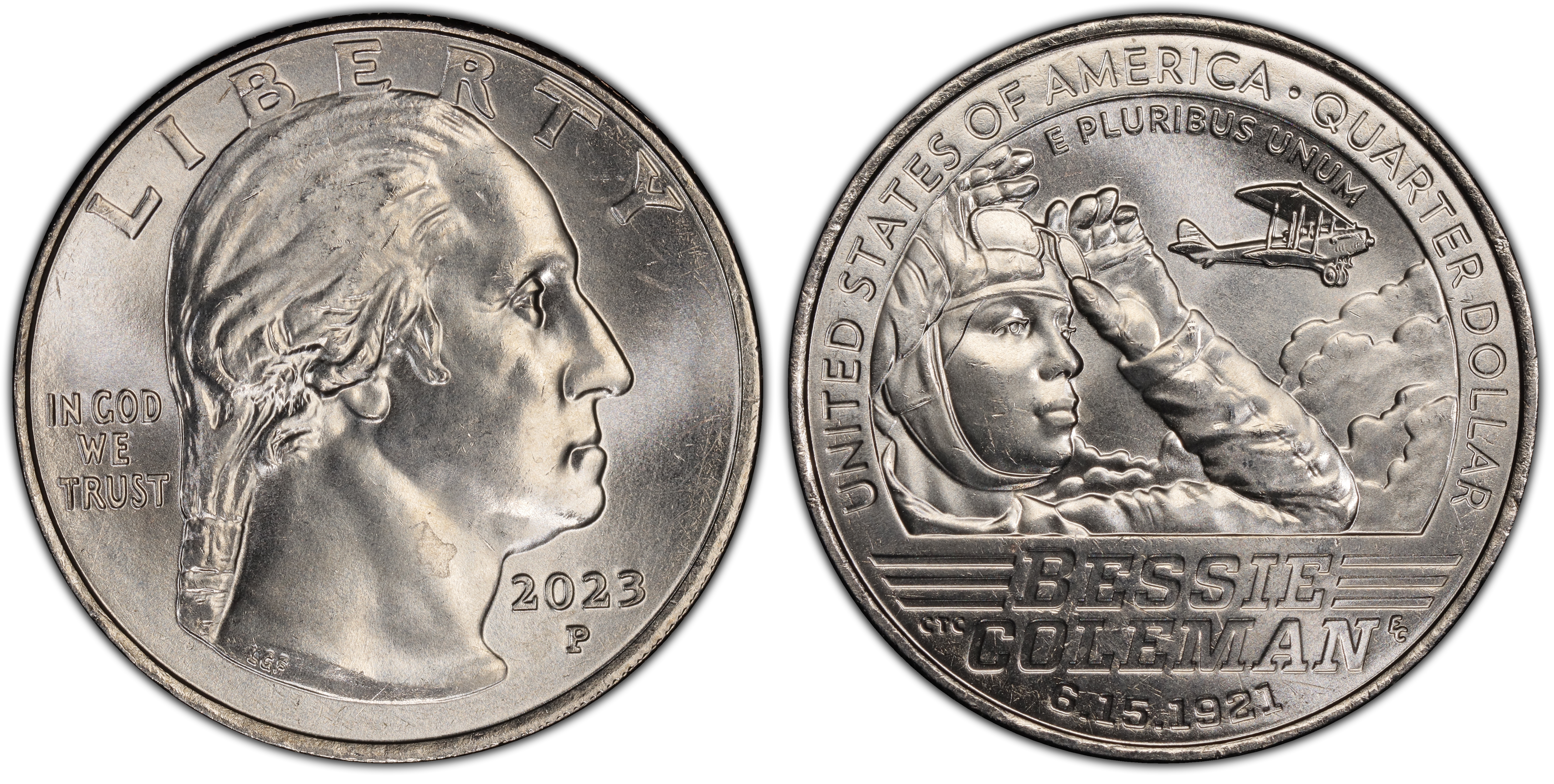
PCGS MS67

PCGS MS66
- PCGS #:
- 916705
- Designer:
- N/A
- Edge:
- Plain
- Diameter:
- 24.26 millimeters
- Weight:
- 5.67 grams
- Mintage:
- N/A
- Mint:
- N/A
- Metal:
- Copper-Nickel
- Auction Record:
- $46 • MS66 • 02-20-2023 • eBay
Major Varieties
- 2023-P 25C Bessie Coleman
The 2023-P Bessie Coleman Quarter
Aside from the one-year "Washington Crossing the Delaware" reverse in 2021, the United States Mint has maintained a steady stream of rotating commemorative quarters since 1999. Following the massive success of the 50 State Quarters and America the Beautiful programs, the American Women Quarters series has captured significant collector interest. This enthusiasm likely stems from the series' shift toward honoring human legacies rather than landmarks, utilizing innovative designs to tell the stories of diverse trailblazers.
The 2023 Bessie Coleman Quarter (#916705) serves as the inaugural release of the program’s second year and the sixth coin overall in the 20-coin series (authorized by Public Law 116-330).
Queen Bess, Daredevil Aviatrix
Elizabeth “Bessie” Coleman was a pioneer who shattered racial and gender barriers to become the first African American and Native American woman to earn a pilot’s license. Born in 1892 to a family of Texas sharecroppers, Coleman’s journey from the cotton fields of Waxahachie to the skies was fueled by an aptitude for mathematics and an indomitable will.
When American flight schools refused her admission based on the color of her skin and her gender, Coleman refused to yield. Supported by benefactors like Robert S. Abbott, founder of the influential Chicago Defender, she learned French and traveled to France in 1920. By June 1921, she had secured her international pilot’s license. To make a living in an era of limited opportunities, she underwent further stunt-pilot training in Europe before returning to the U.S. as a flying sensation as a woman who "flirts with death in her airplane."
Coleman's first airshow in America was held on Long Island in 1922, to honor the the all-Black 369th Infantry Regiment. Her preferred aircraft was the Curtiss JN-4 biplane, the same model made famous by the "Inverted Jenny" postage stamp. With her national celebrity, Coleman used her platform to champion civil rights, famously refusing to perform at venues that practiced segregation.
Tragically, Coleman’s life was cut short on April 30, 1926, during a rehearsal flight in Jacksonville, Florida. She was not piloting the aircraft at the time but was in the passenger seat, unbuckled so she could lean over the fuselage to survey the ground for a planned parachute demonstration. During the flight, a wrench that had been left in the cockpit slid into the control gears, jamming them and causing the plane to suddenly accelerate and pitch into an unexpected dive and flip upside down. With nothing to secure her, Coleman was thrown from the aircraft at an altitude of approximately 2,000 feet. The pilot, William Wills, also perished when the plane crashed into a nearby field. The tragedy was compounded when a witness at the crash site lit a match, accidentally igniting gasoline seeping from the ruptured tanks; the resulting fire consumed the wreckage and burned Wills' body beyond recognition.
Coleman's death was a major blow to the Black community; a memorial was held for her on May 2, 1926, in Jacksonville, before her body was transported to Chicago for a larger service led by the legendary journalist Ida B. Wells.
The 2023 Bessie Coleman Quarter Release
Nearly a century after her final flight, Coleman's legacy was memorialized as part of the Mint's effort to honor women who changed the course of American history. The Bessie Coleman Quarter officially entered circulation in late January 2023. For collectors, the Mint offered several specialized products starting February 14, 2023:
- 100-Coin Bags: Uncirculated business strikes from Philadelphia (P) or Denver (D) priced at $40.00.
- Two-Roll Sets: One roll each from P and D (80 coins total) for $36.00.
- Three-Roll Sets: A premium set including P, D, and the not issued for circulation San Francisco (S) for $54.00.
* * *