1909 $20 (Proof)
Series: St. Gaudens $20 1907-1915
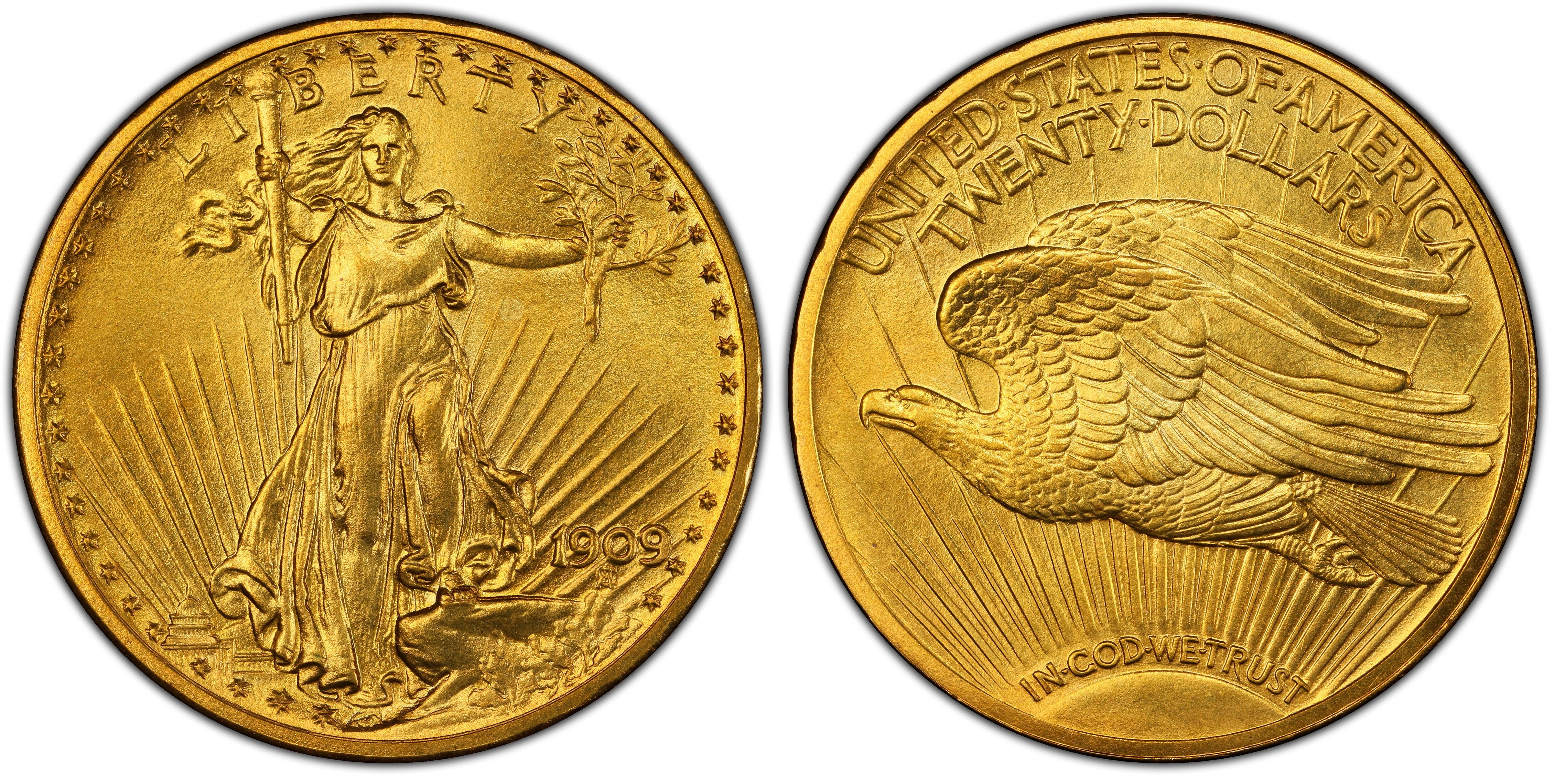
PCGS PR67
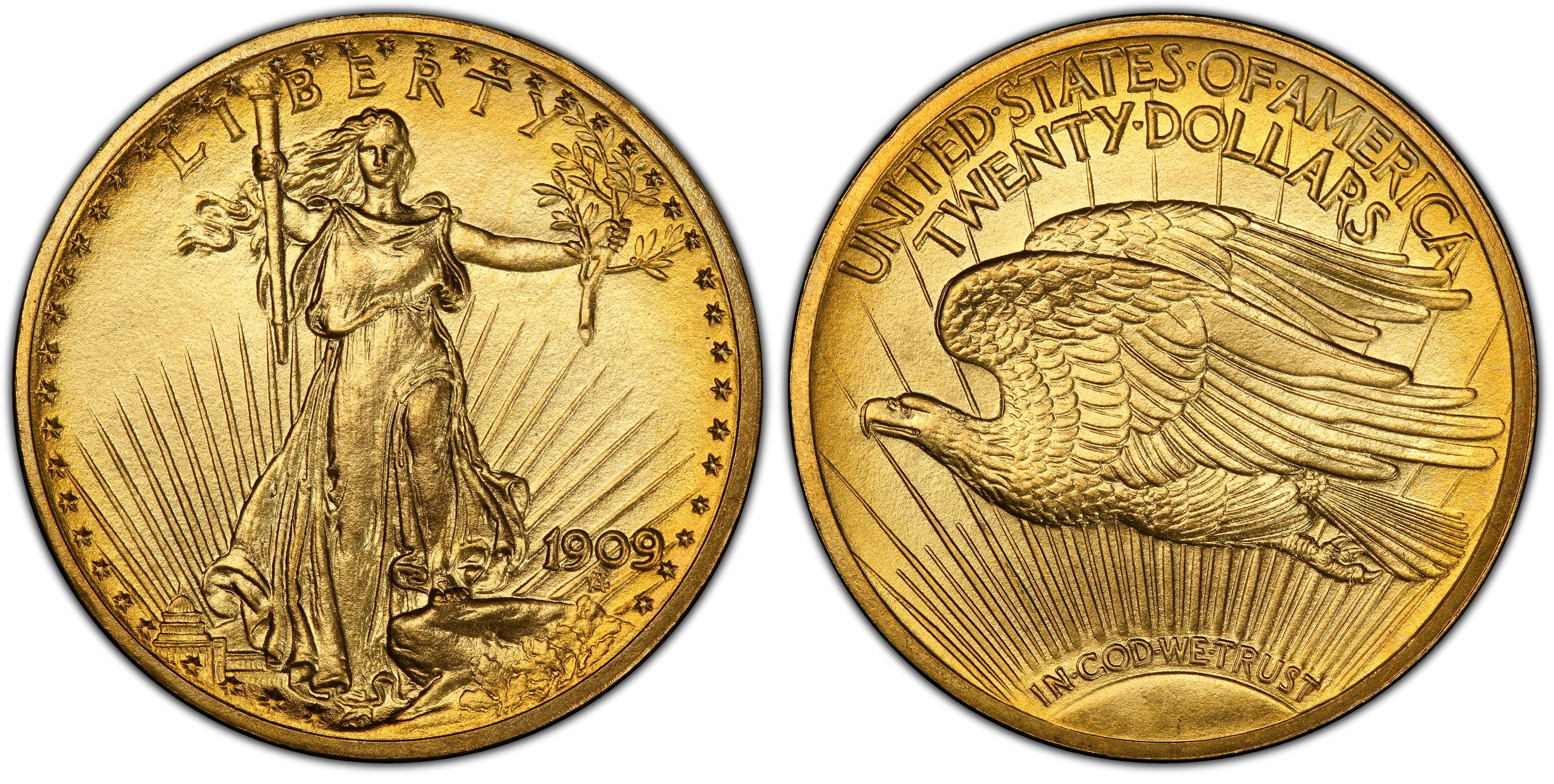
PCGS PR67

PCGS PR66
- PCGS #:
- 9206
- Designer:
- Augustus Saint Gaudens
- Edge:
- Lettered
- Diameter:
- 34.00 millimeters
- Weight:
- 33.40 grams
- Mintage:
- 67
- Mint:
- Philadelphia
- Metal:
- 90% Gold, 10% Copper
- Auction Record:
- $336,000 • PR68 • 09-04-2025 • Stack's Bowers
Major Varieties
- 1909 $20
Rarity and Survival Estimates Learn More
| Survival Estimate | |
|---|---|
| All Grades | 43 |
| 60 or Better | 44 |
| 65 or Better | 17 |
| Numismatic Rarity | |
|---|---|
| All Grades | R-8.6 |
| 60 or Better | R-8.6 |
| 65 or Better | R-9.2 |
| Relative Rarity By Type All Specs in this Type | |
|---|---|
| All Grades | 5 / 9 |
| 60 or Better | 5 / 9 |
| 65 or Better | 3 / 9 TIE |
| Relative Rarity By Series All Specs in this Series | |
|---|---|
| All Grades | 10 / 14 |
| 60 or Better | 10 / 14 |
| 65 or Better | 8 / 14 TIE |
Condition Census What Is This?
 #1 PR67+ PCGS grade
|
|
#2 PR67 PCGS grade
Sam & Rie Bloomfield Collection - Sotheby’s 12/1996:35, $46,200 - Philip Morse Collection - Heritage 11/2005:6563, $195,500 - Heritage 1/2006:3630, $184,000 - Burgess Lee Berlin, M.D., J.D. Collection - Heritage 1/2018:5186, $228,000 |
|
#2 PR67 PCGS grade
|
| #2 PR67 PCGS grade |
|
#5 PR67 PCGS estimated grade
Possibly Sotheby's 6/1993:185, $118,250 - Tacasyl Collection - Bonham’s 9/2013:1025, $184,860 |
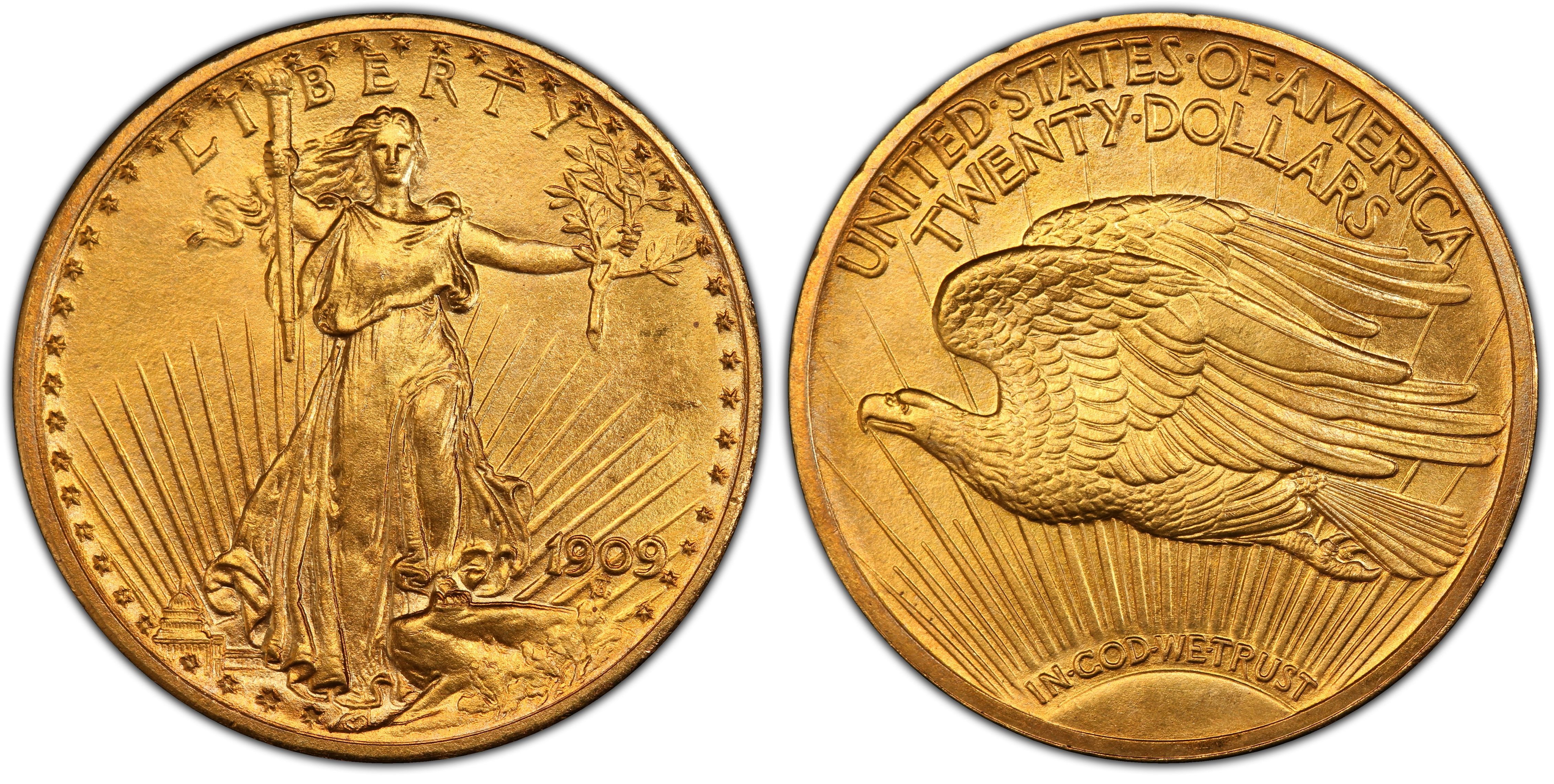 #6 PR66 PCGS grade
Heritage 7/1994:7720 - Legend Numismatics, sold privately in 1994 - “1994 Collection” (PCGS Set Registry) - Legend Rare Coin Auctions 7/2017:43, $193,875 |
|
#6 PR66 PCGS grade
Stack's/Bowers 8/2015:10288, $99,875 |
 #6 PR66 PCGS grade
|
|
#9 PR66 estimated grade
Stack's/Bowers 8/2011:7801, $132,250 |
| #10 PR65 PCGS grade |
The Proof 1909 $20 is a rare coin that suffered from a lack of interest because of the unusual matte finish (collectors preferred than, as they do now, the brilliant and cameo finishes of previous years) and the high face value that represented a significant sum of money in 1909. Thus, very few were made, few were sold, and even fewer were cared for properly after the fact. The premium charged by the government for Matte Proof gold coins in 1909 was such a small amount over the face value that there was no significant loss if the coins were spent, nor was there any great profit incentive to hold them for future gains. Who knew then that they would be so desirable and valuable today?
Once or twice a year, a 1909 Proof $20 will cross the auction block, but it is difficult to determine how many of these are reappearances of the same coin. The lack of sufficient pedigree markers and pervasive conservation makes plate-matching problematic. Nonetheless, a guesstimate of 40 to 50 survivors out of the original mintage of 67 seems reasonable, if not a trifle high.
The finest example of a Proof 1909 $20 is the NGC PR68 that sold for $184,860 in 2013. However, the price record belongs to the PCGS PR67 Morse Collection example that sold in 2005 for $195,500.