1928 50C Hawaiian (Regular Strike)
Series: Silver Commemoratives

PCGS MS67+

PCGS MS67+

PCGS MS67+
- PCGS #:
- 9309
- Designer:
- Juliette May Fraser & Chester Beach
- Edge:
- Reeded
- Diameter:
- 30.60 millimeters
- Weight:
- 12.50 grams
- Mintage:
- 9,958
- Mint:
- Philadelphia
- Metal:
- 90% Silver, 10% Copper
- Auction Record:
- $96,000 • MS67 • 08-31-2022 • Stack's Bowers
Major Varieties
- 1928 50C Hawaiian
Rarity and Survival Estimates Learn More
| Survival Estimate | |
|---|---|
| All Grades | 7,750 |
| 60 or Better | 6,200 |
| 65 or Better | 1,325 |
| Numismatic Rarity | |
|---|---|
| All Grades | R-3.4 |
| 60 or Better | R-3.7 |
| 65 or Better | R-4.8 |
| Relative Rarity By Type All Specs in this Type | |
|---|---|
| All Grades | 60 / 144 TIE |
| 60 or Better | 54 / 144 TIE |
| 65 or Better | 20 / 144 TIE |
| Relative Rarity By Series All Specs in this Series | |
|---|---|
| All Grades | 60 / 144 TIE |
| 60 or Better | 54 / 144 TIE |
| 65 or Better | 20 / 144 TIE |
Condition Census What Is This?
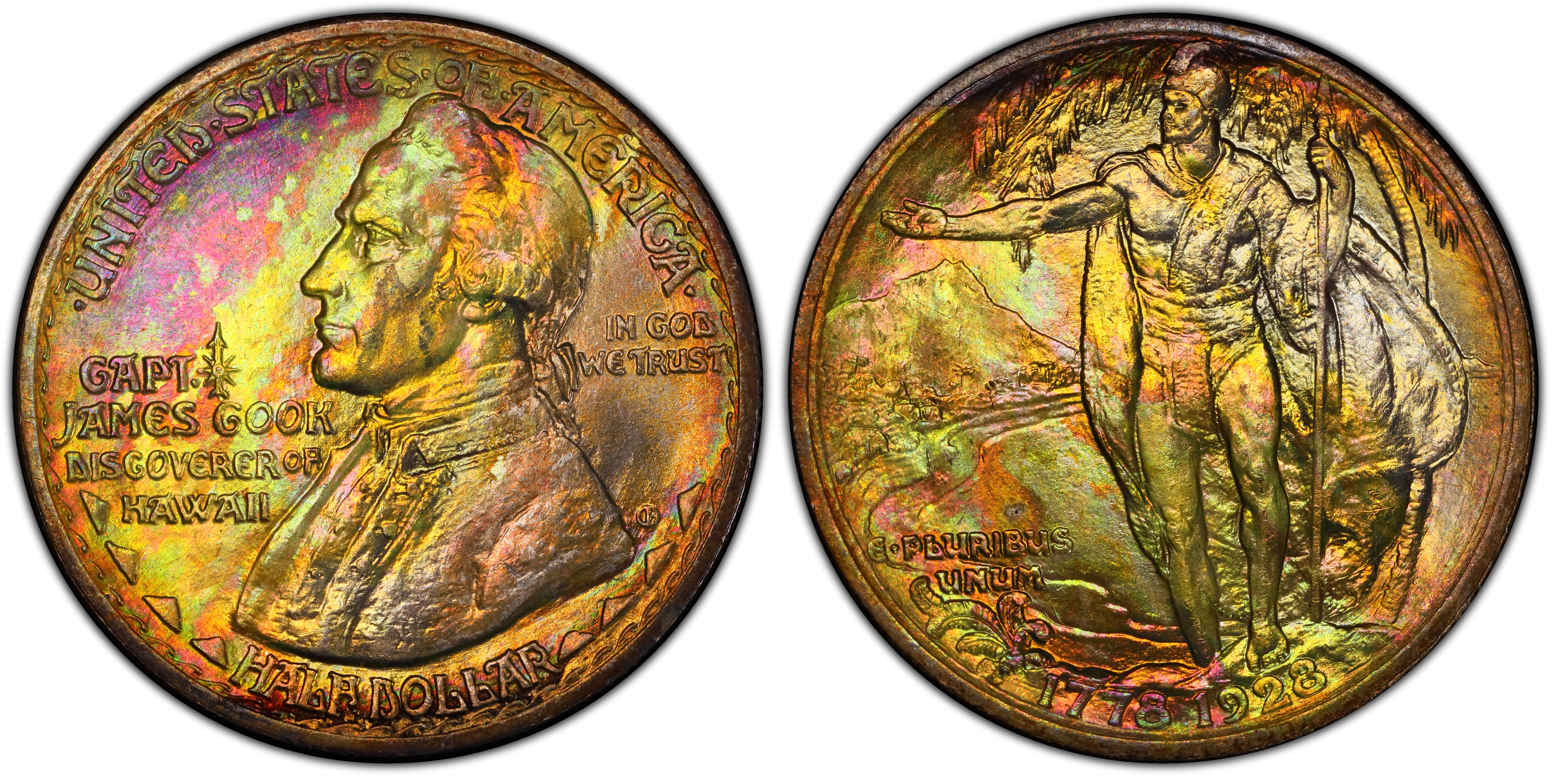 #1 PCGS MS67+
As PCGS MS67 CAC #44627525. Stack’s Bowers, August 24, 2022, Lot 7230 – $96,000. Vivid rainbow toning on both sides. Thin hit on the cheek and vertical hit on the jawline. On the reverse, there is a small carbon spot above B in PLURIBUS. |
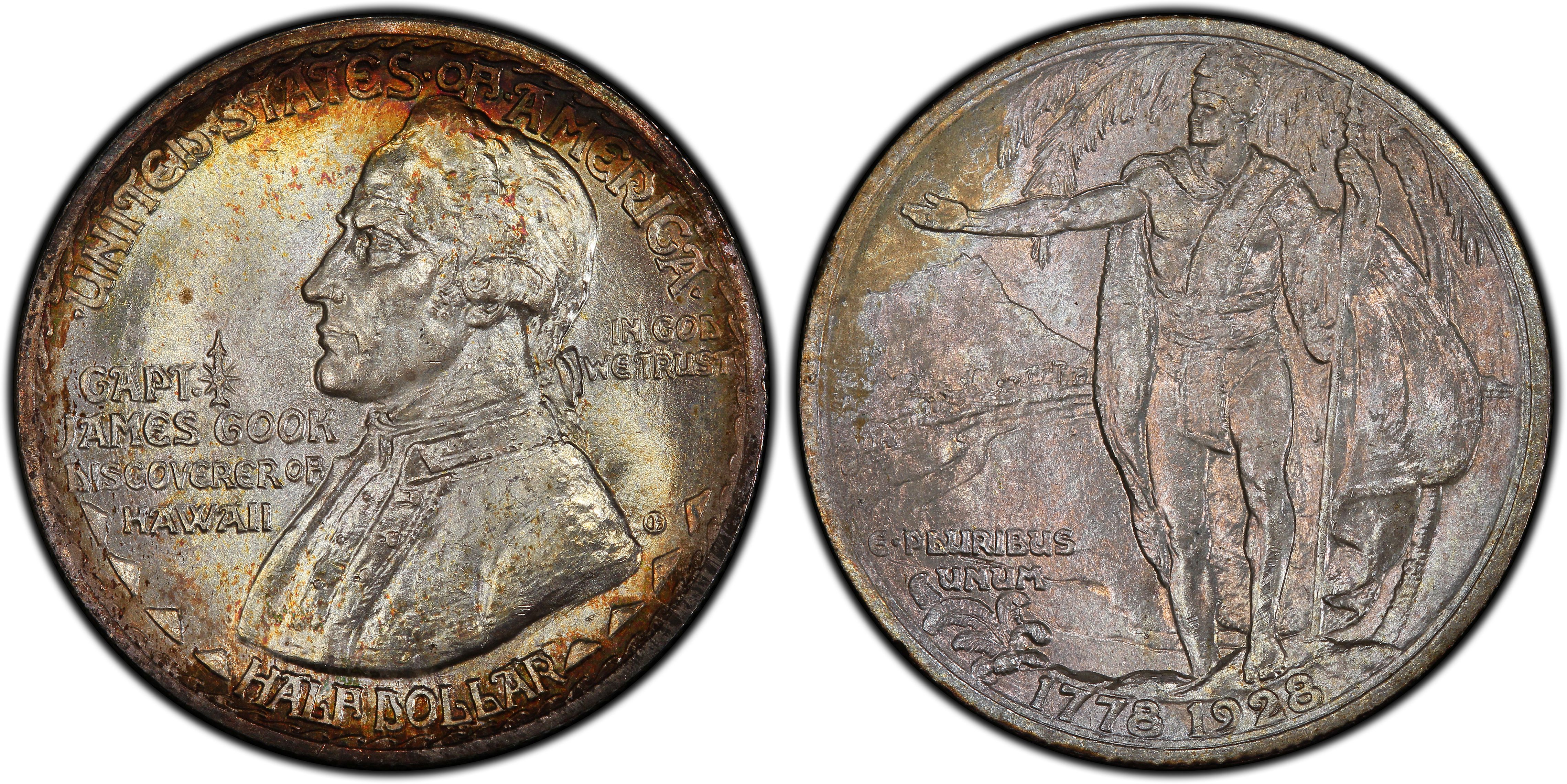 #1 PCGS MS67+
As PCGS MS67 #21765014: “The Bruce Scher Collection,” Heritage Auctions, February 24, 2005, Lot 4158 – $46,000. Top pop, pop one coin when sold. “The Cary & Cheryl Porter Collection,” Heritage Auctions, May 10, 2007, Lot 2529 – $54,625. As PCGS MS67+ #40450816. "The J & L Commemorative Type Set II" (PCGS Set Registry). Gold rim toning. Vivid gold and coppery toning along the obverse periphery. The reverse is toned mauve with gold along the upper left border. |
 #1 PCGS MS67+
"The J & L Commemorative Type Set" (PCGS Set Registry). |
|
#1 PCGS MS67+
|
 #5 PCGS MS67
GreatCollections, September 18, 2022, Lot 1146249 – $55,687.50. Splashes of gold toning dominates the upper left and full right side of the oberse. Copper toning along the right periphery from 3 to 4 o'clock. To darker toning areas under STA. |
|
#5 PCGS MS67
Heritage Auctions, January 5, 2017, Lot 6112 – $39,950. Olive gold and russet toning dominates the obverse and reverse. Lighter area to the left of Cook's face. |
 #5 PCGS MS67
|
1928 Hawaiian Sesquicentennial Half Dollar
The 1928 Hawaiian Sesquicentennial Half Dollar (#9309) was struck to commemorate the 150th anniversary of Captain James Cook’s arrival at the Hawaiian Islands in 1778. While the legislation framed this as a "discovery," the indigenous population was, of course, well-established long before Cook's arrival.
Design and Symbolism
The coin was designed by Honolulu-born painter Juliette May Fraser and engraved by sculptor Chester Beach.
- Obverse: Features the profile of Captain James Cook facing left toward a ship's needle (compass). Eight triangles represent the eight main Hawaiian islands. Beach’s initials, CB, are located at the base of the bust.
- Reverse: Depicts a Hawaiian chieftain in ceremonial dress standing on a cliffside, overlooking the iconic Diamond Head landmark.
Production and Distribution
In June 1928, the Philadelphia Mint struck the total mintage of 10,008 pieces. The distribution was split, with approximately half shipped to Hawaii and the remainder sold on the U.S. mainland. To prevent hoarding, a five-coin limit was placed on individual orders. Notably, 200 specimens were initially held back for special presentation purposes, among them 50 Sandblast Proofs.
Collecting the Hawaiian Half Dollar
The Hawaiian Sesquicentennial is notoriously difficult to find in high grades due to widespread mishandling. The first points to show wear or "stacking" friction are Captain Cook’s cheekbone and the chieftain’s fingers on the reverse.
Because of its high value and scarcity, the issue has been frequently counterfeited. Collectors should note:
- Prooflike Fakes: No genuine Prooflike (PL) specimens exist; any coin with mirrored fields is a counterfeit.
- Sandblast Fakes: Counterfeit sandblast proofs often exhibit a distinct yellowish tint that differs from the matte grey-gold luster of the 50 genuine sandblast proofs.
Vintage Market Snippets
The coin has been a "blue chip" commemorative since its inception. Early market highlights include:
- 1936: Dealer William Rabin advertised examples for $12.50—at the time, only the 1915-S Panamana-Pacific Half Dollar (#9357) commanded a higher price ($15). Simultaneously, Tatham Coin Co. offered them for $11.
- The Ripstra Hoard: According to PCGS Hall of Fame dealer Abe Kosoff, Chicago collector J. Henri Ripstra nearly cornered the market, eventually offering Kosoff a lot of 800 pieces at $20 each.
- 1964: By the mid-1960s, the market price had climbed to $600 per coin, signaling its transition into the upper echelon of U.S. commemoratives.
* * *
The Hawaiian commemorative half dollar, struck to commemorate the sequicentennial (150th anniversary) of Captain Cook's landing in the Hawaiian Islands in 1778, was a rousing success. Unlike many other silver commemoratives, especially those struck in the "abusive" commemorative era of 1935-1939, the Hawaiian was a legitimate anniversary, a relatively low mintage coin, and a "honestly" distributed issue. The Hawaiian halves were sold at an issue price of $2 by the Bank of Hawaii. The original 10,008 coins minted sold out immediately, even though the $2 issue price was the highest of any commemorative half dollar to that point.
The Hawaiian half dollars were widely distributed and, because of thier relatively low type mintage and earlier issue date, they are somewhat rare today. They have always been considered a key issue to the silver commemorative series and they have always had good collector demand. The typical Hawaiian is well-struck and relatively mark-free. Toning can be an issue with Hawaiian halves so eye appeal is very important. Most Hawaiians have semi-frosty/semi-satin luster. But many are toned to various degrees, some quite attractively, but some pretty dark and dingy. Again, eye appeal is critical with this issue.
Note that 50 examples were struck as matte-proofs (see coin# 9310).