1938 50C New Rochelle (Regular Strike)
Series: Silver Commemoratives

PCGS MS68+

PCGS MS68+

PCGS MS68+
- PCGS #:
- 9335
- Designer:
- Gertrude K. Lathrop
- Edge:
- Reeded
- Diameter:
- 30.60 millimeters
- Weight:
- 12.50 grams
- Mintage:
- 15,266
- Mint:
- Philadelphia
- Metal:
- 90% Silver, 10% Copper
- Auction Record:
- $19,550 • MS68* • 07-27-2002 • Heritage Auctions
Rarity and Survival Estimates Learn More
| Survival Estimate | |
|---|---|
| All Grades | 13,000 |
| 60 or Better | 10,000 |
| 65 or Better | 6,000 |
| Numismatic Rarity | |
|---|---|
| All Grades | R-2.9 |
| 60 or Better | R-3.0 |
| 65 or Better | R-3.8 |
| Relative Rarity By Type All Specs in this Type | |
|---|---|
| All Grades | 84 / 144 TIE |
| 60 or Better | 88 / 144 TIE |
| 65 or Better | 98 / 144 TIE |
| Relative Rarity By Series All Specs in this Series | |
|---|---|
| All Grades | 84 / 144 TIE |
| 60 or Better | 88 / 144 TIE |
| 65 or Better | 98 / 144 TIE |
Condition Census What Is This?
|
#1 PCGS MS68+
"The J & L Commemorative Type Set" (PCGS Set Registry). Magenta, orange, and peacock green toning on both sides. |
 #1 PCGS MS68+
"The Gregg Bingham Collection of Silver Commemoratives," GreatCollections, June 19, 2022, Lot 1157816 - $37,125; "The JFM57 Collection" (PCGS Set Registry). Obverse and reverse are dominated by orange and blood-orange toning. Along the bottom left of the obverse is a band of vibrant green and magenta toning. This pattern is less pronounced on the reverse, but it is present around E PLURIBUS UNUM and above HALF. |
 #1 PCGS MS68+
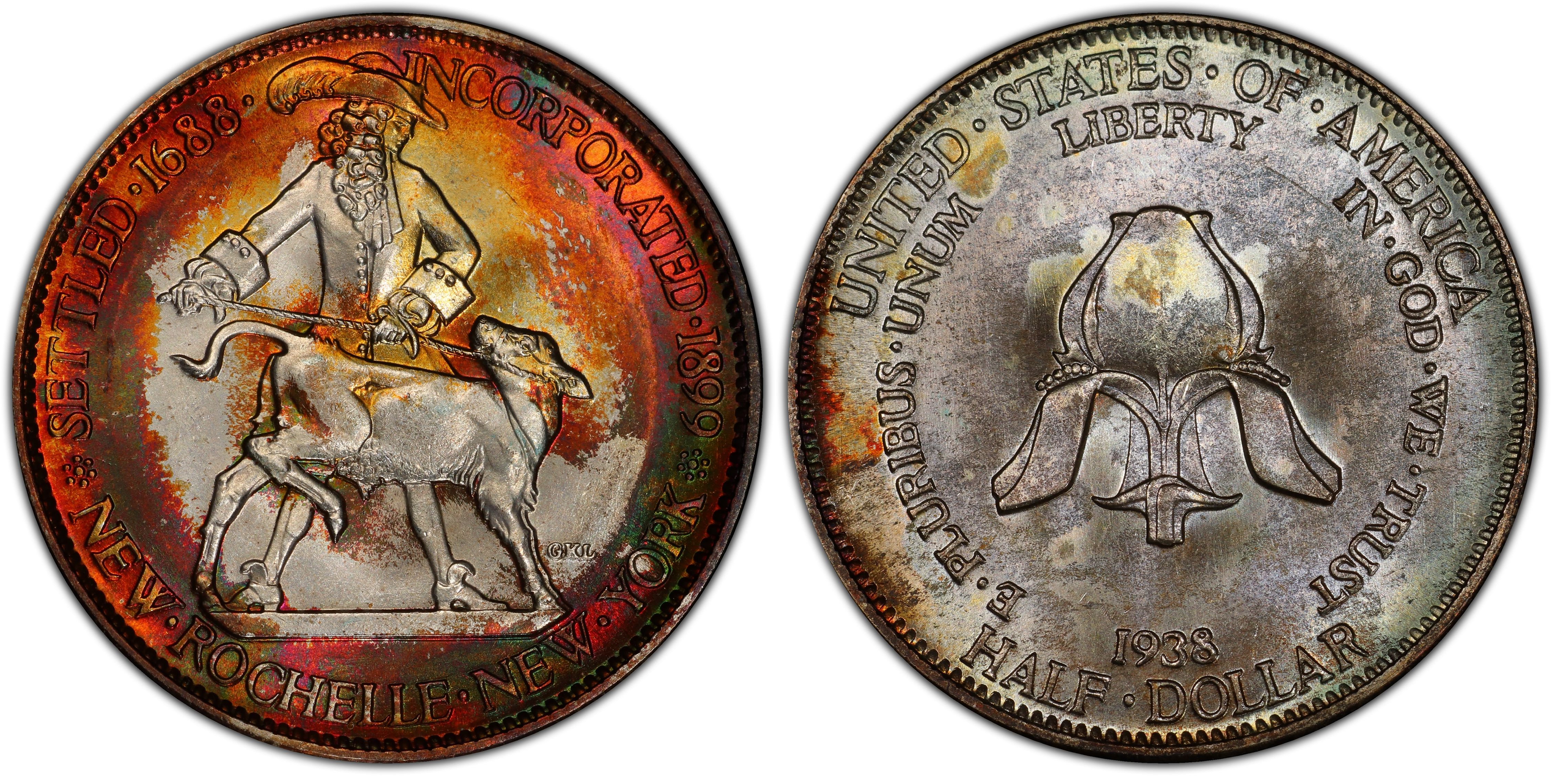
As PCGS MS67 #5562546. Heritage Auctions, July 28, 2003, Lot 9418 - $9,200. As PCGS MS68+ #36775163. Gold toning on the obverse with splashes of blood orange. The reverse features blood-orange target toning with electric-blue highlights scattered along the border. |
 #1 PCGS MS68+
|
|
#1 PCGS MS68+
|
 #6 PCGS MS68
Stack's Bowers, April 9, 2025, Lot 4801 - $4,560. Rainbow tab toning on the reverse. Satin luster throughout. |
 #6 PCGS MS68
|
 #6 PCGS MS68
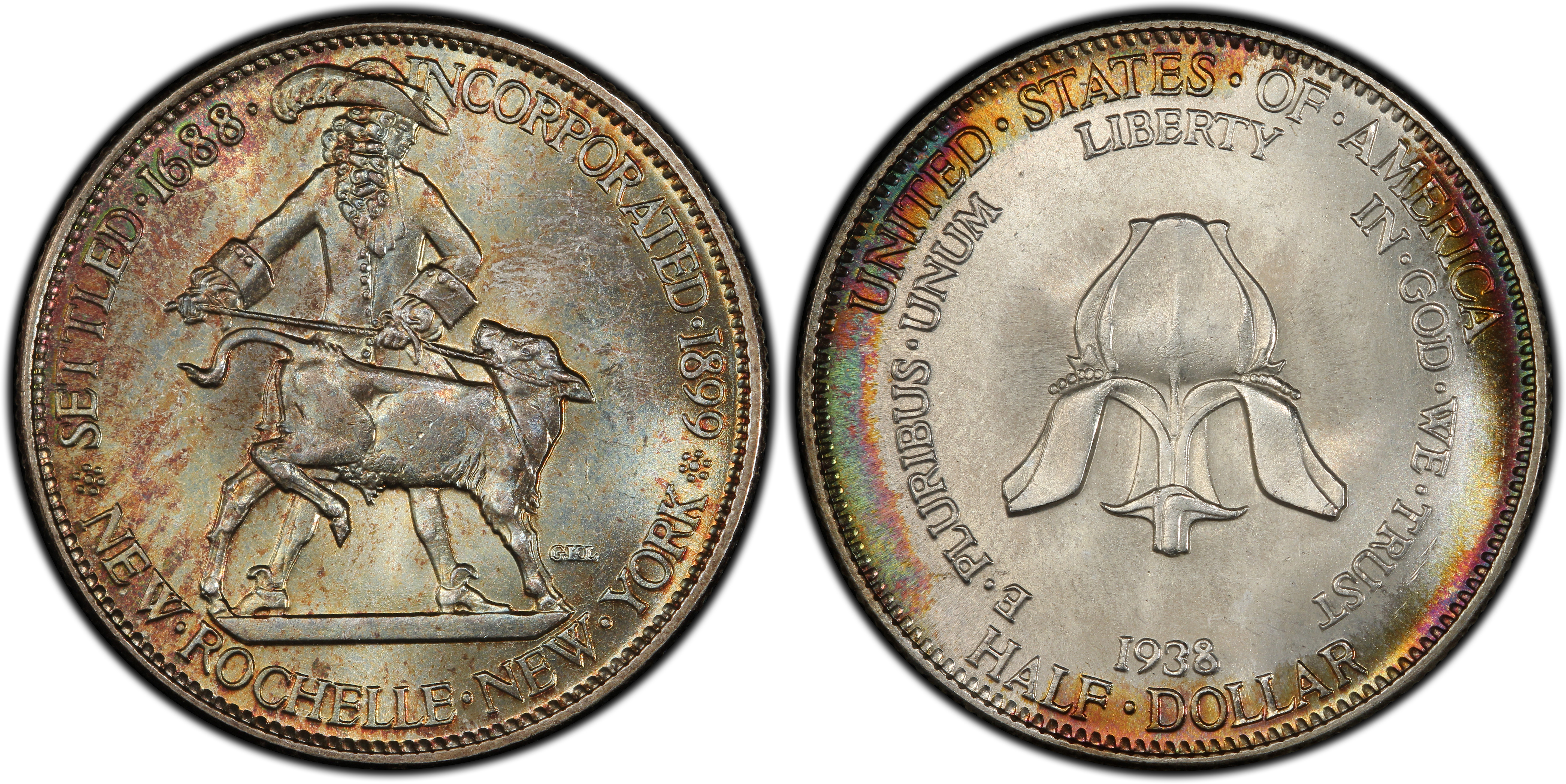
GreatCollections, June 2, 2024, Lot 1591736 - $10,780.88; Heritage Auctions, November 20, 2024, Lot 3463 - $7,800. Gold and orange tab toning along the obverse periphery. The reverse features coppery-cinnamon tab toning with a touch of peacock color at the 11 o'clock position. |
 #6 PCGS MS68
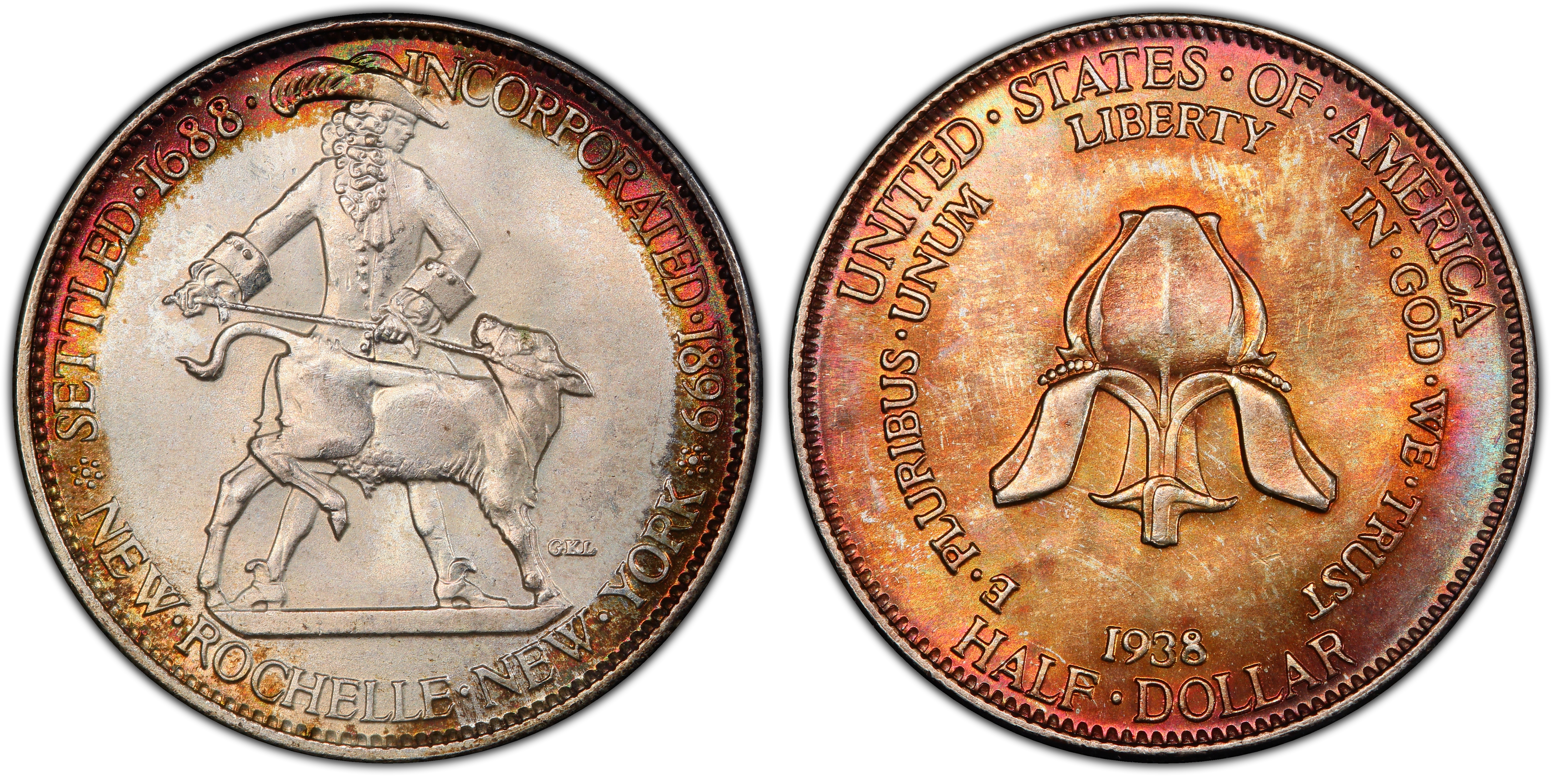
As NGC MS68 #3417047-003. Heritage Auctions, November 30, 2012, Lot 4533 - $3,290; GreatCollections, February 10, 2013, Lot 100112 - $3,060; Stack's Bowers, May 9, 2013, Lot 1482 - $3,319.38. Stack's Bowers, November 6, 2013, Lot 3401 - $3,290. As PCGS MS68 #45369705. GreatCollections, September 25, 2022, Lot 1146234 - $4,360.50; GreatCollections, August 27, 2023, Lot 1248742 - $4,486.50. "The Desert Rose Collection" (PCGS Set Registry). The obverse boasts a champagne hue dappled with russet toning (reminiscent of the surface of Jupiter). The reverse features multicolor tab toning in blood orange, with traces of peacock green, magenta, and blue. |
 #6 PCGS MS68
Stack's Bowers, August 11, 2020, Lot 1307 - $7,200. Soft satin luster. Reverse is awash in tangerine and crimson toning with a hint of blue near the 3 o'clock border. Reverse features the same coloration, but with tab toning. |
 #6 PCGS MS68
|
 #6 PCGS MS68
As PCGS MS67 #9577514. Heritage Auctions, November 2, 2013, Lot 4854 - $7,050. Old Green Holder. Satiny surfaces with a thin layer of green, gold, and rose toning in the centers, accented by intense cinnamon and green toning along the periphery. |
 #6 PCGS MS68
|
 #6 PCGS MS68
|
 #6 PCGS MS68
|
 #6 PCGS MS68
|
| #6 PCGS MS68 |
The New Rochelle 250th Anniversary Half Dollar
New Rochelle, New York, was founded in 1688. As local legend tells it, a Siwanoy Indian watched in wonder as a strange vessel rode the tranquil waters of Echo Bay, carrying a group of people unlike any he had seen before.
In historical reality, the city’s founding stems from a land deal between Huguenots fleeing religious persecution in France and John Pell, Lord of the Manor of Pelham. Acting through their agent, Jacob Leisler, the Huguenots purchased 6,100 acres for 1,625 pounds sterling. A unique provision of the deed required the Huguenots and their heirs to pay John Pell and his successors "one fatt calfe" every year on the 24th day of June (the Feast of St. John the Baptist) "yearly and every year forever, if demanded.”
Approximately 33 Huguenot families settled in the first wave. By 1700, the population had risen to roughly 250 people. In the 1800s, the town’s primary economic engine was agriculture. Steamship service, which began in the 1820s, transformed the waterfront and opened new economic opportunities, with goods traveling by water to New York City. With the arrival of the railroads, the economic structure of the town evolved again, as manufacturing businesses diversified the local economy. By the end of the century, New Rochelle had transformed from the Jeffersonian ideal of an agrarian society into a residential suburb, with hundreds of workers making the daily trip by water or train to the city for work.
Residential living brought the conveniences of leisure. The city became the home of the Thanhouser Film Corporation, where more than 1,000 silent films were produced. It also became a hub for illustrators and commercial artists, led by TerryToons and, later, Norman Rockwell. To service its growing affluent community, all manner of retail shops and merchants emerged.
In 1913, the city celebrated its 225th anniversary, an event fondly remembered as a point of civic pride. When the Semiquincentennial (250th anniversary) approached, few were still living to instruct the new committee on how to organize such a successful event. Undeterred, the committee was eager to succeed, despite the complicating fact that the country was in the throes of the Great Depression.
The idea for a commemorative coin came from the Westchester County Coin Club, founded in 1934 by Julius Guttag, who was then serving as president. Guttag mentioned other commemorative issues and proposed that New Rochelle lobby Congress to produce its own commemorative half dollar. This idea pleased member Pitt M. Skipton, a general contractor and coin collector, whom the club appointed as a "Committee of One."
Skipton’s role was later immortalized by his wife, Amy Connelly Skipton, who published a full account of the coin’s production and distribution in the book One Fatt Calfe. Published in 1939 with a printing limited to 200 copies, the book offers perhaps the most detailed insider account of the coin’s creation and its impact on the city’s celebration.
The matter was taken to Representative Charles Dunsmore Millard and New York Senator Royal S. Copeland. Copeland’s rise to political power in New York had been bolstered by his handling of the Spanish Flu outbreak as the President of the New York City Board of Health.
Getting the Bill Signed Into Law
Despite the fact that Congress and President Franklin D. Roosevelt had grown tired of debating and signing "pesky" commemorative coin bills, legislation authorizing the 1938 New Rochelle Half Dollar (#9355) was signed into law on May 5, 1936.
The law called for a production of no more than 25,000 coins bearing the date 1938, regardless of the year they were minted or distributed. Other language inserted into the bill sought to limit the abuses that had occurred with previous commemoratives; specifically, the order had to be placed for the entire authorized mintage, and there could be no reorders. Another provision required orders to be placed by a committee of at least three persons authorized by the Mayor. This prompted Skipton to enlarge his "Committee of One" to a committee of three, adding Ernest H. Watson, President of the First Westchester National Bank of New Rochelle, and Jere Milleman, a diamond merchant. Harry Scott, the Mayor of New Rochelle, was named Honorary Chairman.
The committee drew up its own design and commissioned a local artist to create a model. However, this design was rejected by the Commission of Fine Arts (CFA), which recommended several changes. The committee tried again, but failed a second time to gain approval. The New Rochelle group was informed, in no uncertain terms, that they would have to hire an artist who had already designed a coin and start over with a fresh concept. The group felt the CFA was holding them to a higher standard than other organizers, but they remained determined. Meanwhile, correspondence from interested collectors was piling up.
After consulting with the Westchester County Coin Club, Skipton sought to commission Gertrude K. Lathrop, the designer of the 1936 Albany Half Dollar (#9227). After seeing the Albany design, Skipton thought "G.K. Lathrop" would be the perfect man for the job—not realizing at the time that the artist was, in fact, a woman.
Lathrop took inspiration from a tour of the city. She landed on the idea of designing the coin around the “fatt calfe,” the annual tithe stipulated in the original land sale. The committee was shocked by this sudden change in direction but accepted the recommendation, allowing Lathrop the freedom to bring her idea to fruition. Lathrop based her bovine on a young Guernsey bull calf loaned to her by a sculptor from Kenwood Park, New York. The likeness of Pell was created after a study of available portraits, and the fleur-de-lis on the reverse was inspired by the French ancestry of the Huguenot founders.
The CFA and the Treasury approved the designs, and a deposit of $300 was paid on March 2, 1937, for the creation of hubs and dies. Once the dies were ready, the committee paid for the coins with a $12,500 certified check. Distribution was handled on the second floor of Watson’s bank, and the coins were delivered on April 16, 1937.
According to Amy Skipton's account, the coins were struck and poured into canvas bags. As a result, they frequently exhibited contact marks, some severe enough to render them unsaleable to picky collectors. When a collector received a coin with prominent scratches, the committee attempted to make it right by swapping it for a better specimen.
Of the 25,000 coins struck, 15,266 were distributed, and the remainder were returned to the Mint for melting or held for assay. The committee recorded $16,517.50 in profits, which funded the anniversary parade, lighting, decorations, fireworks, and general administration.
* * *
The New Rochelle was a somewhat contrived issue. It was authorized in 1936, struck in 1937, and had a date of 1938. Whatever the intent of its issue, it is a beautiful design and it is quite popular with collectors today. The original mintage was 25,015 coins and the issue price was a relatively high $2.00. Apparently New Rochelles were subject to above average care in minting and handling as nearly all specimens are very high grade. The average grade is MS64 to MS66. Superb Gem MS67 specimens aren't really rare either. In fact, this issue is scarce in MS63 and for all practical purposes unknown in circulated grades.
The typical New Rochelle has frosty surfaces and is well struck. Minor abraisions are the only problem usually encountered. There are a few specimens that have semi-prooflike surfaces.