1979-S 10C Type 1, DCAM (Proof)
Series: Roosevelt Dimes 1965 to Date

PCGS PR70DCAM
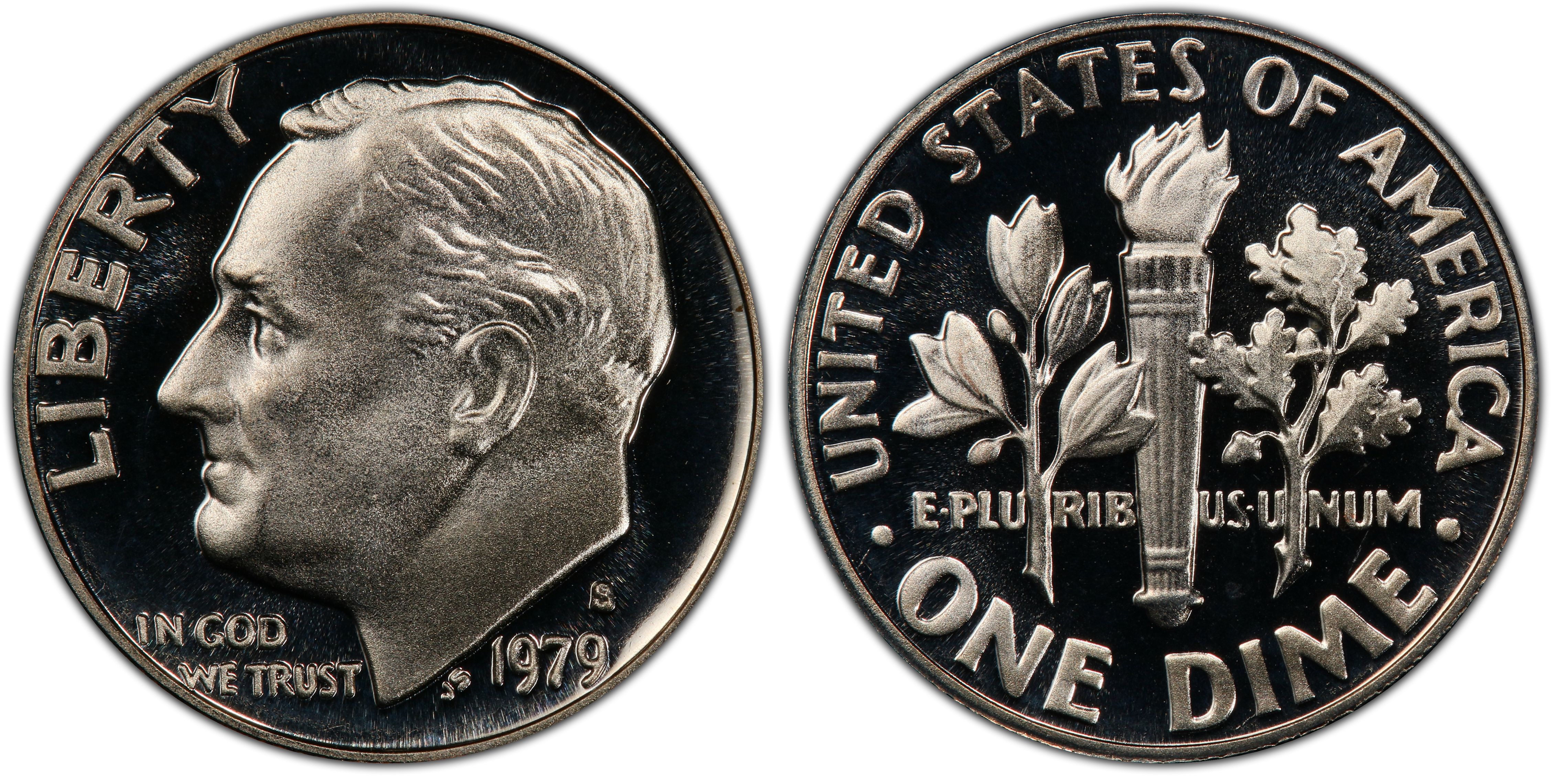
PCGS PR70DCAM
- PCGS #:
- 95258
- Designer:
- John R. Sinnock
- Edge:
- Reeded
- Diameter:
- 17.90 millimeters
- Weight:
- 2.27 grams
- Mintage:
- 3,677,175
- Mint:
- San Francisco
- Metal:
- 75% Copper, 25% Nickel over a pure Copper center
- Auction Record:
- $472 • PR70 • 05-01-2003 • Heritage Auctions
Condition Census What Is This?
|
#1 PCGS PR70DCAM
GreatCollections, April 12, 2026, Lot 211544 - $20. |
|
#1 PCGS PR70DCAM
GreatCollections, April 5, 2026, Lot 2058040 - $26. |
|
#1 PCGS PR70DCAM
GreatCollections, March 8, 2026, Lot 2077545 - $35. |
|
#1 PCGS PR70DCAM
GreatCollections, March 1, 2026, Lot 2062793 - $12.89. |
|
#1 PCGS PR70DCAM
GreatCollections, February 8, 2026, Lot 2010970 - $20. |
The 1979-S Roosevelt Dime
A modern Proof issue, the 1979-S Roosevelt Dime (#95258; #95259) was struck exclusively for the annual 1979 United States Proof Set. Because production for these sets was dictated by direct collector demand, the San Francisco Mint produced a total of 3,677,175 Proof Dimes that year. In a normal production year, it is the intention of the Mint to maintain a consistent quality standard throughout the year, but in 1979 (and again in 1981), the need to replace the overworked S-mintmark punch led to the creation of two mintmark styles for coins of all denominations.
At the time, the 1979 Proof Set carried a face value of $1.91 and was sold by the Mint for $9.00 (roughly $41.00 today). This mintage was the highest since the Bicentennial year of 1976 and remains one of the larger Proof issuances of the period. Only the sets from 1976, 1981, 1982, and 1987 were produced in greater quantities.
Ill-Fitting Plastic
For the 1979 Proof Set, the Mint reused packaging originally designed to fit the much larger Eisenhower Dollar. As a result, a plastic spacer was added to secure the smaller Susan B. Anthony Dollar. While the Mint redesigned its packaging for the 1980 Proof Set to accommodate the Anthony Dollar, the denomination's production was suspended in 1982. This forced the Mint to produce a bronze Treasury Token to fill the vacant slot in the 1982 Proof Set. Finally, for the 1983 set, new packaging was introduced that eliminated the dollar slot entirely.
Understanding the Type 1 and Type 2 Mintmark Styles
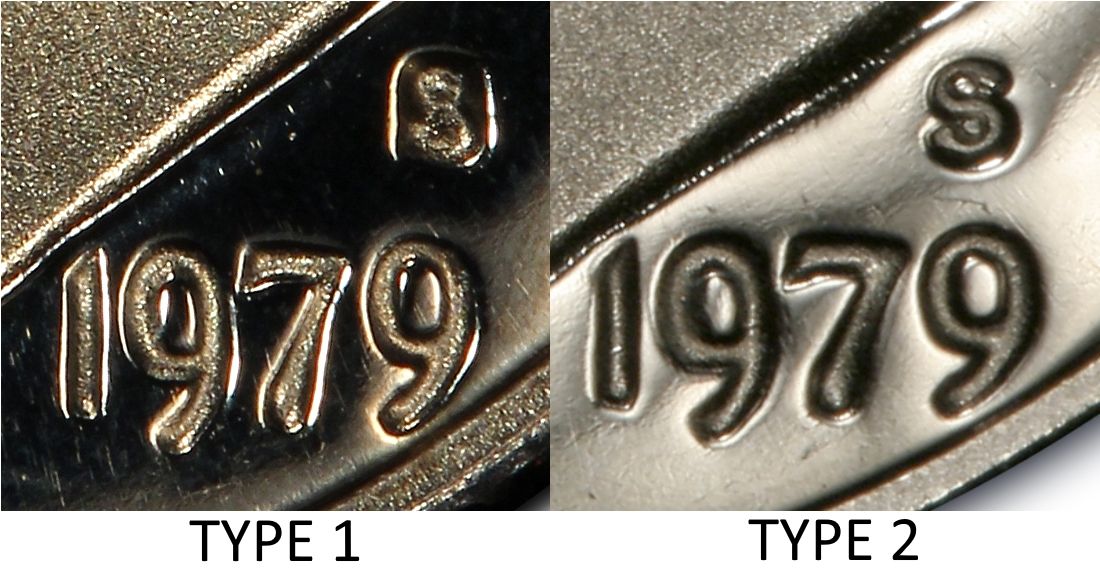
The Mint utilized two distinct mintmark styles for every denomination in the 1979 Proof Set, though the Type 1 (#99589) and Type 2 Susan B. Anthony Dollars (#99590) remain the most famous. Production began with the Type 1 mintmark: a compact, upright "S" with filled counters (the openings tucked into the upper and lower curves). The vast majority of the year's proof coinage was struck using this style.
Variety researcher Alan Herbert suggests that the Mint transitioned to the Type 2 style specifically for November and December production, which accounts for its relative scarcity. The Type 2 punch is cleaner and more rounded, featuring open counters that allow the mirrored field of the coin to show through the loops of the "S."
According to the PCGS Population Report, the Type 1 is roughly 1.4 times more common than the Type 2 for most denominations. While this ratio remains consistent for the Lincoln Cent, Jefferson Nickel, and Washington Quarter, it shifts significantly for the Kennedy Half Dollar and the Susan B. Anthony Dollar. For these two larger denominations, the certified populations more heavily favor the Type 1, making a "Clear S" Type 2 specimen harder to find.
* * *