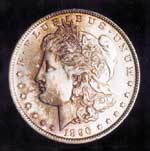
There are some coins that don’t get a second look when it comes to authenticity. After all, the dealer (or collector) reasons, it’s not a $5,000 coin or anything, so why would someone alter it? Such an attitude can lead to disastrous results, as all coins of value are susceptible to counterfeiting and alteration.
Most silver dollars are easy to differentiate from the obverse alone. This coin cries out, "I was made in Philadelphia!" even though there’s an "S" on the reverse. What is the giveaway on the obverse? There’s that "Philly" look to it, with the relatively dull luster and the almost rounded periphery with poorly defined denticles. This coin simply doesn’t have the "oomph" of a San Francisco issue.
The real proof of alteration lies on the reverse. The "S" mintmark sits there in all its glory, surrounded by the adhesive material that was used to place and hold it there. There is also a seam in evidence that gives us a glimpse of the sloppy work the counterfeiter did while adhering the mintmark to the coin.
Remember to stay on the lookout for counterfeits in all price ranges. It is not just the 1893-S dollar or the 1927-D $20 that needs close examination, but ANY coin of value that might profit the unscrupulous counterfeiter.
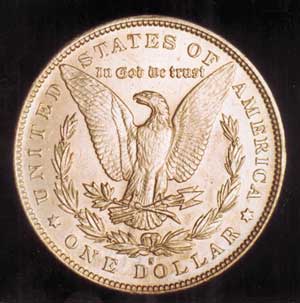
This reverse has a Philly look to it, plus there's discoloration around the pseudo-mintmark and slightly odd placement as well.
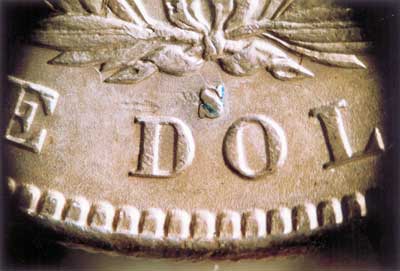
This reverse has a Philly look to it, plus there's discoloration around the pseudo-mintmark and slightly odd placement as well.


 Copper & Nickel
 Silver Coins
 Gold Coins
 Commemoratives
 Others
 Bullion
 World
World
 Coin Market
 Auctions
 Coin Collecting
 PCGS News