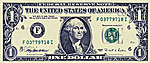
The Sacagawea dollar is in. Television advertisements sponsored by the Mint hint that the dollar bill is out. Is there a happy medium?
America’s “romance” with the dollar has been an on-again, off-again marriage of convenience. Either we love it or hate it. The denomination has appeared in coin and paper form since before there was a United States.
Between 1567 and 1571, James VI of Scotland struck a 30-shilling coin called the “Sword Dollar.” The Double Merk of 1578 is called the Thistle Dollar. A dollar-denominated coin, and its fractions in half-, quarter-, eighth- and sixteenth-dollar, were struck for Scotland by Charles II of England (1660-1685). The dollar denomination existed before there was such a denomination for “the Colonies.”
During the early years of the 13 original Colonies the subsequent Years through 1857, the Spanish colonial American silver 8-reales coin was used in local commerce and referred to as a “Spanish milled dollar.”
Maryland issued dollar paper notes in 1766; the United States issued dollar paper notes in 1775 and the famous Continental dollar coins the following year. It took the Mint until 1794 to strike the first silver dollar because several Mint officials needed to post a very high bond before they were allowed to do so. (Requirements for this bond were lowered to accommodate the officials.)
The so-called romance with the dollar has been battling on ever since. The first US silver dollar coins were struck primarily in small quantities through 1803 (Coins were struck during early 1804, but these are dated 1803. The 1804-dated coins were produced by special order for presentations during the 1830s.) Large deposits of silver made by banks to the Mint during the early years resulted in high mintages for some years, but since the banks received the bullion back as dollar coins, few of them circulated anyway.
The dollar coin was resurrected in 1836 as the Gobrecht dollar. By this time “broken” paper bank notes were in circulation. The silver dollar was hard currency, but the paper money, although risky, was already in competition for the public’s favor.
Adding to the mix was the dollar-denomination gold coin first appearing in 1849 as a result of the gold rush in California. Now you had your choice of coins in gold or silver or a paper note of some questionable reliability (Broken banks were called such because they often went broke.).
United States Notes (also called Legal Tender issues) dated 1862 were in circulation by the late 1860s, again stiff competition for its namesake coin. The dollar coin sputtered out again in 1873, the only silver dollars being made between then and 1877 being Trade dollars meant for overseas rather than domestic use. The Trade dollar continued to be struck through 1885, but after 1878 the only Trade dollars struck were for collectors since the coin never gained general acceptance in foreign trade.
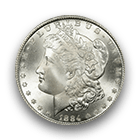
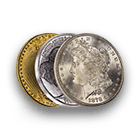
We can thank the Bland-Allison Act of 1878 for the establishment of the Morgan silver dollar as our next dollar coin meant for circulation. The coins were struck primarily to help the silver lobby rather than out of public demand. United States Notes in the dollar denomination were in regular use by this time. The dollar denominated Silver Certificate appears for the first time in 1886, yet more competition for a coin of the same value. Dollar denominated Treasury or “Coin” notes dated 1890 soon followed. The gold dollar coin was last struck in 1889.
The so-called “horse blanket” large size paper $1 Silver Certificate dated Series 1923 was the first to have the basic vignettes as the dollar bill of today. The silver dollar ceased to be produced after 1935. For the moment the paper note had won over the coin.
Silver was last used in our circulating coins in 1964 (with the exception of the half dollar). The $1 Silver Certificate was soon replaced in circulation with the $1 Federal Reserve Note beginning with Series 1963.
In 1971 the Eisenhower dollar, a copper-nickel coin, was introduced to circulation. It was needed primarily by the gaming industry rather than in commerce. Its failure to circulate against the dollar bill was recognized, the coin being last produced in 1978. The following year the government tried unsuccessfully to introduce a smaller diameter Susan B. Anthony dollar coin into circulation without withdrawing the dollar bill. The coin was struck in four years between 1979 and 1999 but is considered a failure.
Now comes the distinctly golden-colored 2000 Sacagawea dollar coin, again entering circulation without the withdrawal of the dollar bill. Will it succeed? Can both the note and the coin co-exist? This will be the next chapter in America’s romance with the dollar.
Richard Giedroyc is a numismatic writer, researcher, auction cataloger and coin dealer. He has been in the hobby and business most of his life, now having more than three decades’ experience in this fascinating hobby field. During this time Giedroyc has been the owner of Paris Bergman Galleries, owner of Classical Coin Newsletter, international editor of Coin World and owner of Giedroyc-Anderson Interesting World Coins. He is currently a numismatic consultant. He has written more than 2,000 byline numismatic stories and contributed to several coin catalogs.
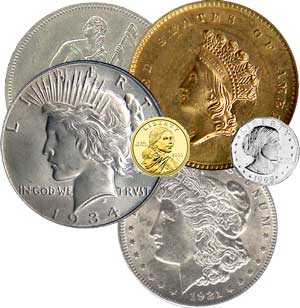
Dollar coins have varied in design and popularity
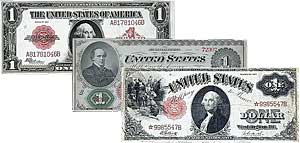
Dollar coins have varied in design and popularity


 Copper & Nickel
 Silver Coins
 Gold Coins
 Commemoratives
 Others
 Bullion
 World
World
 Coin Market
 Auctions
 Coin Collecting
 PCGS News