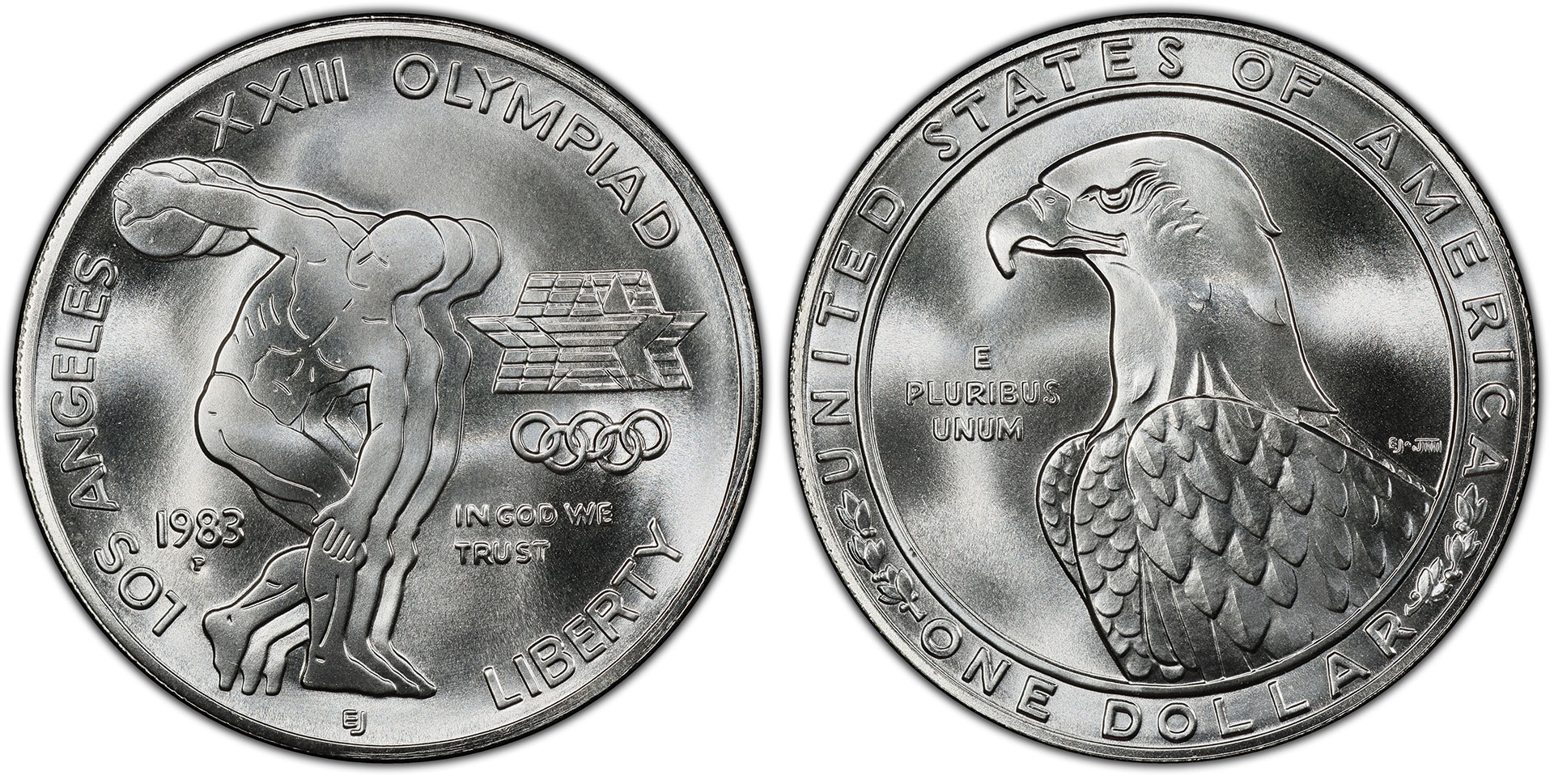
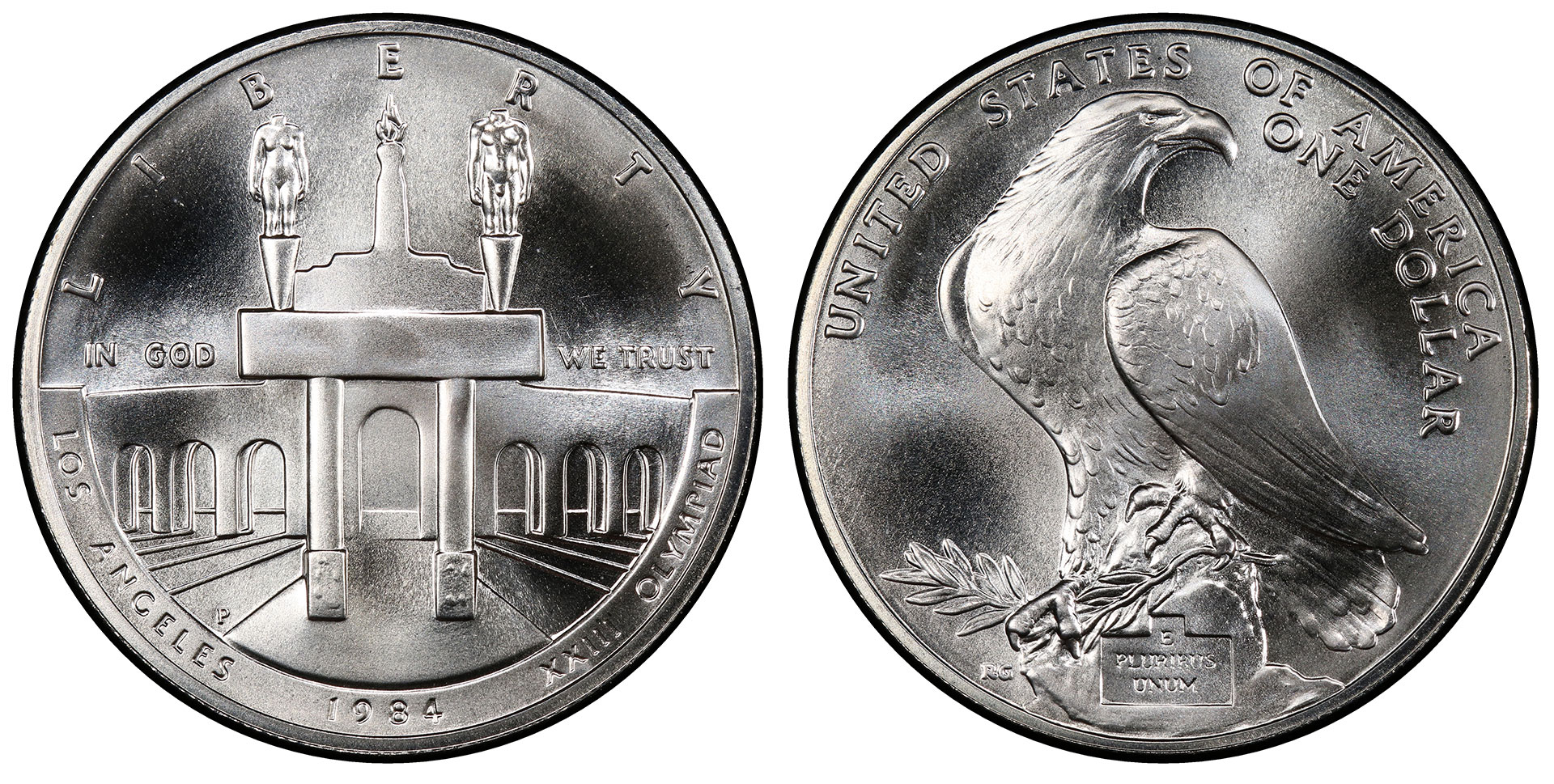
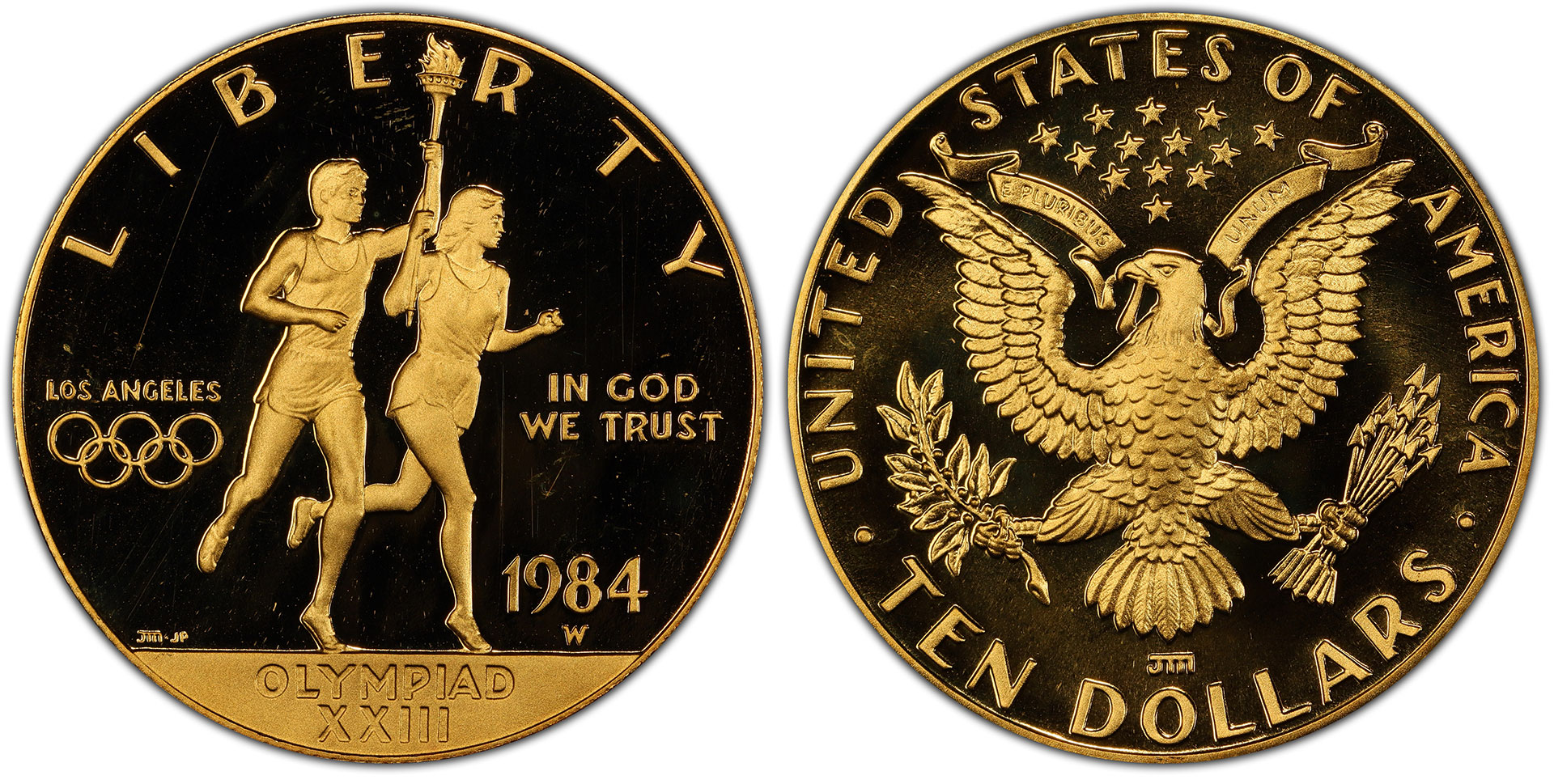
Coming on the heels of the first modern commemorative coins in the form of the 1982 George Washington Half Dollar, Congress debated the next round of commems, this time honoring the 1984 Summer Olympic Games in Los Angeles. Following an absence of commemoratives since 1954, the concept of a renewed commemorative program excited some lawmakers to the point of proposing a 53-coin set involving five clad uncirculated dollar coins, 16 different $10 silver coins in proof and uncirculated, four $50 gold coins in proof and uncirculated, and four $100 gold coins in proof and uncirculated. This audacious proposal was pared back to a more modest program of three different designs, including two silver dollars and a $10 gold coin.
The Senate ultimately passed the scaled-back version of the Olympic coin program on July 1, 1982, with President Ronald Reagan signing the bill into law on July 22, 1982. Public Law 97-220 authorized the production of a 1983 silver dollar, 1984 silver dollar, and 1984 $10 gold coin. From these three basic designs came 13 different issues, including:
- 1983-P Uncirculated Silver Dollar
- 1983-D Uncirculated Silver Dollar
- 1983-S Uncirculated Silver Dollar
- 1983-S Proof Silver Dollar
- 1984-P Uncirculated Silver Dollar
- 1984-D Uncirculated Silver Dollar
- 1984-S Uncirculated Silver Dollar
- 1984-S Proof silver Dollar
- 1984-P Proof $10 Gold
- 1984-D Proof $10 Gold
- 1984-S Proof $10 Gold
- 1984-W Uncirculated $10 Gold
- 1984-W Proof $10 Gold
All told, the U.S. Mint was authorized to strike a combined 50 million silver dollars and two million of the $10 gold pieces. Net mintages came nowhere near those high production caps. Cumulatively, just 4,472,110 sold across all silver dollar options, or barely 8.9% of the entire authorized production allowances. The $10 gold coin didn’t fare much better, selling 573,364 total pieces – about 28.7% of the total authorized production of gold eagles.
The most notable elements of the series may be the 1984-W $10 eagles, which became the first legal-tender gold coinage produced by the U.S. Mint since 1933 and the first U.S. coins to bear a “W” mint mark representing the West Point Mint. This program also boasts the first “P” mint marks from Philadelphia on U.S. commemorative coinage. None of the issues is rare, though MS70 specimens of the uncirculated coinage is scarcer and sells for significant premiums.
Sources
Breen, Walter. Walter Breen’s Complete Encyclopedia of U.S. and Colonial Coins. Doubleday, 1987.
Provost, David. “Commemorative Stories: The 1983-84 LA Olympics Coins – Part I.” CoinWeek. July 5, 2021. Accessed March 14, 2022. https://coinweek.com/modern-commemoratives/commemorative-stories-1983-84-la-olympics-coins-part/
Swiatek, Anthony. Encyclopedia of the Commemorative Coins of the United States. KWS Publishers, 2012.


 Copper & Nickel
 Silver Coins
 Gold Coins
 Commemoratives
 Others
 Bullion
 World
World
 Coin Market
 Auctions
 Coin Collecting
 PCGS News