The Norweb Collection - An American Legacy
Michael Hodder and Q. David Bowers
Besides chronicling Ward's endless progress towards the good city of Cleveland, Browne wrote humor under his own name and reviews of cultural events of the day. On one occasion his mother is said to have told him to be more respectful of her, reminding him of what the Bible said on the subject. Browne replied "Well, I expect I ought to, but it is so different from the Plain Dealer I don't putter with it much ... a man cannot serve two masters, and I'm a democrat:' At another time, Browne was told to attend a lecture by Ralph Waldo Emerson. All Cleveland's intelligentsia were there, including those with pretensions to understanding Emerson's sometimes obscure images. The lecture hall was hot, and Emerson spoke for a long time. Browne's review the next day read, in part: "He is a man of massive intellect, a great and profound thinker, but ..............his lecture last night was rather a sleepy affair. For our part ............we had quite as lief see a perpendicular coffin behind a lecture desk as Emerson. The one would amuse as much as the other"
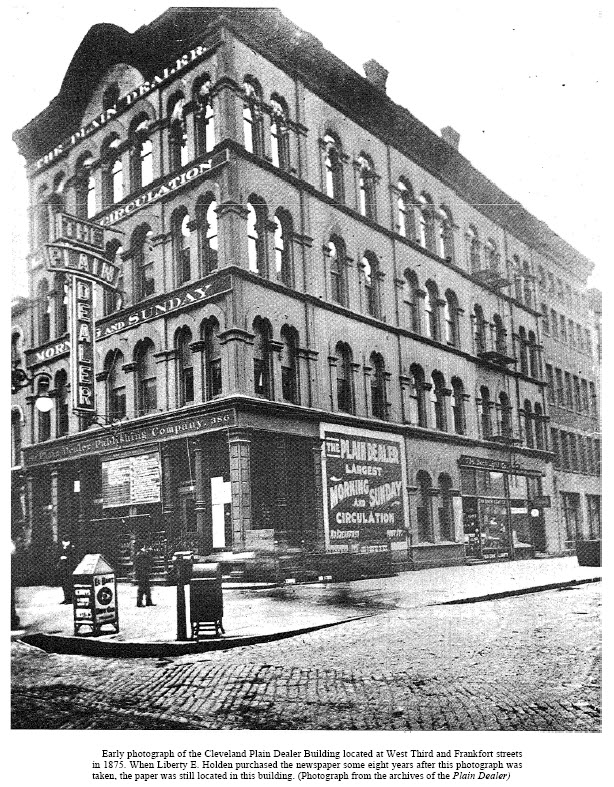
As mentioned earlier, Browne later left the Plain Dealer and went to work for Vanity Fair. Before his death, at only 33, he had published two collections of his Artemus Ward stories and gone on lecture tours in America and England recounting Ward's exploits. When he died, in 1867, the name of the Plain Dealer was known in newspaper and magazine circles and was familiar to the most sophisticated readers in the country. When Liberty Holden purchased the paper 18 years later he bought a vehicle for his own political ideas that would garner national attention for them.
By 1885 Liberty was a successful businessman who had proved himself in the courts, and in the silver fields of Utah. He must have felt that running a newspaper was no different from running any other sort of business. While he learned differently, it was not until 1898 that he finally realized that the newspaper business required professionals trained by experience to the task, and that the ordinary precepts of business did not altogether apply to running a great newspaper. When, at last, he gave up the reins of editorial control to men more skilled than he and saw the paper prosper, he at least had the grace to admit his mistake, perhaps with relief, for he never fully felt comfortable with the single role of owner. He always felt he should exercise some editorial control over the paper, if only to keep its editorial column aligned with his own political beliefs.
In the beginning, however, Liberty ran his paper as he ran his mines. He was a "roll up your sleeves and take charge" kind of manager. When he was in residence in Cleveland, no detail was too small to escape his attention. He favored especially the editori-al page, which soon became the champion of his favored causes, chief among them the free coinage of silver and the national Democratic Party.
It was accepted and completely usual that a newspaper would unerringly reflect the views of its owners. William Randolph Hearst's New York American, which Hearst used to promote his own beliefs and prejudices, is the classic case that gave birth to the phrase "yellow journalism:' Liberty's Plain Dealer did not qualify for such a characterization, but its outspoken support for William Jennings Bryan in the 1896 campaign did not fall far short of it.
Between 1885, when he bought the Plain Dealer, and 1893, when he jointly assumed editorial page control with Charles E. Kennedy, Liberty spent almost as much time overseeing his affairs, and his son's, in Utah and the West as he did in Cleveland, and the paper was run much as it had been earlier. The editorial page in the early days of Liberty's proprietorship reflected his views, but the actual running of the Plain Dealer was in the hands of his brother, Roman R. Holden, and J.H.A. Bone, then editor-in-chief. The year 1893 was pivotal for the paper, seeing changes that would affect its future, with ramifications felt even today.