The Norweb Collection - An American Legacy
Michael Hodder and Q. David Bowers
Liberty and the Cleveland Museum of Art
As his fortune grew so did Liberty's gifts and benefactions to civic associations and other institutions in his adopted home town. In addition, his position in society involved him in numerous voluntary undertakings. In 1890 he was one of the organizers of and main speakers at the dedication of the Garfield Mausoleum completed that year. In 1894 he was again asked to address the public, who were gathered for the dedication of the Soldiers and Sailors Monument, erected to the memory of Admiral Perry's men who fell at the Battle of Lake Erie. Liberty took these, and similar forums, as opportunities to educate the public in the lessons of proper civic responsibility, patriotism, and his own brand of capitalism. Always the educator by training and habit, if no longer by profession, Liberty believed that his wealth and position required him to educate the masses to strive beyond their simple needs for shelter, food, clothing, and so on. A social Darwinist of the classic school, he escaped some of the smug disdain for those less fortunate than himself that characterized other subscribers to that philosophy.
The Cleveland Museum of Art owes its inspiration in large measure, and its foundation in an equal degree, to Liberty Holden and his wife Delia's interest in promoting the advanced education of the working class. Delia was among the original founders of the Cleveland Art School, established in 1882 to provide a work space and learning opportunity for Cleveland's artists, which at the time consisted mostly of young women of the middle and upper-middle class.
The school quickly became popular, as it provided a social outlet as well as a place to learn. Additional programs were set up to attract more of the public to the rewards of art. In 1894 the Cleveland Art Association was formed, whose purpose was to award grants to students in the Cleveland Art School and to sponsor lectures designed "to educate the masses;' according to a prospectus. Liberty was among the founders of the association. That same year, following the Panic of 1893, Liberty helped organize the Citizen's Relief Association, which put on an exhibition of paintings, sculpture, and other arts and handicrafts, the proceeds from which were spent on relief work for the victims of the economic depression.
The Exhibition of 1894, a year later, was a huge success and inspired its organizers to prepare for annual exhibitions. The First Annual Exhibition of the Cleveland Art Association was held from January 22 to February 22, 1895. Exhibits included paintings from Liberty's own collection, sculpture, local craftswork, and other artistic items. Adults paid 25 cents admission, while school children paid 15 cents on Saturdays. The dates of the exhibition were specially chosen. There was a gala Napoleon Night, a Lincoln Night, and a Washington Night. During the last, the ladies dressed in Martha Washington costumes and served tea to the guests.
The success of the first Annual Exhibition convinced Cleveland society that an art museum of a permanent nature was needed in the city. By 1905 Liberty Holden had been chosen as chairman of the building committee charged to engage an architect and approve plans for the new museum, all at a time when the competing legal relationships among the three trust bequests set up for the creation and funding of an art museum had not yet been straightened out. Eight years later, however, work had begun on what was to become one of the finest art museums in the country.
Liberty Holden owned a collection of paintings which he purchased en bloc in 1884 from James Jackson Jarves. A stipulation in the agreement of purchase allowed Jarves free room and board in Liberty's Fairmount Hotel, later in the Hollenden, and unlimited access to a carriage and driver. Jarves was ill at the time of the sale and apparently no one expected him to live long, so the deal probably did not look too unbalanced to Liberty. Jarves surprised everyone, however, "lingering" on until 1888, staying at Cleveland's best hotel when he was in town and driving about the city behind a fine pair of horses, all at Liberty's expense.
Jarves was a colorful character. His father, Deming, was the creator of the pressed glass known as Sandwich glass, manufactured in his factory located in Sandwich, Massachusetts. In 1840 James Jarves founded and edited the first newspaper published in the Hawaiian islands, The Polynesian. In 1851 he moved to Italy, settling in Florence, where he began collecting works of art chosen as representative of their schools and styles. Always at a loss for money, Jarves offered his collection intact to Yale University in 1811, and sold all but 54 paintings. These remaining 54 he sold to Liberty Holden 13 years later. They subsequently became the nucleus of the fledgling Cleveland Museum of Art's collection of Italian paintings. The Holden Collection was first housed in a gallery in Liberty's mansion in Bratenahl, which he built on the shore of Lake Erie. Years later, his granddaughter, Emery May Holden Norweb, remembered playing in the gallery where the paintings hung, recalling that it was cold there despite the warmth and brightness of the pictures' colors. Liberty exhibited some of his paintings during the First Annual Exhibition of the Cleveland Art Association in 1894.
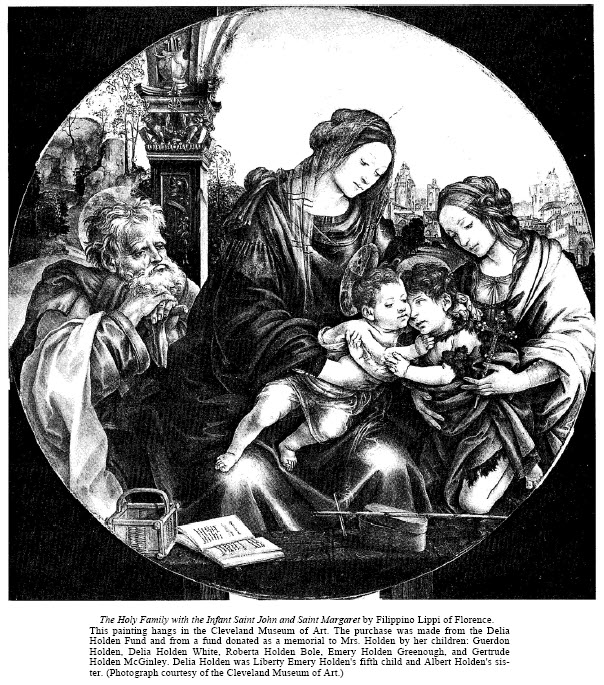
Delia Holden donated the family art collection to the new Cleveland Museum of Art in 1916, thus helping to establish the new museum's reputation. In 1917 the museum published an il-lustrated volume titled Catalogue of the Collection of Paintings Presented to the Cleveland Museum of Art by Mrs. Liberty E. Holden. The majority of the paintings were Italian primitives, pre-Renaissance works of varying quality. Several have since been reattributed. One earlier said to have been by Leonardo da Vinci had been particularly prized by Jarves and Holden. William Mathewson Milliken, director of the Museum from 1930 to 1958, once listed the three most important acquisitions in the museum's first 35 years of activity. Among them were Filippino Lippi's The Holy Family with St. Margaret and St. John, purchased with money from the Delia Holden Fund; and the Guelph Treasure, purchased for $570,000 in 1930 using gift funds donated by Liberty's granddaughter Emery May Holden Norweb, among others. The Cleveland Museum of Art, which numbers among its early benefactors Liberty and Delia Holden, later Emery May and R. Henry Norweb Sr. and their family, was a favorite philanthropy of the Holden family. We shall hear more of the institution later.