2011-P 25C Gettysburg NP (Regular Strike)
Series: (None)
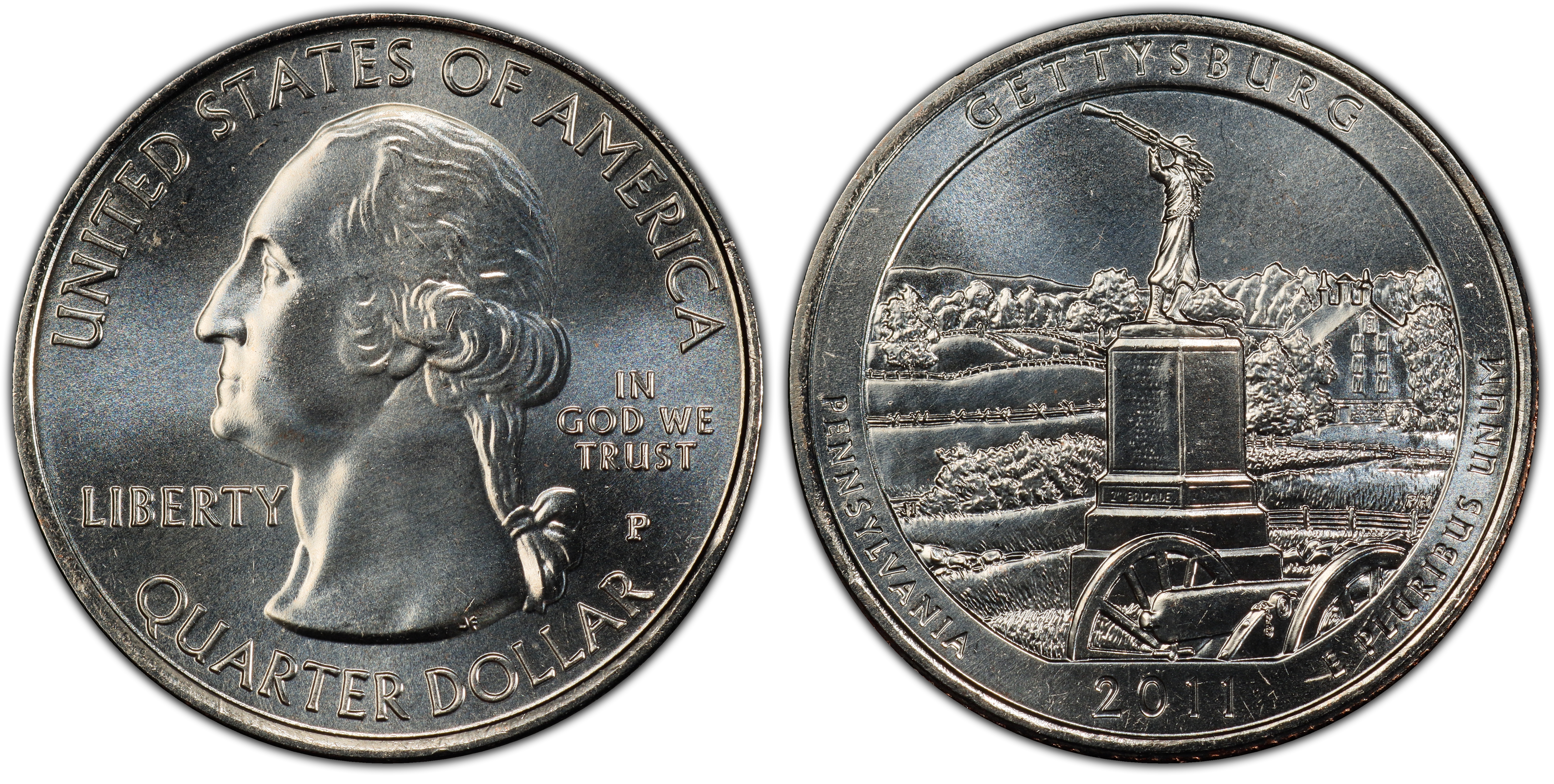
PCGS MS68
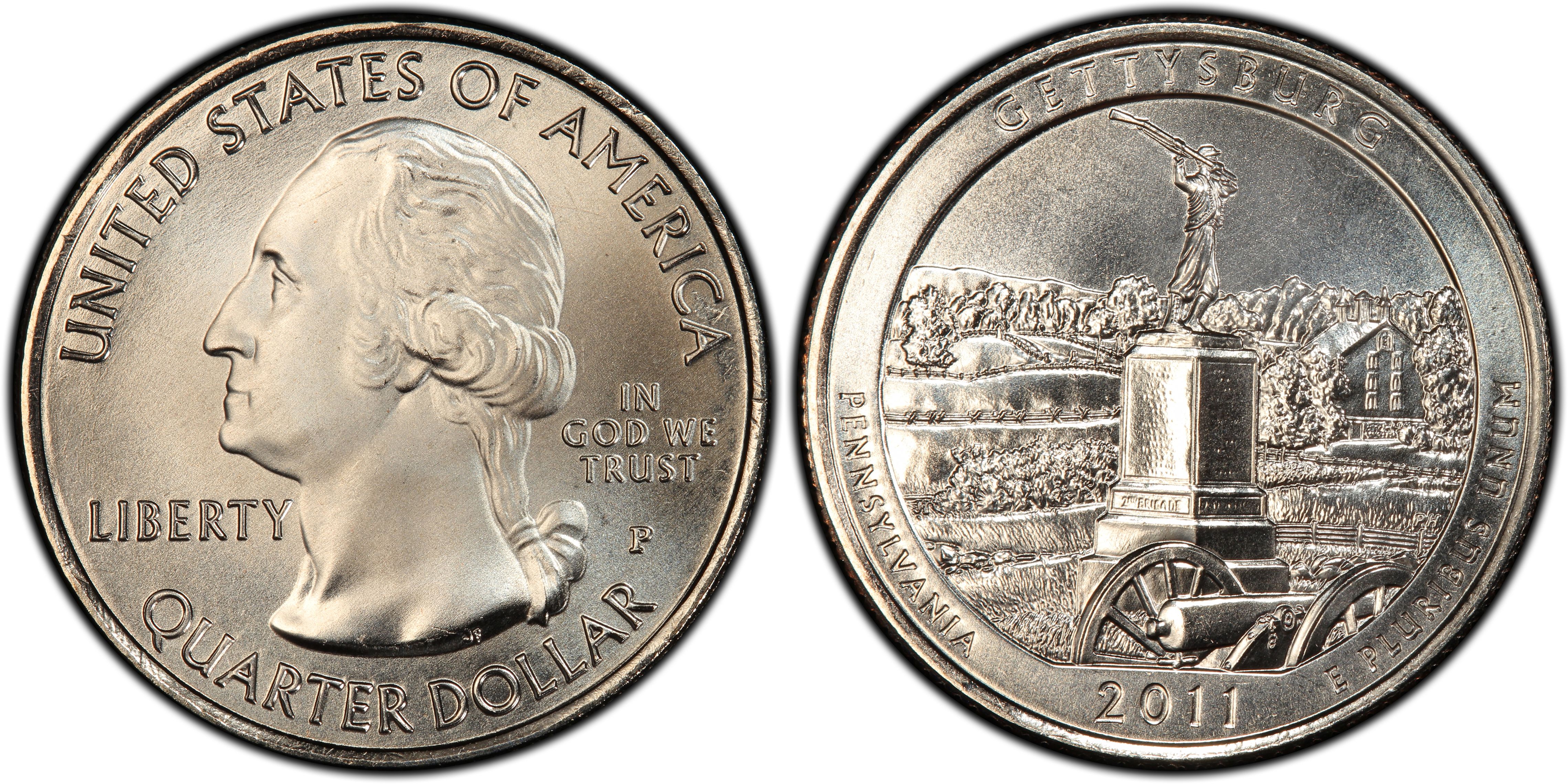
PCGS MS67+

PCGS MS67
- PCGS #:
- 505080
- Designer:
- John Flanagan/Phebe Hemphill
- Edge:
- Reeded
- Diameter:
- 24.30 millimeters
- Weight:
- 5.67 grams
- Mintage:
- 30,800,000
- Mint:
- Philadelphia
- Metal:
- 75% Copper, 25% Nickel over a pure Copper center
- Auction Record:
- $409 • MS67+ • 07-14-2018 • eBay
Major Varieties
- 2011-P 25C Gettysburg NP
Condition Census What Is This?
|
#1 PCGS MS68
"The Huskers Collection" (PCGS Set Registry). Tiny diagonal contact mark above Flanagan's monogram. |
|
#1 PCGS MS68
"The Diehl Washington Quarter Collection" (PCGS Set Registry). |
|
#1 PCGS MS68
"The admiraladm Collection" (PCGS Set Registry). |
|
#1 PCGS MS67+
GreatCollections, February 7, 2021, Lot 937992 - $292.50. |
|
#1 PCGS MS67+
Heritage Auctions, November 21, 2018, Lot 25378 - $120. Small diagonal mark above and to the left of the bust truncation. |
|
#1 PCGS MS67+
Heritage Auctions, March 13, 2018, Lot 23633 - $74; Dell Loy Hansen; "The D.L. Hansen Washington Quarters Complete Variety Set" (PCGS Set Registry). |
|
#1 PCGS MS67+
"The tink5201 Collection" (PCGS Set Registry). |
| #1 PCGS MS67+ |
| #1 PCGS MS67+ |
2011-P Gettysburg National Military Park Quarter
The 2011-P Gettysburg Quarter (#505080) is the sixth release in the 56-coin America the Beautiful (ATB) series and the first issued in 2011. The coin honors the hallowed ground where more than 3,100 Union soldiers made the ultimate sacrifice. While the three-day battle (July 1-3, 1863) resulted in over 51,000 total casualties, its strategic impact was even greater: it broke the back of Lee’s Army of Northern Virginia. Following this defeat, Confederate forces were never again able to mount a large-scale invasion of the North, beginning a defensive decline that ultimately led to the fall of Richmond in 1865.
Design and Symbolism
The coin’s reverse depicts the 72nd Pennsylvania Infantry Monument, located at "The Angle" on Cemetery Ridge. This site marks the "High Water Mark of the Confederacy" reached during Pickett’s Charge.
By selecting this specific monument rather than a generic battle scene, the U.S. Mint highlights the personal sacrifice required to repel the assault. The monument itself carries a unique history; its placement was once the subject of a Supreme Court of Pennsylvania legal battle, serving as a reminder of the postwar struggle over how battlefield heroism should be permanently recorded
From Carnage to Hallowed Ground
In the immediate aftermath of the battle, the town of Gettysburg (population 2,400) was overwhelmed by 30,000 wounded men and thousands of unburied dead. The "sickening stench" of the July heat left an indelible scar on the local citizenry, spurring a movement to create a dignified burial ground.
This led to the establishment of the Soldiers’ National Cemetery. At its dedication on November 19, 1863, President Abraham Lincoln delivered the 272-word Gettysburg Address.
Four score and seven years ago our fathers brought forth on this continent, a new nation, conceived in Liberty, and dedicated to the proposition that all men are created equal.
Now we are engaged in a great civil war, testing whether that nation, or any nation so conceived and so dedicated, can long endure. We are met on a great battle-field of that war. We have come to dedicate a portion of that field, as a final resting place for those who here gave their lives that that nation might live. It is altogether fitting and proper that we should do this.
But, in a larger sense, we can not dedicate -- we can not consecrate -- we can not hallow -- this ground. The brave men, living and dead, who struggled here, have consecrated it, far above our poor power to add or detract. The world will little note, nor long remember what we say here, but it can never forget what they did here. It is for us the living, rather, to be dedicated here to the unfinished work which they who fought here have thus far so nobly advanced. It is rather for us to be here dedicated to the great task remaining before us -- that from these honored dead we take increased devotion to that cause for which they gave the last full measure of devotion -- that we here highly resolve that these dead shall not have died in vain -- that this nation, under God, shall have a new birth of freedom -- and that government of the people, by the people, for the people, shall not perish from the earth.
Abraham Lincoln, November 19, 1863
The speech transformed the site from a scene of military catastrophe into a symbol of a "new birth of freedom." Lincoln shifted the war's narrative from a struggle for political preservation to a moral mandate for equality, as envisioned in the Declaration of Independence.
Establishment of the National Military Park
The preservation of the landscape began with veterans' organizations like the Gettysburg Battlefield Memorial Association (GBMA). However, federal control was officially instituted on February 11, 1895, when Congress established the Gettysburg National Military Park. This 1895 date serves as the chronological anchor for the coin's release order within the ATB series.
Today, the park encompasses 6,000 acres and features over 1,300 monuments and markers. Since 1998, the National Park Service (NPS) has expanded its mission to act as a "living classroom," integrating the military history of the battle lines with the broader social history of slavery and abolition.
* * *