1830 $2.50 Templeton Reid (Regular Strike)
Series: Territorials
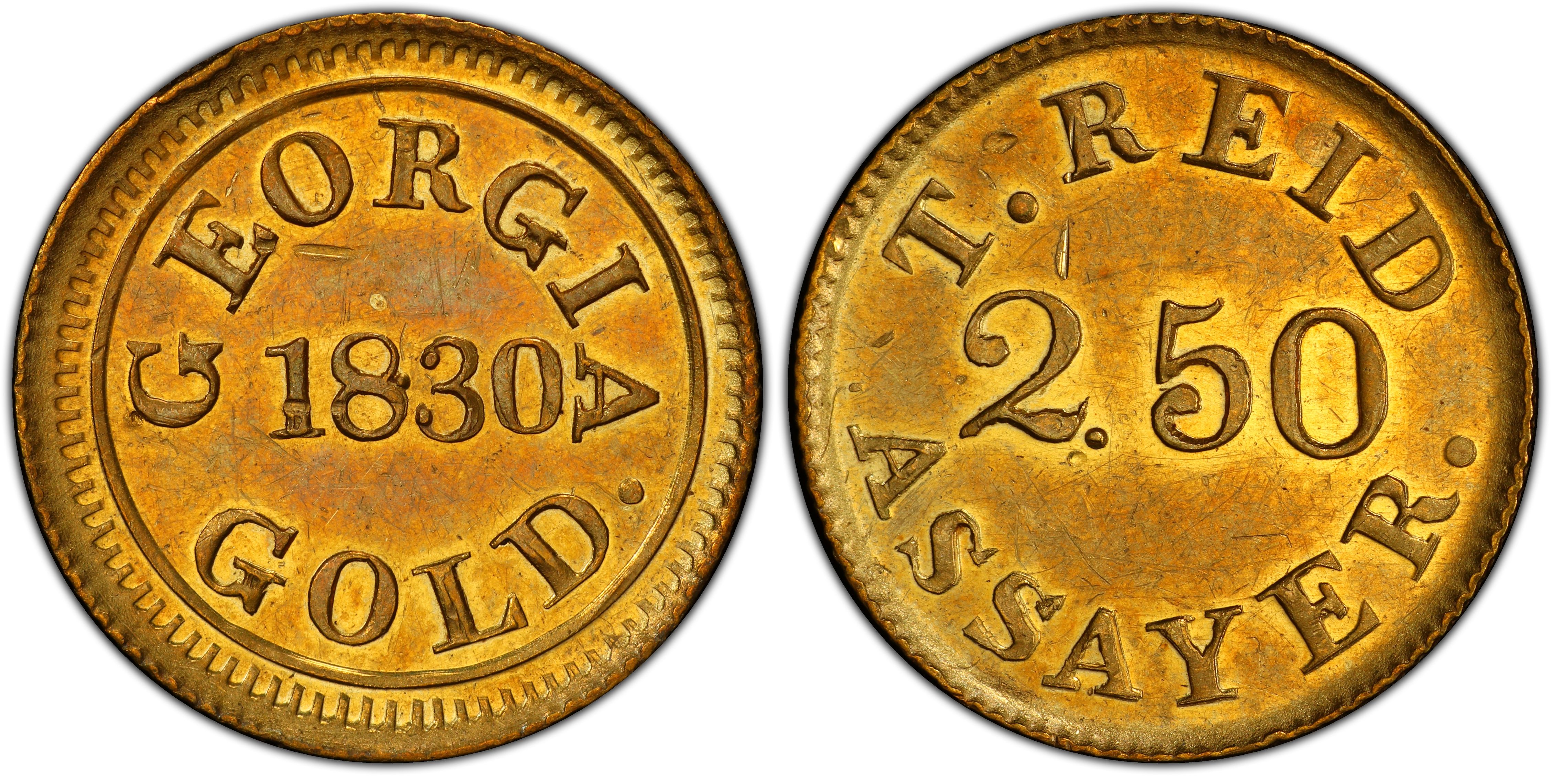
PCGS MS61

PCGS AU58+

PCGS AU58
- PCGS #:
- 10320
- Designer:
- N/A
- Edge:
- N/A
- Diameter:
- N/A
- Weight:
- N/A
- Mintage:
- N/A
- Mint:
- Philadelphia
- Metal:
- Other
- Auction Record:
- $504,000 • AU58 • 02-03-2026 • Stack's Bowers
Major Varieties
- 1830 $2.50 Templeton Reid
Condition Census What Is This?
|
#1 PCGS MS61
Kagins, March 2, 2020, Lot 1303 - $480,000; "The Longhorn Collection" (PCGS Set Registry). Bright gold color in the protected areas around the lettering. Hit across the bottom leg of E and into the field. Hit across the lower portion of 18. On the reverse, there is a vertical hit from the top of 2 to R. |
|
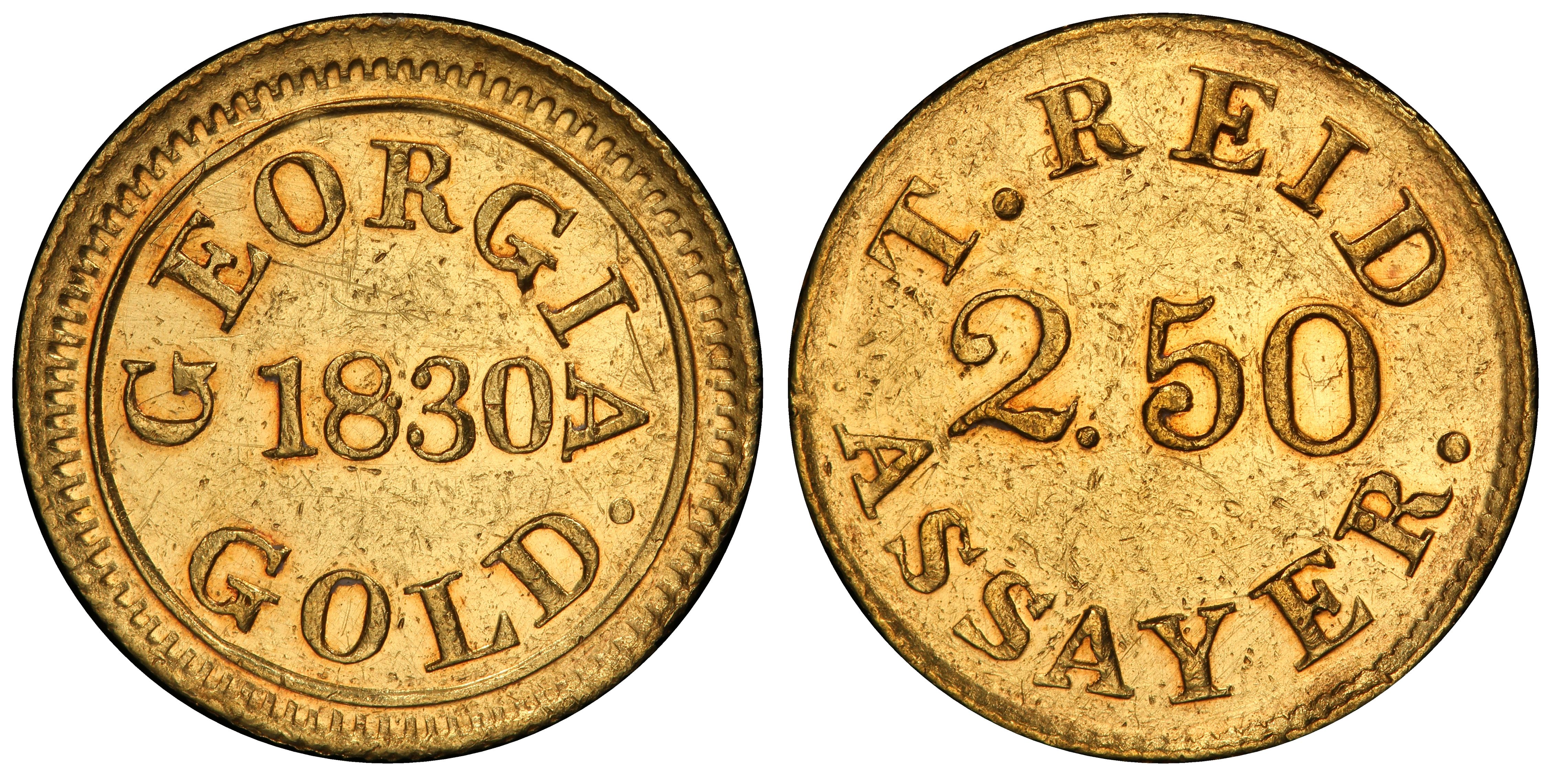
#2 PCGS AU58+
"The Charles Gregory Collection," S.H. Chapman, June 1916, Lot 2283; "The A.C. Nygren Collection," Henry Chapman, April 1924, Lot 20; J.C. Morgenthau & Co., October 1933, Lot 236; "The Stanislaw Herstal Collection," Bowers and Ruddy, February 1974, Lot 803; "The Lighthouse Collection," Stack's, June 1978, Lot 677; "The Jerome S. Coles Collection," Stack's, October 1983, Lot 193."The C.R.W. Collection." As NGC MS61 # 1922251-001. Stack's Bowers, August 15, 2018, Lot 1414 - Passed. As PCGS AU58+ #36162044. "The Palisades Collection" (PCGS Set Registry). Small marks between "2 and 5," small scratch below RE. Tick to the right of "0". |
 #3 PCGS AU58
"1973 ANA Convention Auction," Jess Peters, Inc., Lot 940. Jack Klausen. As PCGS AU58 #27247143. "The Dr. Dexter Seymour Collection," Stack's Bowers, May 2013, Lot 1204 - $329,000; "The Old Pioneer Collection," Heritage Auctions, January 11, 2024, Lot 4422 - $384,000. Small diagonal mark below R of GEORGIA. On the reverse, there is a series of small ticks on a horizontal plane below denomination. Rim hit at 9 0'clock. |
|
#3 PCGS AU58
|
| #3 Est. AU58 |
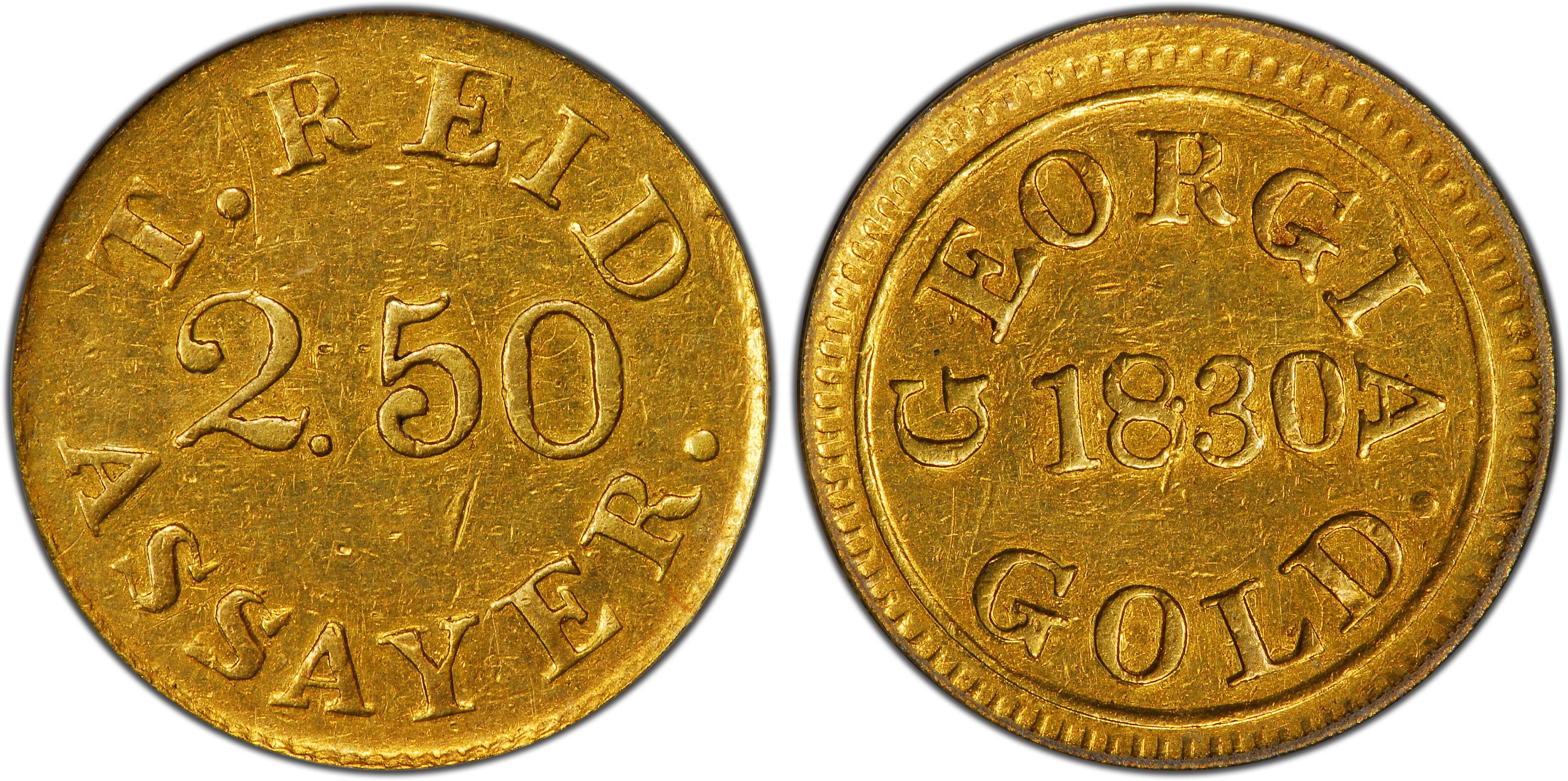 #6 PCGS AU55
J. Cohen; June 1970; "The Gainsborough Collection," Abner Kreisberg and Jerry Cohen, September 24-26, 1980, Lot 1693 - $52,000; Ed Milas; Bob Harwell, private collector. As PCGS AU55 #5544973. "The Chestatee Collection," Heritage Auctions, August 13, 1999, Lot 7706 - $62,000; Don Kagin, August 2000. As PCGS AU55 #16171247. "FallRiverCoins" (PCGS Set Registry). |
|
#6 PCGS AU55
"The Donald E. Bentley Collection," Heritage Auctions, March 2014, Lot 30547 - $282,000; "The Buffalo Bayou Collection of Territorial Gold," Heritage Auctions, January 14, 2022, Lot 4443 - $336,000. Two vertical rim hits just above the gap between 2 and 5. Diagonal marks from center to second S of ASSAY and to the right tip of the serif of A. Scratch below GI. |
Templeton Reid: Pioneer of Private Gold
Born in Greene County, Georgia, Templeton Reid was the son of Alexander Reid, a Revolutionary War patriot who settled in the area with his four brothers between 1786 and 1792. The elder Reid was a prominent local figure, operating a ferry, a gristmill, and a slaveholding plantation.
Early Career and Engineering
Reid initially established himself as a machinist, manufacturing cotton gins in Putnam County. By 1813, he moved to the Georgia capital of Milledgeville, where he rebranded as a watchmaker and repairman under the firm T & E Reid (partnering with his brother, Elisha). His technical expertise extended to civil engineering; from 1814 to 1817, he participated in a public works project aimed at making the Oconee River navigable. Demonstrating his broad mechanical aptitude (and his entrepreneurial spirt), Reid also operated as a jeweler and gunsmith between 1811 to 1828.
The Georgia Gold Rush
Reid’s most enduring legacy began in the early summer of 1830 in Lumpkin County. Exploiting the local gold rush, he struck the first private-issue gold coins denominated in United States dollars. He issued denominations of $2.50 (#10320), $5.00 (#10323), and $10.00 (#10326), all of which are legendary rarities today.
Reid's 1830 coinage shares a stark epigraphic aesthetic. While the three denominations feature distinct obverse layouts, they are unified by several key design elements: a prominent annular inner border, the peripheral inscription "GEORGIA GOLD" (punctuated with periods on the $2.50 and $5 pieces), and the date "1830." On the $5 coin, the denomination is centered on both the obverse and reverse. The $2.50 coin is characterized by elongated denticles that extend more than halfway from the rim to the inner circle. The reverse of each denomination bears Reid's identying mark, stylized on the $2.50 as "T. REID ASSAYER."
Reid’s minting career was short-lived. Following the publication of a scathing (and likely exaggerated) letter in the Georgia Courier claiming his coins were underweight, Reid lacked the social capital to defend himself, and a wave of public distrust effectively shuttered his mint. Beyond the bullion value, critics questioned whether Reid’s operation violated the United States Mint’s constitutional monopoly on coinage. By 1832, the controversy forced Reid to abandon minting; he returned to Putnam County to reside with Elisha and resumed his trade making cotton gins.
Texas and Legal Decline
In 1839, Reid sought a fresh start in the Republic of Texas. He applied for a patent for an improved cotton gin brush—the sixth patent ever granted by the nascent republic—and partnered with John Cornick & Co. of Houston to manufacture and sell the design.
Despite his ingenuity, Reid’s later years were defined by financial instability. Upon returning to Georgia, he was beset by legal troubles. In 1839, he was arrested and forced to post bail over an unpaid promissory note. Throughout the early 1840s, both Reid brothers faced a battery of lawsuits from creditors, including R.H.L. Buchannon and John B. Peabody. These legal battles culminated in 1847, when Reid's property was liquidated to satisfy his debts.
Final Years and a Resumption of Coinage
Reid continued to market his cotton gins until his death on August 5, 1851, following an accidental fall. His body was found on the banks of the Chattahoochee River. Earlier, in 1849, he had attempted to revive his private mint as news of the California Gold Rush swept the nation. This second venture was short-lived; only two specimens from this effort are known to exist. Both dated 1849 and sent to the Philadelphia Mint for assay in 1850.
The first, a $10 gold piece, retains Reid's classic 1830 aesthetic but incorporates idiosyncratic design changes: a beaded border replaces his signature flat annular ring, a six-pointed star precedes Reid's name on the obverse, and two similar stars flank the words "CALIFORNIA GOLD." Notably, these stars are not aligned on a level plane, reflecting the hand-punched nature of die. Furthermore, the denomination is curiously rendered as "TEN DOLLAR" rather than "TEN DOLLARS."
The second, a $25 gold piece, is even more eccentric. It features a six-pointed star preceding Reid's name and an unusual obverse denomination rendered with a double-stroke dollar sign as "$XXV." The reverse centers a rosette between the words "TWENTY-FIVE" and "DOLLARS."
Critically, the $25 specimen was found to be approximately 2% underweight. Following their examination, both coins were transferred to the Mint Cabinet. In 1858, the $25 piece was stolen from a display in the Philadelphia Mint lobby and never recovered; no other examples of Reid’s 1849 coinage have ever resurfaced. Today, the $10 piece resides in the National Numismatic Collection at the Smithsonian Institution, alongside a copper electrotype of the missing $25 rarity.
Templeton Reid's obituary appeared in the Columbus Times the day of his passing. Today, the man who struck Georgia's first gold coins and pioneered private coinage in the United States lies in an unmarked grave at Linwood Cemetery.
Collecting the 1830 Templeton Reid $2.50 Gold Coin
Collectors pursuing a Pioneer Gold "maker set" will likely have to settle for the 1830 Templeton $2.50. Its counterparts are quite rare: only seven specimens of the $5 half eagle are known (with four in private hands), and just six of the $10 eagle survive (with only three available to collectors). By contrast, approximately 20 to 25 examples of the $2.50 piece are known to exist, with grades ranging from Very Good (VG) to low Mint State (MS).
The finest known is the "Longhorn" PCGS MS61. Because no blemish-free examples survive, those seeking to enter this artisanal genre of American numismatics have grown accustomed to the dings, scratches, and "frontier character" typical of these rare private issues.
* * *