1852-D $2.50 (Regular Strike)
Series: Liberty Head $2 1/2 1840-1907
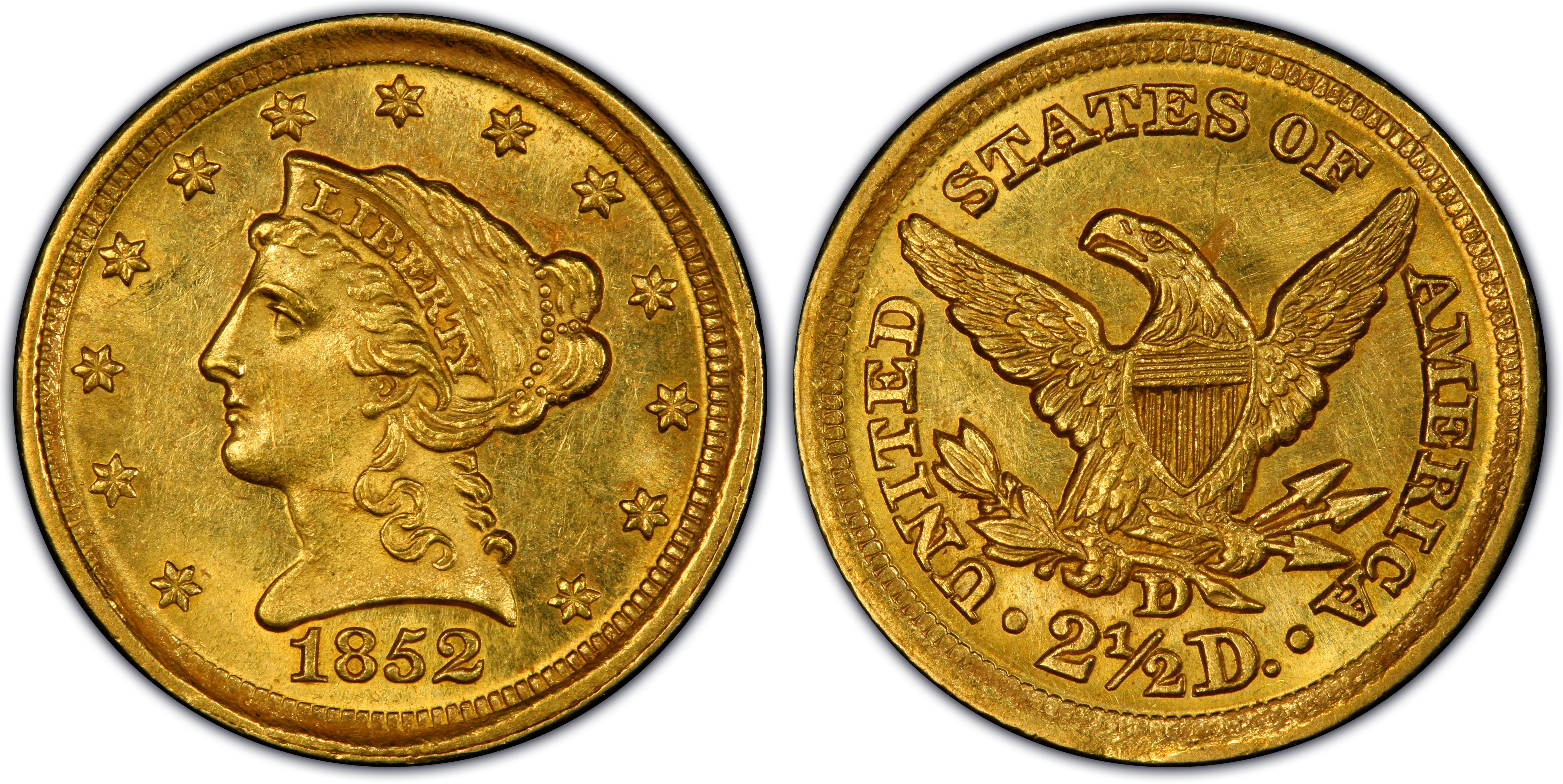
PCGS MS63

PCGS MS62
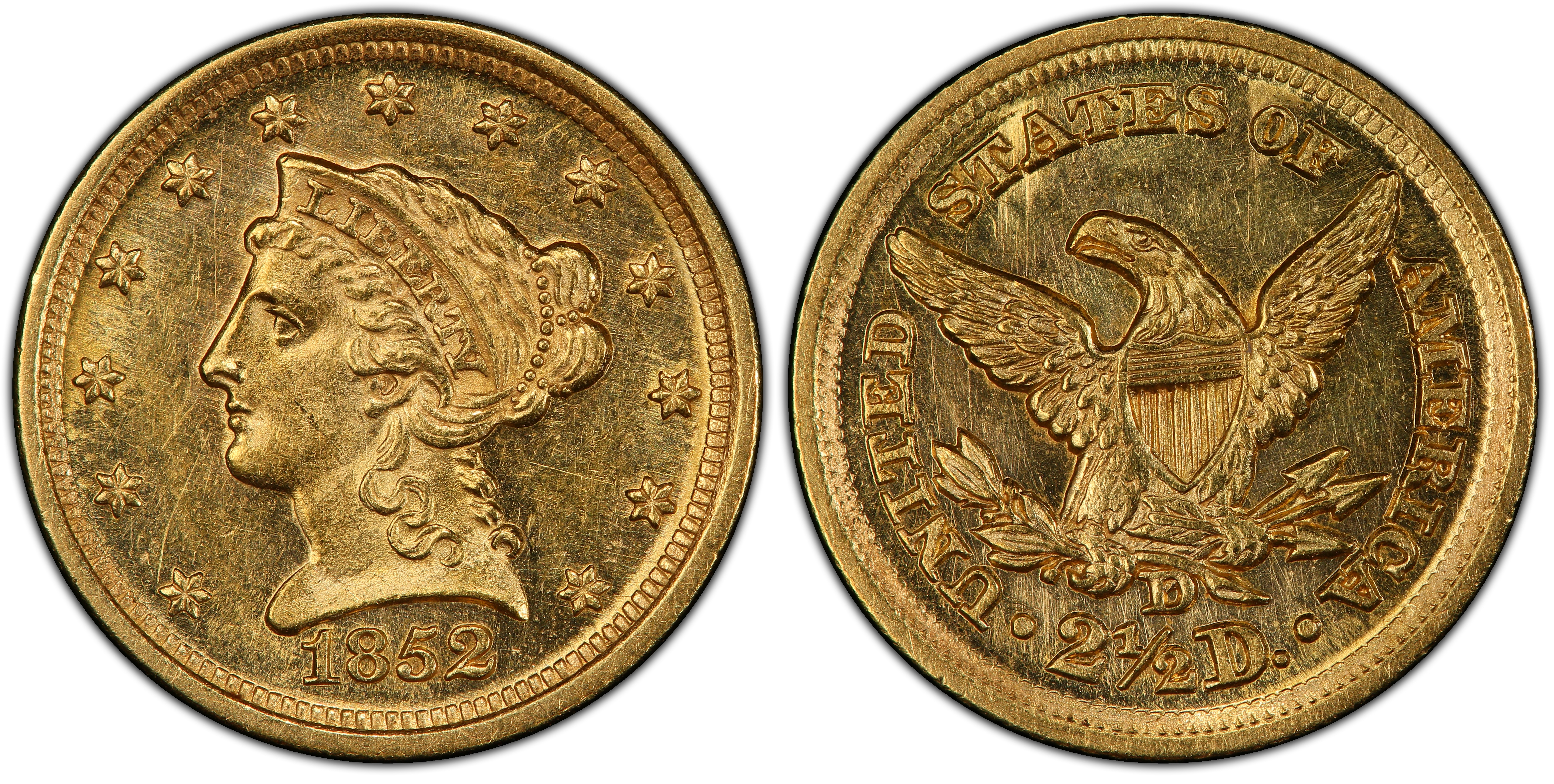
PCGS MS62
- PCGS #:
- 7765
- Designer:
- Christian Gobrecht
- Edge:
- Reeded
- Diameter:
- 18.00 millimeters
- Weight:
- 4.18 grams
- Mintage:
- 4,078
- Mint:
- Dahlonega
- Metal:
- 90% Gold, 10% Copper
- Auction Record:
- $57,500 • MS64 • 04-06-2006 • Heritage Auctions
Major Varieties
- 1852-D $2.50
Rarity and Survival Estimates Learn More
| Survival Estimate | |
|---|---|
| All Grades | 100 |
| 60 or Better | 6 |
| 65 or Better | |
| Numismatic Rarity | |
|---|---|
| All Grades | R-8.0 |
| 60 or Better | R-9.7 |
| 65 or Better | R-10.1 |
| Relative Rarity By Type All Specs in this Type | |
|---|---|
| All Grades | 32 / 147 TIE |
| 60 or Better | 27 / 147 TIE |
| 65 or Better | 1 / 147 |
| Relative Rarity By Series All Specs in this Series | |
|---|---|
| All Grades | 32 / 147 TIE |
| 60 or Better | 27 / 147 TIE |
| 65 or Better | 1 / 147 |
Condition Census What Is This?
|
#1 PCGS MS64
As NGC MS62. Superior, May 1990, Lot 5429 – $27,500; Leon Farmer; Hancock & Harwell. As NGC MS64 #302712-019. “The Duke’s Creek Collection of Daholonega Gold,” Heritage Auctions, April 7, 2006, Lot 1509 – $57,500. As PCGS MS64 #10538404. |
|
#2 PCGS MS63
As PCGS MS62 #21560959. “The Harold W. Anderson Collection, Part Two,” Heritage Auctions, August 20, 2004, Lot 7146 – $28,175; As NGC MS63 #548917-009. Heritage Auctions, December 2004, Lot 6051 – ; Heritage Auctions, March 25, 2005, Lot 6865 – $34,500. As PCGS MS63. Stack’s Bowers, March 4, 2010, Lot 3617 – $33,000 Reserve Not Met. |
| #2 PCGS MS63 |
|
#4 PCGS MS62
Goldberg Auctioneers, May 30, 2006, Lot 3697 - $28,750; Goldberg Auctioneers, January 28, 2014, Lot 1703 - $25,850. |
|
#4 PCGS MS62
"The Della Collection," Heritage Auctions, September 15, 2006, Lot 3168 - $25,300. |
| #4 PCGS MS62 |
|
#4 Est. MS62
As NGC MS62 #371873-002. "The Baltimore Collection, Part Two," Heritage Auctions October 14, 2011, Lot 4682 - $29,900. Three thin diagonal marks on Liberty's neck. |
|
#4 Est. MS62
As PCGS MS62 #21026478. "The Green Pond Collection," Heritage Auctions, January 7, 2004, Lot 1030 - $25,875. PCGS certificate number is inactive. |
| #4 PCGS MS62 |
|
#4 PCGS MS62
|
The 1852-D Liberty Head Quarter Eagle
In 1852, the Dahlonega Mint struck 4,078 Liberty Head Quarter Eagles. This production run represented a major shift for the facility, marking the start of significantly reduced mintage figures compared to the higher-volume years of 1839 through 1851. Within the decade of the 1850s, the 1852-D (#7765) stands out as one of the most elusive quarter eagles to locate, trailing only the legendary 1854-D (#7771), 1855-D (#7776), and 1856-D (#7779) in overall rarity.
Collecting the 1852-D Liberty Head Quarter Eagle
The 1852-D is a scarce coin across all grades and is comparable in overall scarcity to the 1841-D (#7722) and 1842-D (#7725) issues. Most surviving examples grade in the lower range of Extremely Fine (PCGS XF40). About Uncirculated pieces number in the low 30s, but Mint State examples are rare and through August 2026, PCGS has certified only one example as high as PCGS MS64.
In his 1975 reference work, United States Gold Coins: An Analysis of Auction Records, David Akers estimated a surviving population of just 35 coins across all grades. Modern PCGS population data suggests the true surviving population is slightly over 100 pieces. Due to grading resubmissions, gold coin specialist Doug Winter estimates that only five or six distinct Mint State examples exist. Eight entries in our condition census represent verified, specific specimens; the remaining three lack recorded sales or auction appearances and may be duplicates.
Notable Specimens
No Gem Mint State example has ever surfaced. The famous "Dukes Creek" coin comes closest to Gem status; along with the specimen from "The Harold W. Anderson Collection," these two represent the finest known auction-verified pieces.
Die Varieties & Diagnostic Markers
Although the Philadelphia Mint prepared three separate die pairs for Dahlonega in 1852, Doug Winter reports that only one die marriage (Winter 15-M) was actually used:
- Obverse: The numeral 1 in the date rests close to Liberty’s bust, while the 2 is centered evenly between the bust and the rim denticles. Every genuine 1852-D exhibits a distinct obverse die scratch. It originates at the denticles, passes through the lower points of the 3rd star, and extends into the field between the 2nd and 3rd stars.
- Reverse: The reverse die was carried over from the 1847-D issue (Variety 9-M).
The strike quality on the 1852-D closely mirrors that of the 1850-D (#7757), featuring a strong contrast between central detail and peripheral softness. Central details are unusually sharp for a Dahlonega gold coin. Obverse hair details are typically complete, with only occasional softness near the ear and eye. Most obverse stars show full radial lines, with the exception of stars 5 through 9, which frequently display central flatness. On the reverse, the feather details on the eagle's neck and wings are bold, though weakness is routinely visible on the eagle's right leg and claws. Rim denticles on both sides are weak.
Most survivors suffer from heavy abrasions and conspicuous field marks. Mint-made planchet imperfections are also common, frequently presenting as dark grease smudges or copper-colored spots Despite these flaws, thanks to its crisp central strike and frosty luster, the 1852-D often offers surprisingly strong eye appeal — though locating an original, mark-free piece remains a significant challenge.
* * *