1872 25C (Regular Strike)
Series: Liberty Seated Quarters 1838-1891
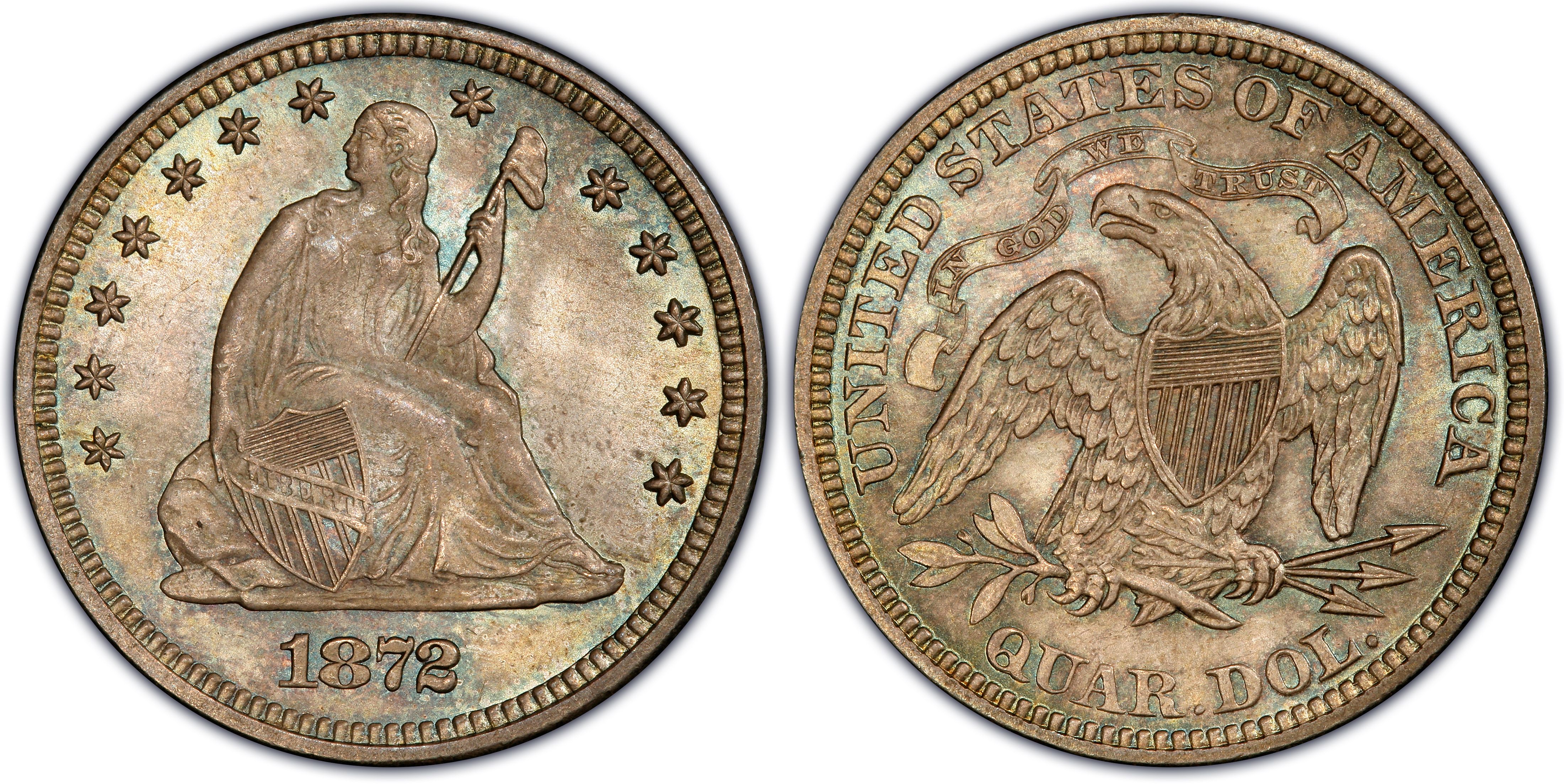
PCGS MS66+

PCGS MS66
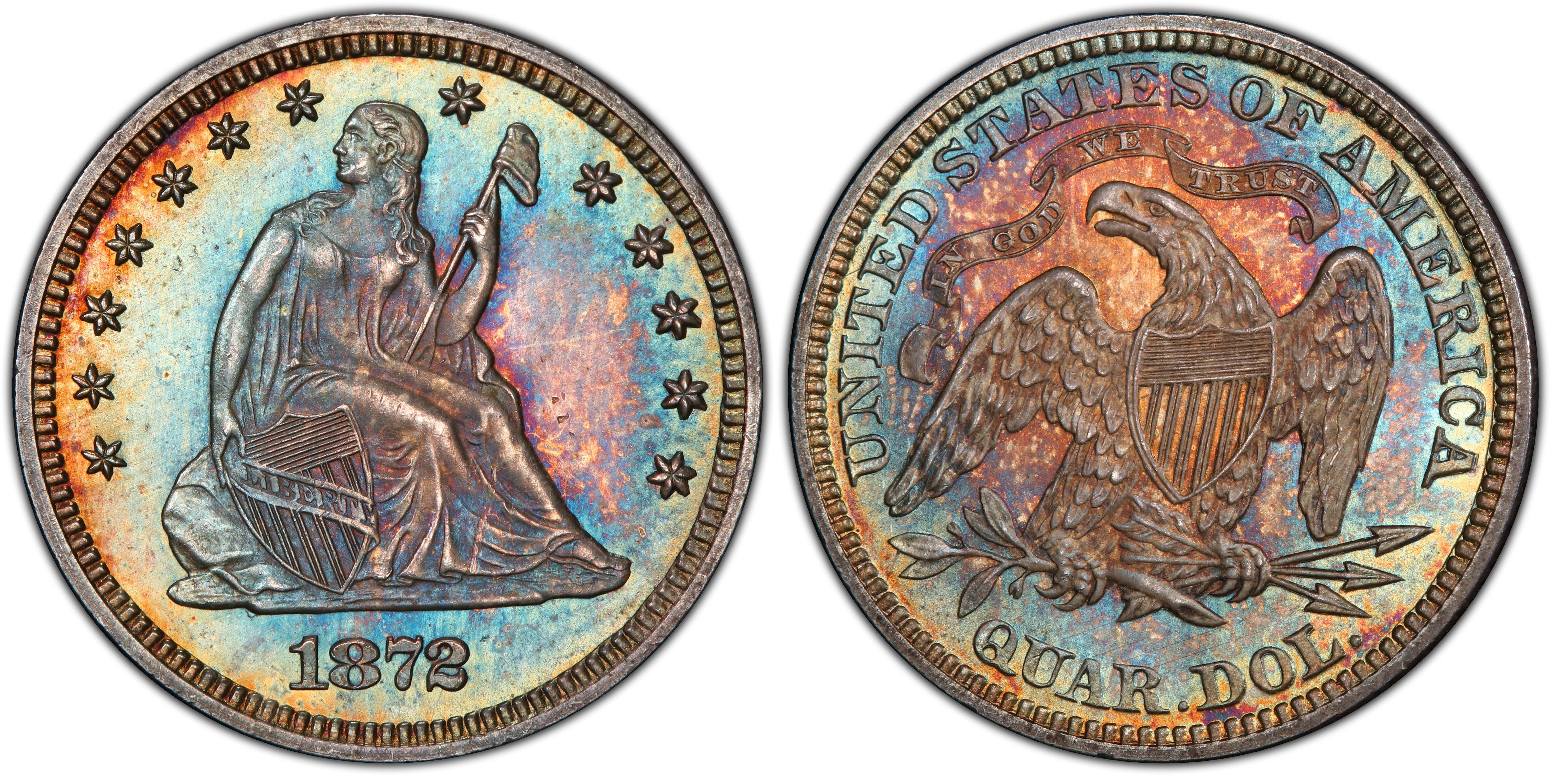
PCGS MS65
- PCGS #:
- 5481
- Designer:
- Robert Ball Hughes/Christian Gobrecht
- Edge:
- Reeded
- Diameter:
- 24.30 millimeters
- Weight:
- 6.20 grams
- Mintage:
- 182,000
- Mint:
- Philadelphia
- Metal:
- 90% Silver, 10% Copper
- Auction Record:
- N/A
Major Varieties
- 1872 25C
Rarity and Survival Estimates Learn More
| Survival Estimate | |
|---|---|
| All Grades | 400 |
| 60 or Better | |
| 65 or Better | 2 |
| Numismatic Rarity | |
|---|---|
| All Grades | R-6.2 |
| 60 or Better | R-10.1 |
| 65 or Better | R-9.9 |
| Relative Rarity By Type All Specs in this Type | |
|---|---|
| All Grades | 15 / 48 TIE |
| 60 or Better | 1 / 48 |
| 65 or Better | 2 / 48 TIE |
| Relative Rarity By Series All Specs in this Series | |
|---|---|
| All Grades | 34 / 114 TIE |
| 60 or Better | 1 / 114 |
| 65 or Better | 3 / 114 TIE |
Condition Census What Is This?
|
#1 PCGS MS66+
"The Red Bank Collection," Stack's, December 1, 2003, Lot 657 - $13,225; "The Hollow Mointain Collection" (PCGS Set Registry). Lustrous champagne patination with patches of green along the design's protected areas. |
|
#2 PCGS MS66
GreatCollections, May 31, 2025, Lot 2146612 - $15,265. Blue, aubergine, seafoam, and sun-yellow toning on the obverse. Sun-yellow toning on the reverse with highlights of seafoam and magenta. |
|
#3 PCGS MS65
As NGC MS66 #596325-008. Heritage Auctions, April 24, 2013, Lot 1967 - $8,550.48. As PCGS MS65 #43203621. GreatCollections, March 13, 2022, Lot 1126982 - $5,980.50; Stack's Bowers, April 9, 2025, Lot 4027 - $6,600. Both the obverse and reverse exhibit intense target toning, transitioning through a vibrant spectrum of orange, aubergine, blue, and green. |
 #3 PCGS MS65
As PCGS MS64 #2513649. Heritage Auctions, November 8, 2003, Lot. 6187 - $4,225; Heritage Auctions, November 6, 2014, Lot 3460 - $3,525; Stack's Bowers, March 22, 2015, Lot 22133 - Passed. Old Green Holder. As PCGS MS65 #25687980. Heritage Auctions, August 14, 2015, Lot 4662 - $6,025.40. As PCGS MS65 #83205723. Heritage Auctions, April 26, 2017, Lot 3189 - $4,710.58. Brtiggs 2-B. |
| #3 PCGS MS65 |
| #6 PCGS MS64 |
| #6 PCGS MS64 |
| #6 PCGS MS64 |
|
#6 PCGS MS64
"The jhd Collection" (PCGS Set Registry). |
| #6 PCGS MS64 |
The 1872 Liberty Seated Quarter
In 1872, Liberty Seated Quarters were struck at the Philadelphia, Carson City, and San Francisco Mints. Compared to the rare 1872-CC issue (#5482) and the scarce 1872-S (#5483), the Philadelphia business strike is considered common in lower grades, though its availability in Choice to Gem Mint State is underapreciated.
The issue was struck during a period of rapidly growing silver supply. As the immense scope of the Comstock Lode became fully evident, it triggered the monumental monetary shifts of 1873: a slight upward adjustment to the weight of America’s subsidiary silver coinage and the complete suspension of standard silver dollar production. Meanwhile, just across the Sierra Nevada, a state-of-the-art new San Francisco Mint building, the future "Granite Lady," was nearing completion.
Beyond its mintage of 182,000 pieces and the relative ease of finding circulated examples, America's 1872 coinage was struck during a pivotal moment of American history, one defined by a rather unusual presidential election.
The Presidential Campaign of 1872 Reveals Fissures
Despite a first term dogged by scandal, Ulysses S. Grant entered a presidential contest like no other. His administration was plagued by a series of controversies almost from the start. One of the largest was the Black Friday gold scandal of 1869, where Grant allies Jay Gould and James Fisk, already notorious for manipulating the stock of the Erie Railroad Company, hatched a scheme to corner the gold market in September 1869.
Fisk and Gould recruited Grant's brother-in-law, Abel Rathbone Corbin (husband of the President's sister, Virginia), to influence White House policy. Their pitch was that the government should withhold Treasury gold sales to keep prices high, claiming this would boost agricultural exports and benefit shipping on their Erie Railroad. The conspirators spread rumors that Grant had given personal assurances that the Treasury would lock up its gold reserves, causing prices to surge from $132 to a peak of over $160 an ounce.
Once Grant caught wind of the deception, he ordered Treasury Secretary George Boutwell to release $4 million in government gold on September 24, 1869. The market collapsed within hours, triggering a massive financial panic. While those acting on Fisk and Gould's prompts were utterly wiped out, the two masterminds had already covertly cashed out before the crash. In the court of public opinion, Grant bore the brunt of the blame, despite acting decisively to end the corner.
Within his own party, fractures began almost immediately. Newspaper magnate Horace Greeley, who would become Grant's 1872 election rival, spent much of the president's first term using his press empire to rail against the corruption and cronyism surrounding the administration. This dissent gave rise to a breakaway "Liberal Republican" faction, which eventually formed a bizarre coalition with Southern Democrats.
The Southern Strategy and The "Flip-Flopper"
White Southerners found Grant's actions as President highly objectionable, particularly his use of the newly formed Department of Justice and the U.S. Army to suppress paramilitary Klan violence across the South, as well as his staunch support for Reconstruction. For the South, opposing Grant lay at the heart of their plan to retake control of local politics. Their goal was to re-establish an economic system built on a foundation of sharecropping, debt peonage, convict leasing, and vagrancy laws. This created a system of quasi-slavery that dominated the Southern agricultural economy through the 1930s and 1940s, when the Great Migration, the emergence of modern farm machinery, and the outbreak of World War II finally caused it to collapse.
The Election of 1872 was highly charged. The Democrats officially joined the Liberal Republicans in backing the eccentric, neck-bearded Greeley. Greeley was a man for the moment in the sense that his positions, and the editorials of his New York Tribune, frequently shifted with the political winds. A political chameleon par excellence, Greeley had historically been anti-slavery, pro-Lincoln, and pro-Union. Yet, in 1872, he threw his lot in with the losing side of that very conflict.
Greeley vowed to restore the rights of former Confederates, personally signed Jefferson Davis’s bail bond, and advocated for an end to the federal occupation of the South. Furthermore, he sought to clean up Washington by replacing Grant's political patronage with a strict, civil service merit system.
The profound irony here is that Grant's messy patronage system had actually opened the federal bureaucracy to Union loyalists and newly emancipated African Americans. Greeley's proposed system, by relying strictly on elite educational testing, would have inherently favored wealthy Northern elites and established an entrenched federal bureaucracy unmoved by political shifts - a "deep state" of the 19th century.
A Tragic Campaign and an Unprecedented Aftermath
Despite Grant's liabilities, Greeley's chances of taking the White House were always a long shot. The very medium he had used to cudgel his opponents was turned against him as Harper's Weekly cartoonist Thomas Nast (of Santa Claus fame) mercilessly pilloried Greeley's shifting political positions, his odd appearance, and the conflicting goals of his base.
Exhausted by the brutal campaign trail, tragedy struck Greeley on October 30, when his wife, Mary, died after a long illness. While an event of this magnitude might shift public sympathy in a modern election cycle, it did no such thing in 1872.
On November 5, roughly 6.4 million Americans cast their ballots, giving Grant a commanding 286 to 66 Electoral College victory. Only six states sided with Greeley: Texas, Missouri, Kentucky, Tennessee, Georgia, and Maryland.
Following the humiliating defeat and the loss of his wife, Greeley suffered a severe mental collapse. He was institutionalized at Dr. George Choate’s private asylum in Pleasantville, New York, where he died on November 29, just 24 days after the election.
Because Greeley died before the Electoral College could officially meet, his 66 pledged electors scrambled:
- 42 votes were cast for Thomas A. Hendricks (an Indiana Democrat elected governor that year)
- 18 votes went to Greeley's running mate, Benjamin Gratz Brown.
- 2 votes went to Charles J. Jenkins (a conservative Georgia Democrat).
- 1 vote was given to David Davis (the Supreme Court Associate Justice appointed by Lincoln).
The final 3 votes were cast for Greeley anyway, but Congress formally disallowed them because he was deceased.
Collecting the 1872 Liberty Seated Quarter
Careful study of the PCGS Population Report reveals a clear undercount of circulated specimens. This gap creates a prime opportunity to source raw coins in the XF to AU range and submit them for grading. Certified pieces consistently prove to be far more liquid than ungraded ones, which carry the risk of being counterfeit or suffering from conditional issues, such as past harsh cleanings.
At the top end of the market, toned examples are the norm, though catalogers frequently note specimens with semi-prooflike or prooflike surfaces. These deeply mirrored fields strongly suggest they were early strikes from fresh dies.
Navigating the Liberty Seated Series
The sheer length and complexity of the Liberty Seated series can easily intimidate aspiring collectors. If you find yourself overwhelmed, remember this: collect the coins you genuinely enjoy without the self-imposed pressure to fill every hole or complete a massive set. A more rewarding goal is to define your own collection around a specific theme or subject. In this regard, Philadelphia Mint issues offer excellent opportunities, as they are generally much more readily available.
* * *