1879 5C (Proof)
Series: Shield Five Cents 1866-1883

PCGS PR67+

PCGS PR67+
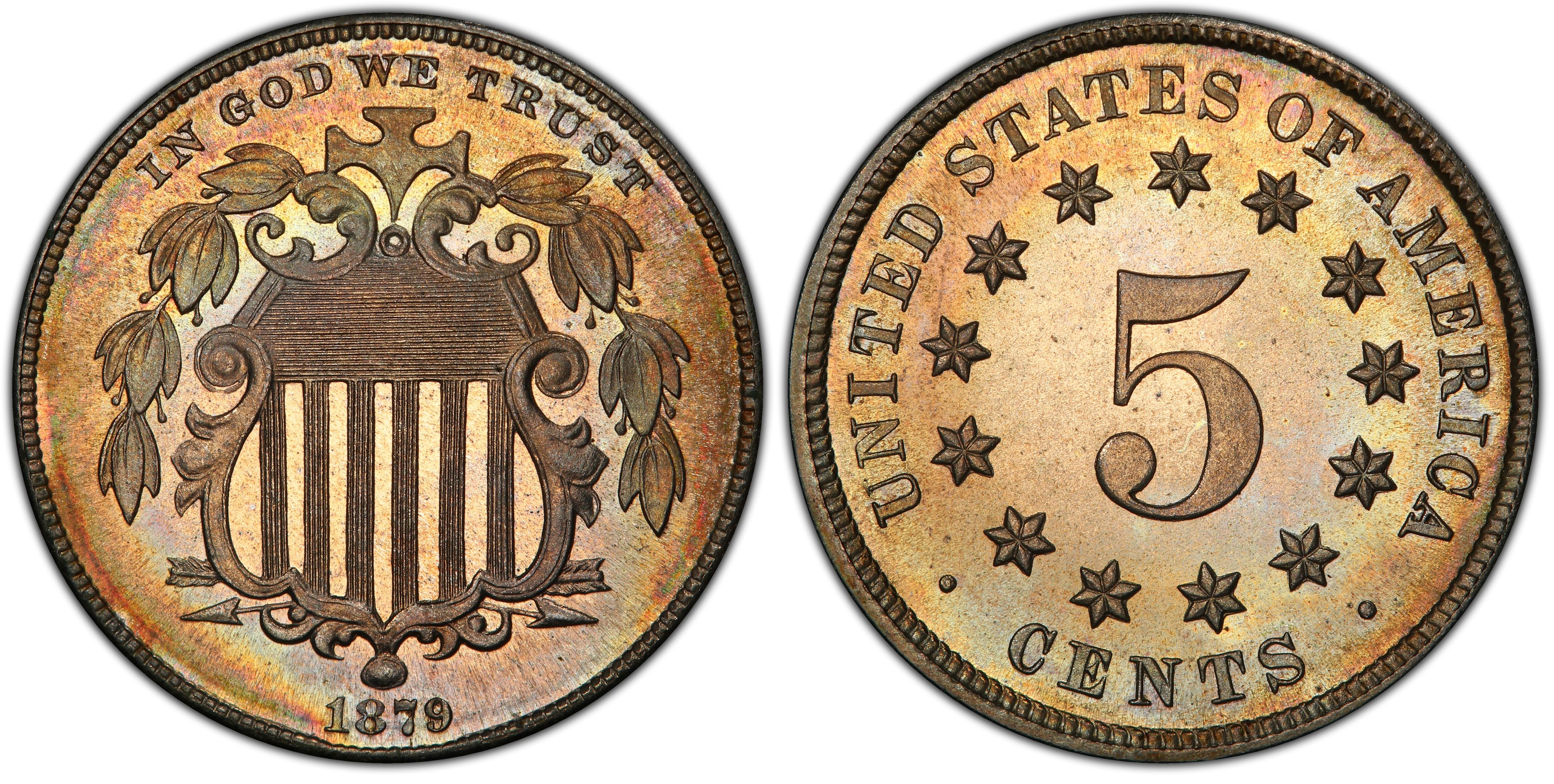
PCGS PR67+
- PCGS #:
- 3833
- Designer:
- James Barton Longacre
- Edge:
- Plain
- Diameter:
- 20.50 millimeters
- Weight:
- 5.00 grams
- Mintage:
- 3,200
- Mint:
- Philadelphia
- Metal:
- 75% Copper, 25% Nickel
- Auction Record:
- $10,350 • PR68 • 05-25-2005 • American Numismatic Rarities
Rarity and Survival Estimates Learn More
| Survival Estimate | |
|---|---|
| All Grades | 900 |
| 60 or Better | 860 |
| 65 or Better | 400 |
| Numismatic Rarity | |
|---|---|
| All Grades | R-5.2 |
| 60 or Better | R-5.2 |
| 65 or Better | R-6.2 |
| Relative Rarity By Type All Specs in this Type | |
|---|---|
| All Grades | 10 / 18 |
| 60 or Better | 10 / 18 |
| 65 or Better | 12 / 18 |
| Relative Rarity By Series All Specs in this Series | |
|---|---|
| All Grades | 12 / 20 |
| 60 or Better | 12 / 20 |
| 65 or Better | 14 / 20 |
Condition Census What Is This?
|
#1 PCGS PR67+
Legend Rare Coin Auctions, May 27, 2021, Lot 205 - $3,055; "Reel Coug Dansco 7070 Modified Type Set 1796 to Date Collection" (PCGS Set Registry). Pale green and apricot toning throughout. |
|
#1 PCGS PR67+
Heritage Auctions, October 31, 2016, Lot 3806 - $3,055. Golden rust toning with thin ring of prismatic rainbow toning along the periphery. |
|
#1 PCGS PR67+
Small planchet void to the bottom right of the right arrow fletching. |
 #1 PCGS PR67+
|
The 1879 Shield Nickel Proof
The 1879 Shield Nickel Proof (#3833) is an intriguing issue in that the Guide Book "1879/8 variety" is actually typical for the year, while the "perfect date" is less frequently encountered. In United States Proof Coins Volume IV: Nickel (2023), John W. Dannreuther suggests that the perfect date represents approximately 30–35% of the total 3,200-piece mintage. This leaves the remainder—roughly 2,080 pieces—bearing the 9/8 overdate. As Dannreuther notes, the perfect date comprises two die marriages: JD-2 (Obverse 2 / Reverse B) and JD-3 (Obverse 3 / Reverse C). Interestingly, the overdate shares the same obverse (Obverse 1) but is paired with two distinct reverses (Reverses A and D).
Applying a liberal attrition rate of 25% to these estimates over the 150 years since their issue, one might expect to find roughly 1,560 to 1,680 surviving overdates alongside 720 to 840 perfect dates. While the current PCGS census shows a closer breakdown of 47/53, this may be a reflection of the complexities of variety attribution. Because many overdates are likely submitted and encapsulated as "perfect dates," the raw census data can be difficult to reconcile with the estimated production numbers. This highlights the ongoing challenge for specialists in accurately documenting the true scarcity of these two distinct families of varieties.
Collecting the 1879 Shield Nickel Proof
Recognizing that the perfect date is the scarcer of the two variety families, the PCGS Population Report shows a typical grade in the PCGS PR64 to PCGS PR65 range. Superb Gem PCGS PR67s are conditionally scarce, as one would expect, with the very finest reaching PCGS PR67+. Roughly 8% of the certified population has been designated Cameo, and to date, only a single example has exhibited sufficient frost to earn the Deep Cameo designation. Interestingly, cameo frost appears more prevalent on the overdates; eight overdates reach the grade of PCGS PR68, while the Dan Rosenthal "Just Having Fun" rainbow-toned specimen stands alone as the finest known at PCGS PR69.
Overall, the 1879 issue represents the second nickel five-cent date where the PCGS population exceeds 1,000 pieces. While the connoisseur or advanced registry set collector will likely focus on the two major varieties, a single example will suffice for most. James B. Longacre’s Shield design ushered in a new era of symbolism for American coinage. Though his prowess as an artistic engraver is perhaps better demonstrated on his Indian Cent, collectors have long maintained a fondness for the first design of the popular nickel five-cent piece.
* * *