1930 10C, FB (Regular Strike)
Series: Mercury Dimes 1916-1945

PCGS MS68FB

PCGS MS67+FB

PCGS MS67+FB
- PCGS #:
- 4979
- Designer:
- Adolph Alexander Weinman
- Edge:
- Reeded
- Diameter:
- 17.90 millimeters
- Weight:
- 2.50 grams
- Mintage:
- 6,770,000
- Mint:
- Philadelphia
- Metal:
- 90% Silver, 10% Copper
- Auction Record:
- $21,960 • MS68FB • 09-10-2026 • Stack's Bowers
Rarity and Survival Estimates Learn More
| Survival Estimate | |
|---|---|
| All Grades | 1,000 |
| 60 or Better | 1,000 |
| 65 or Better | 500 |
| Numismatic Rarity | |
|---|---|
| All Grades | R-5.0 |
| 60 or Better | R-5.0 |
| 65 or Better | R-6.0 |
| Relative Rarity By Type All Specs in this Type | |
|---|---|
| All Grades | 28 / 80 TIE |
| 60 or Better | 28 / 80 TIE |
| 65 or Better | 36 / 80 TIE |
| Relative Rarity By Series All Specs in this Series | |
|---|---|
| All Grades | 28 / 80 TIE |
| 60 or Better | 28 / 80 TIE |
| 65 or Better | 36 / 80 TIE |
Condition Census What Is This?
|
#1 PCGS MS68FB
|
|
#2 PCGS MS67+FB
Heritage Auctions, October 8, 2026, Lot 3059 - $5,124. Peacock crescent toning on obverse and reverse. |
|
#2 PCGS MS67+FB
GreatCollections, February 23, 2025, Lot 1675331 - $11,812.50; "The New Hampshire Set" (PCGS Set Registry). Wispy toning. |
 #2 PCGS MS67+FB GreatCollections, March 27, 2022, Lot 874361 - $11,025. Brilliant. |
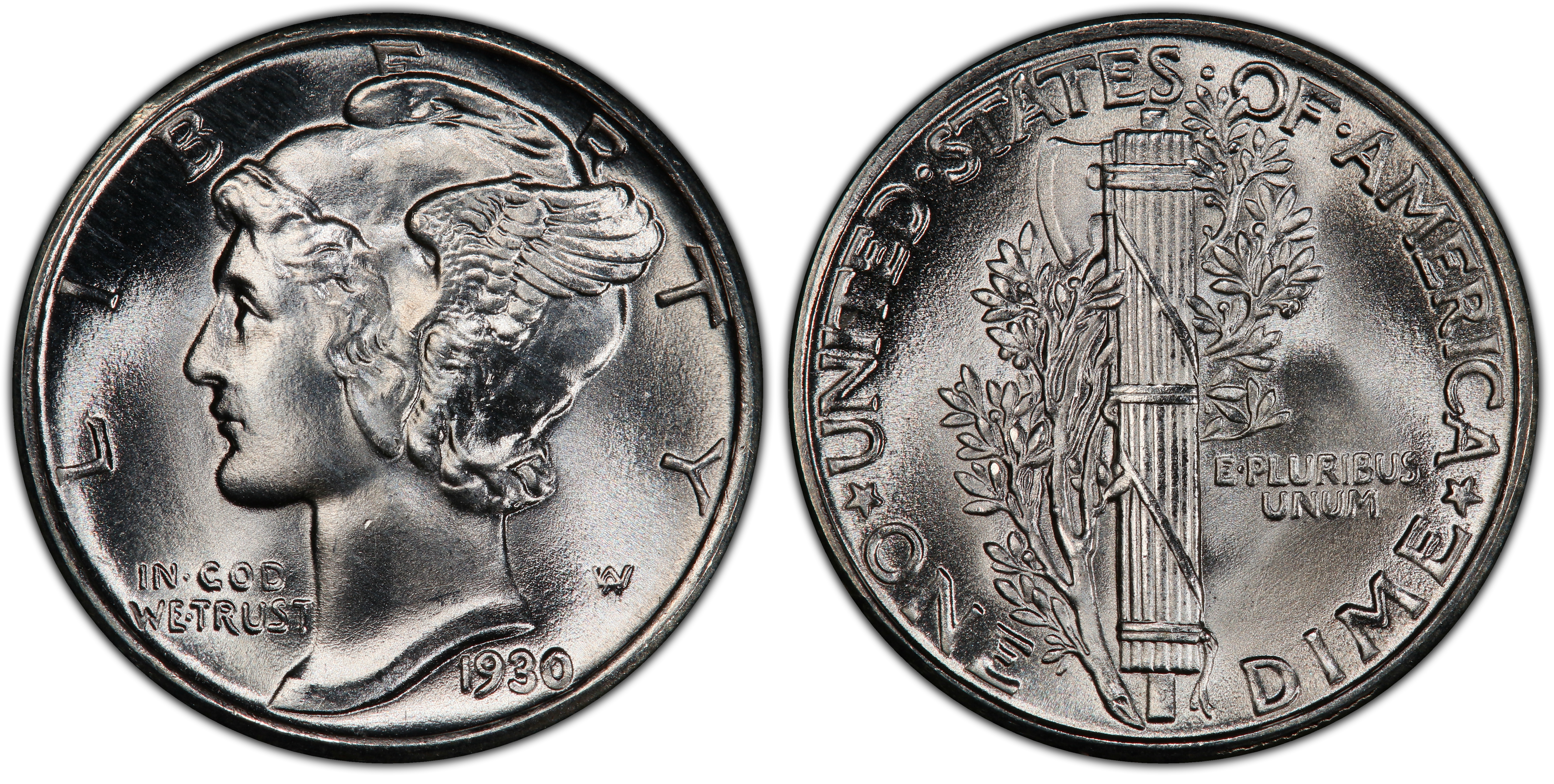 #2 PCGS MS67+FB As PCGS MS67+FB #40703792. GreatCollections, February 21, 2021, Lot 897739 - $10,631.25. As PCGS MS67+FB #41893127. Heritage Auctions, June 20, 2021, Lot 3076 - $9,600. Brilliant. |
| #2 PCGS MS67+FB |
 #2 PCGS MS67+FB Legend Rare Coin Auctions, January 30, 2020, Lot 159 - $10,281.25; Legend Rare Coin Auctions, February 25, 2021, Lot 109 - $14,697.50. |
 #2 PCGS MS67+FB Heritage Auctions, January 12, 2020, Lot 3567 - $9,000; "The Holman Collection" (PCGS Set Registry). |
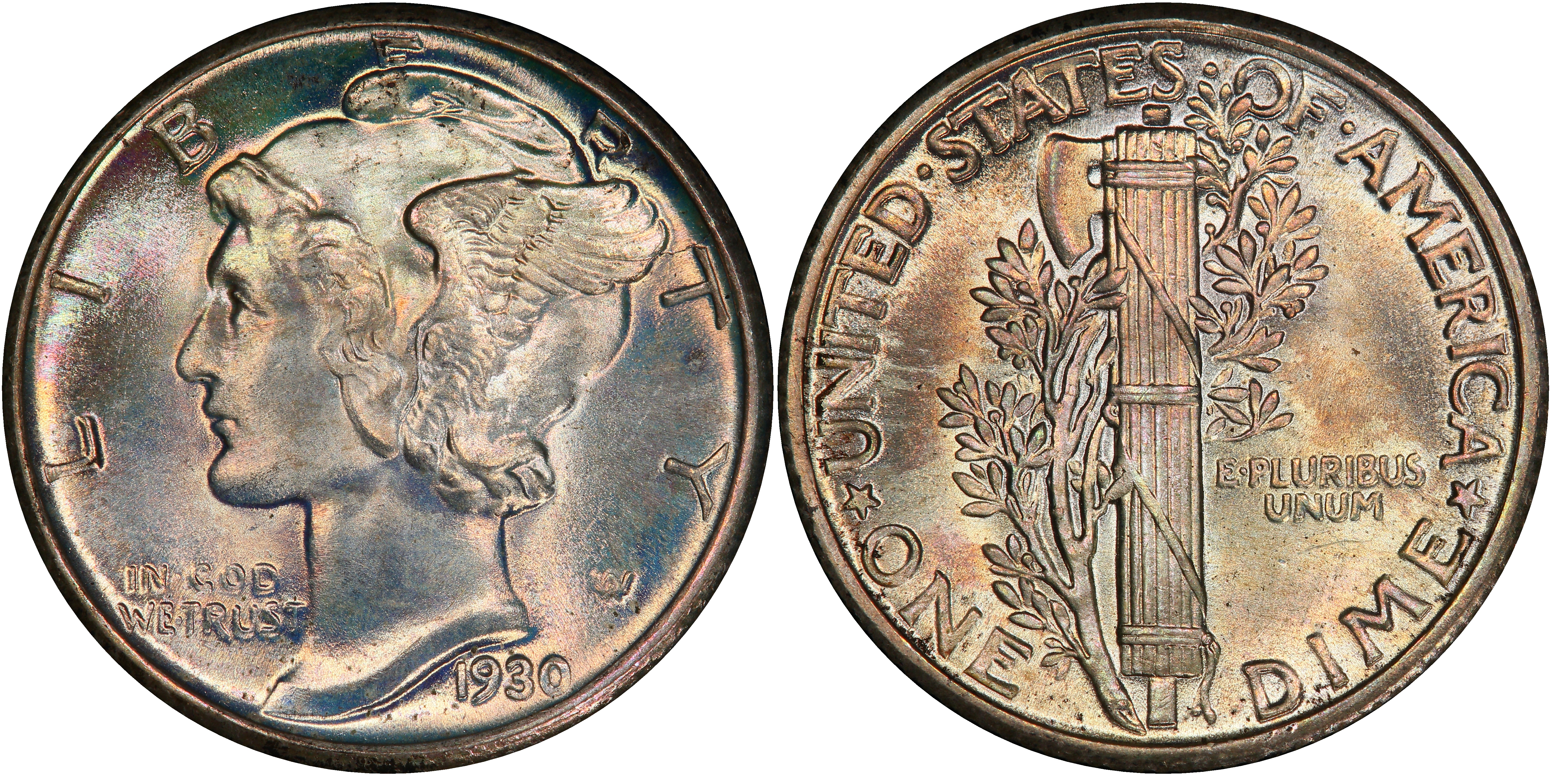 #2 PCGS MS67+FB The Hallett Collection; Legend Rare Coin Auctions, September 27, 2018, Lot 382 - $4,817.50; "The MERC MADNESS Collection" (PCGS Set Registry). |
 #2 PCGS MS67+FB Heritage Auctions, April 26, 2017, Lot 3786 - $7,050. Gold and magenta toning along the periphery. |
 #2 PCGS MS67+FB Gerald Forsythe; "The Merc Madness Collection" (PCGS Set Registry). Intense iridescent toning with peacock green along the upper periphery. |
 #2 PCGS MS67+FB |
The 1930 Mercury Dime
New York was the epicenter of a growing global financial crisis. Meanwhile, in Washington, Congressional Republicans and Democrats were deeply divided over how the federal government should respond to the collapsing economy. Republicans argued that providing relief was the duty of local governments and private charities, and that maintaining a balanced budget was essential to restoring economic confidence. Democrats argued that local municipalities were completely overwhelmed and broke, demanding direct federal relief in the form of grants and public works funding.
In Herbert Hoover, the Republicans had a highly effective executive who boasted one of the finest logistics and engineering minds of his generation. During World War I, Hoover had masterminded a brilliant humanitarian relief effort in Belgium and coordinated several key development projects prior to taking office as the Secretary of Commerce under Presidents Warren G. Harding and Calvin Coolidge. But even with his great mind and experience, the economic toll of the Great Depression overwhelmed the Hoover administration. Charles Michelson, the publicity director of the Democratic National Committee, popularized the term "Hoovervilles" to describe the shantytowns that began to spring up in late 1929 and early 1930. The term stuck, and the suffering public grew increasingly impatient with the administration.
In March 1930, New York Governor Franklin D. Roosevelt appointed the Committee on Stabilization of Industry for the Prevention of Unemployment. The working group, the first of its kind following the stock market crash, focused its early efforts on understanding the problem and seeking regulatory approaches to prevent future crashes and stabilize employment. Direct relief efforts came later. In 1931, Roosevelt hosted an interstate governors' conference in Albany to discuss unemployment remediation strategies. Later that year, he convened a special legislative session to create a Temporary Emergency Relief Administration, which was the first state-funded relief effort for the unemployed. It quickly ran through its $20 million appropriation.
Roosevelt's approach was ideologically opposed to Hoover's, and the American people had grown increasingly desperate. The unemployment rate, which had been stable at about 3% in 1929, grew to almost 25% by 1933. Communities were ravaged by bank failures, farm foreclosures, chronic unemployment, and little-to-no relief in sight. Within the Republican Party, even Hoover's renomination was in doubt, but he succeeded in standing for reelection, blaming the Depression on the aftermath of World War I and warning that Roosevelt's policies represented a dangerous, radical expansion of federal powers. Roosevelt's appeal to the out-of-work was clear: help was needed, and fast.
Beyond his platform of economic interventionism, a significant factor in the electoral outcome was Roosevelt's public willingness to repeal the 18th Amendment, which had established nationwide Prohibition. This unpopular amendment was seen as a major overreach, both in terms of its goals and its practical effects. By 1930, the government was actively investigating the impacts of this amendment; the resulting Wickersham Commission report exposed widespread enforcement failures, making it clear to the public that its continued existence was no longer tenable.
This was the setting for the production of the 1930 Mercury Dime. Production took place at the Philadelphia and San Francisco Mints. Philadelphia struck 6,770,000 examples, while San Francisco struck 1,843,000. These production numbers were far lower than in 1929, but would fall still lower in 1931. Despite these lower emissions, the growing popularity of coin boards and coin albums popularized the collecting of modern mint issues by date and mintmark, ensuring the survival of rolls and singles of most of the coins from this era.
* * *