1939 5C Reverse of 1940 (Regular Strike)
Series: Jefferson Five Cents 1938-1964

PCGS MS67+

REVERSE COMPARISON

PCGS MS67+
- PCGS #:
- 94003
- Designer:
- Felix Schlag
- Edge:
- Plain
- Diameter:
- 21.20 millimeters
- Weight:
- 5.00 grams
- Mintage:
- 120,627,535
- Mint:
- Philadelphia
- Metal:
- 75% Copper, 25% Nickel
- Auction Record:
- $1,725 • MS67 • 09-19-2005 • Superior Galleries
Major Varieties
Rarity and Survival Estimates Learn More
| Survival Estimate | |
|---|---|
| All Grades | 40,000,000 |
| 60 or Better | 135,000 |
| 65 or Better | 125,000 |
| Numismatic Rarity | |
|---|---|
| All Grades | R-1.0 |
| 60 or Better | R-1.9 |
| 65 or Better | R-1.9 |
| Relative Rarity By Type All Specs in this Type | |
|---|---|
| All Grades | 9 / 68 TIE |
| 60 or Better | 13 / 68 TIE |
| 65 or Better | 31 / 68 TIE |
| Relative Rarity By Series All Specs in this Series | |
|---|---|
| All Grades | 12 / 82 TIE |
| 60 or Better | 16 / 82 TIE |
| 65 or Better | 36 / 82 TIE |
Condition Census What Is This?
|
#1 PCGS MS67+
GreatCollections, October 2, 2022, Lot 1236138 - $204.75. |
|
#1 PCGS MS67+
GreatCollections, November 17, 2019, Lot 735900 - $148.50; "Cat's Jefferson Set #1" (PCGS Set Registry). |
|
#1 PCGS MS67+
GreatCollections, January 8, 2017, Lot 383794 - $339,75. |
|
#1 PCGS MS67+
GreatCollections, April 24, 2016, Lot 354438 - $455.63; "The Stephen M. Sparks Collection" (PCGS Set Registry). |
|
#1 PCGS MS67+
|
 #1 PCGS MS67+
|
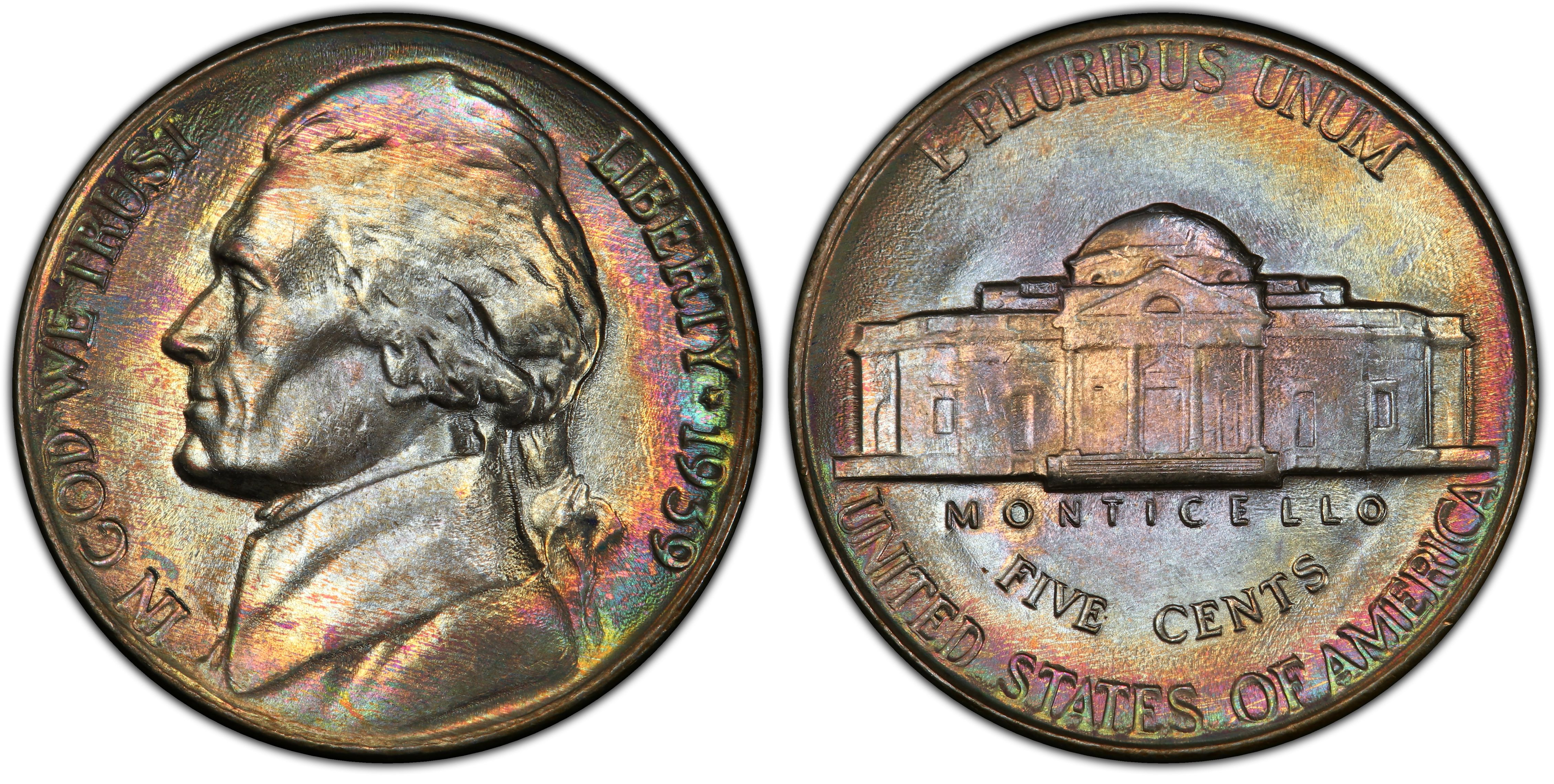 #1 PCGS MS67+
|
The 1939 Jefferson Nickel
In 1938, the Jefferson Nickel made its official debut, replacing the Buffalo Nickel after its 25-year production run. The new coin was born from an open design competition held in 1937 to honor the nation's third president. German émigré and American artist Felix Oscar Schlag won the contest, securing the $1,000 grand prize for his submission.
Schlag’s concept for the obverse of the coin featured a profile of Jefferson based on Jean-Antoine Houdon's famous bust. This timeless design proved remarkably durable, remaining essentially unchanged on the five-cent piece for 66 years. However, the reverse design was a completely different story. Schlag’s original vision featured an innovative, dynamic three-quarters perspective of Jefferson’s Monticello estate. The Treasury Department flatly rejected this angled view, demanding instead the flat, head-on portrayal of the mansion that remains the standard on nickels minted to this day.
As is often the case, any flaws with a coin's design will come to light in the first few years of mass production. Midway through 1939, the Mint identified defficiencies with the Monticello portion of the reverse design and made a series of changes to strengthen the design. This led to the production of two distinct varieties for the year: the Reverse of ’38, so-called because it used the original reverse design that debuted in 1938; and the Reverse of ’40, so-called because all Jefferson Nickel issues struck in 1940 bore this enhanced design.
The difference between the two designs is difficult for non-specialists to point out, but can best be described as a strengthening of the steps on Monticello, with the borders being less rounded and more defined. Of the two varieties, the Reverse of ’40 is less common.
The 1939 Nickel Two Reverses
As is often the case, design flaws typically come to light during the first few years of a coin's mass production. Midway through 1939, the Mint identified deficiencies in the Monticello portion of the reverse and made a series of modifications to sharpen the image. This resulted in two distinct varieties for the year:
- The Reverse of ’38: So named because it used the original design that debuted the previous year.
- The Reverse of ’40: So named because it featured the enhanced design that would become standard for all 1940 Jefferson Nickels.
While these differences can be difficult for non-specialists to spot, the primary change is a sharpening of the steps on Monticello, which feature crisper, more defined borders rather than the original rounded look. Of the two 1939 varieties, the Reverse of ’40 is the scarcer find.
The 1939 Doubled Monticello Variety
For cherrypickers, the 1939 "Reverse of ’40" Jefferson nickel offers a prominent variety featuring doubling on the word MONTICELLO that is clearly visible to the naked eye.
* * *