1982-D 5C (Regular Strike)
Series: Jefferson Five Cents 1965 to Date
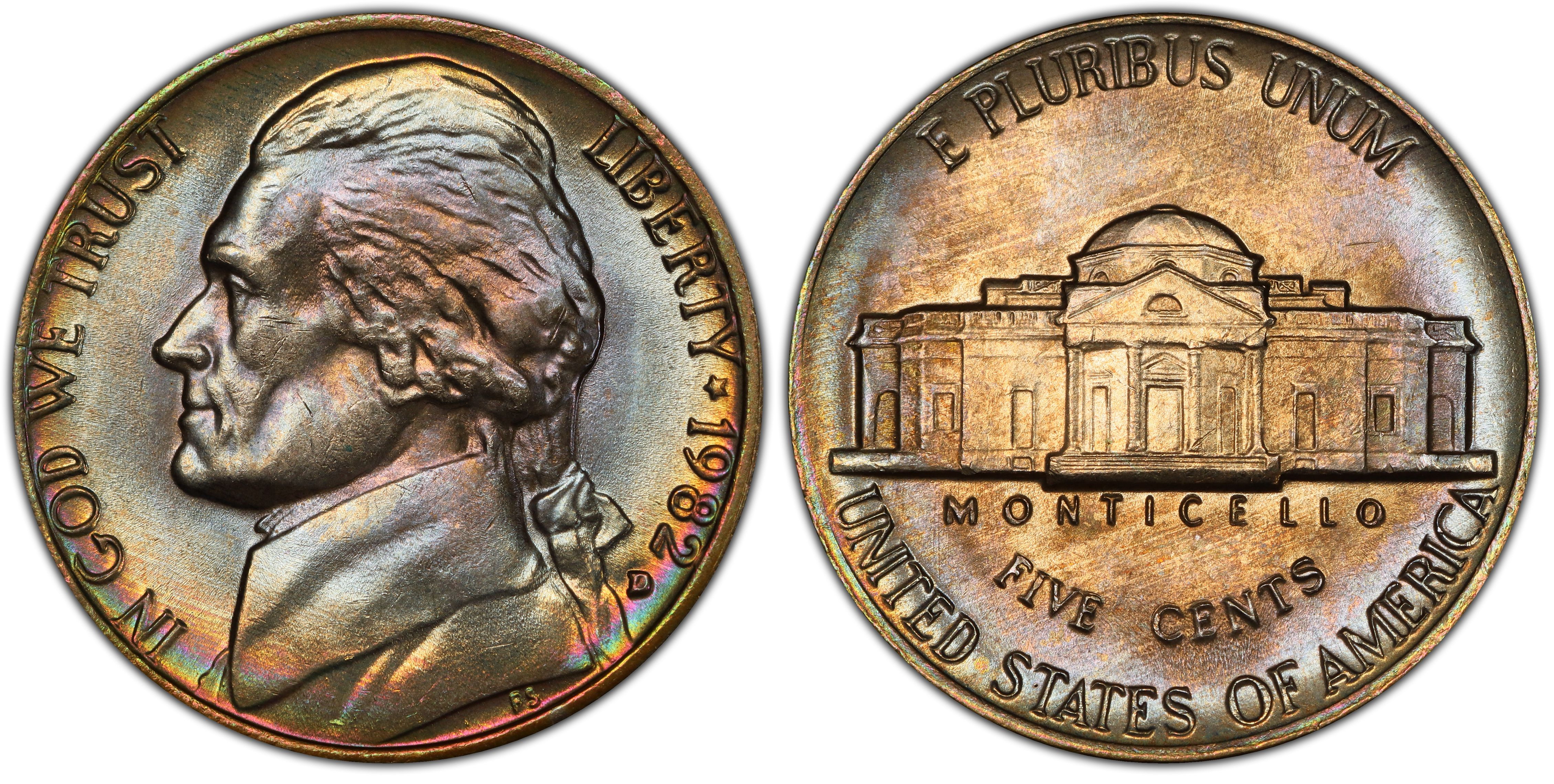
PCGS MS66+

PCGS MS66+
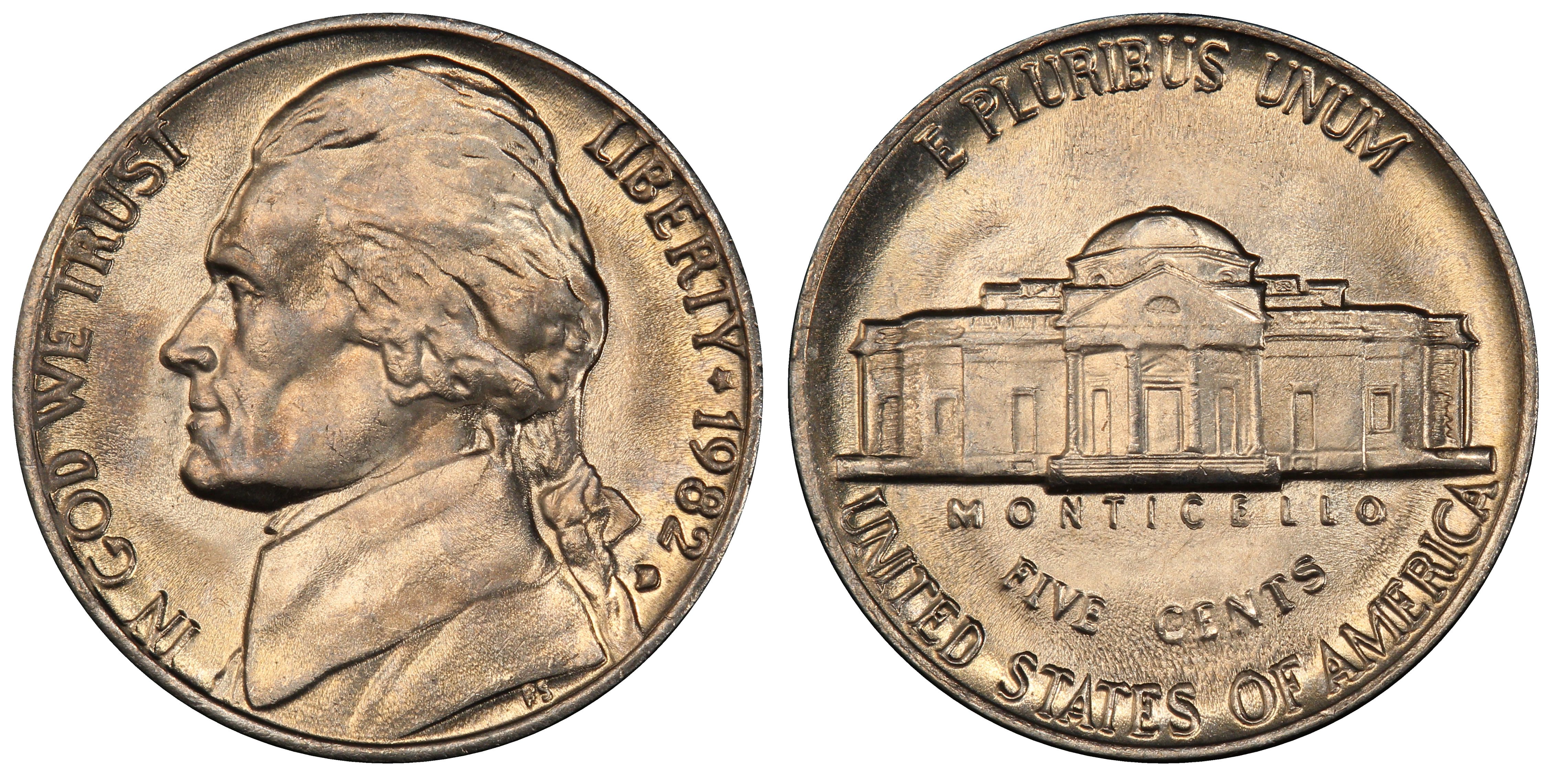
PCGS MS66+
- PCGS #:
- 4109
- Designer:
- Felix Schlag
- Edge:
- Plain
- Diameter:
- 21.20 millimeters
- Weight:
- 5.00 grams
- Mintage:
- 373,726,544
- Mint:
- Denver
- Metal:
- 75% Copper, 25% Nickel
- Auction Record:
- $495 • MS67 • 08-28-2019 • eBay
Condition Census What Is This?
|
#1 PCGS MS67
Heritage Auctions, February 7, 2017, Lot 21424 - $152.75; "The Rick Jones Collection" (PCGS Set Registry). Small tick on Jefferson's forehead. Die lines and pebbled surfaces visible around Monticello. |
|
#1 PCGS MS67
Heritage Auctions, February 14, 2016, Lot 27393 - $282. Prominent die lines on the obverse. Small cluster of ticks above Monticello, to the left of the dome. |
|
#1 PCGS MS67
"The Stephen M. Sparks Collection" (PCGS Set Registry). |
| #1 PCGS MS67 |
The 1982-D Jefferson Nickel
The United States Mint took a two-year hiatus from manufacturing official Uncirculated Coin Sets beginning in 1982. The official justification was government budget cuts; the Treasury anticipated that terminating the program would save approximately $3.5 million annually—a mere rounding error relative to the government's total annual spending of $750 to $800 billion.
Despite this suspension, the Treasury did not eliminate all collector products. Proof Set production continued, and 1982 marked the return of the commemorative coin program with the 1982-D George Washington Half Dollar (#9600). Additionally, the American Arts Gold Medallion series saw new issues in both 1982 and 1983. For those who physically visited the Philadelphia or Denver Mints, uncirculated coins were still available through Souvenir Sets sold at the mint gift shops.
Private companies attempted to capitalize on the hiatus by assembling their own "mint sets" from coins pulled from general circulation. However, because collectors expected official sets to contain Choice specimens struck from fresh dies, these "ersatz" sets failed to satisfy the market. In 1984, persistent lobbying from the numismatic community convinced the Mint to reverse course. When production resumed, the packaging was modernized and the coins exhibited a notably "fresher" appearance than those found in the clad sets issued through 1981.
Collecting the 1982-D Jefferson Nickel
In a typical year, the Mint produced roughly two million Mint Sets, ensuring a baseline pool of at least that many uncirculated specimens for collectors. To put that in perspective, a two-million-coin pool represents over 75% of the entire mintage of the "key date" 1950-D Jefferson Nickel (#4042).
Without these sets in 1982 and 1983, the supply of Mint State coins was restricted to the limited number of Souvenir Sets sold at the mints, a small volume of private aftermarket sets, and whatever bags or rolls were set aside by proactive dealers and collectors. While the Denver Mint struck 373,726,544 nickels in 1982, survival estimates for Mint State examples vary wildly. It is impossible to determine the exact figure, but a realistic estimate suggests that no more than a few hundred thousand were held back at the time of release—and at least 25% of those likely eventually trickled into circulation. This diffuse supply has made the search for Superb Gems, particularly those with Full Steps, exceptionally difficult.
The scarcity is reflected in the grading data: PCGS did not certify its first PCGS MS67FS until 2019, and its first PCGS MS66FS was not recorded until 1998. Currently, the condition census for coins graded PCGS MS66+FS or better remains in the single digits. While the 1982-D with Full Steps may not be as elusive as the notoriously poorly struck issues of the 1950s, for the average hobbyist, sourcing a Gem 1982-D is a much tougher challenge than finding a Gem 1950-D.
* * *