1879/8 5C, CAM (Proof)
Series: Shield Five Cents 1866-1883

PCGS PR67+CAM
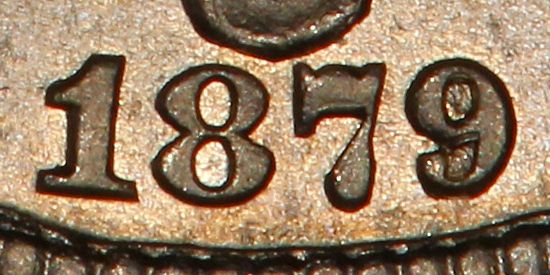
CLOSEUP OF OVERDATE

PCGS PR67+CAM
- PCGS #:
- 83834
- Designer:
- James Barton Longacre
- Edge:
- Plain
- Diameter:
- 20.50 millimeters
- Weight:
- 5.00 grams
- Mintage:
- 3,200
- Mint:
- Philadelphia
- Metal:
- 75% Copper, 25% Nickel
- Auction Record:
- $15,275 • PR67 CAC • 02-27-2014 • Heritage Auctions
Condition Census What Is This?
 #1 PCGS PR67+CAM
Legend Rare Coin Auctions, January 27, 2019, Lot 40 - $19,975. JD-1. Small toning spot between the 3rd and 4th columns. |
|
#1 PCGS PR67+CAM
Legend Rare Coin Auctions, September 27, 2018, Lot 269 - $9,400. JD-1. |
|
#1 PCGS PR67+CAM
JD-1. A thin hairline touches the left side of the lower-left leaves. On the reverse, there is a strikethrough at the denticles near the 8 o'clock position. |
The 1879/8 Shield Nickel Proof
The 1879/8 Shield Nickel Proof (Base #3834) is a popular Guide Book overdate that actually encompasses two of the four 1879 Shield Nickel Proof die marriages, as identified by John W. Dannreuther in United States Proof Coins, Volume II: Nickel (2023). Of the two marriages, JD-1 (Obverse 1 with Reverse A) represents the overwhelming majority of all 1879 Proofs struck. The second overdate marriage, JD-4 (Obverse 1 with Reverse D), is rare, representing an estimated 5% of the total mintage.
While some have argued that the overdate is actually a repunched 9 or a result of a clogged die, the characteristics of an 8 punch are clearly visible under magnification.
Overdate Diagnostics: JD-1 (#102795) and JD-4 (#102804)
JD-1
Obverse:
- The 1: The left edge of the bottom serif of the 1 is positioned just to the right of the center of a denticle.
- Alignment: A vertical line extended upward from the left edge of this bottom serif aligns with the inside of the right diagonal stroke of the W in WE.
- The Ball: The top-left serif of the 1 nearly touches the ball of the shield.
- Rim: A denticle ridge is visible extending from the 6 o'clock toward the 7 o'clock position.
Reverse:
- Doubling: "Longacre Doubling" is present on several stars, specifically the star above the T in CENTS and the stars below AMERICA.
- The T: The letter T in CENTS features a thin, irregular top bar.
JD-4
Obverse: (Same as JD-1)
- The 1: The left edge of the bottom serif of the 1 is positioned just to the right of the center of a denticle.
- Alignment: A vertical line extended upward from the left edge of this bottom serif aligns with the inside of the right diagonal stroke of the W in WE.
- The Ball: The top-left serif of the 1 nearly touches the ball of the shield.
- Rim: A denticle ridge is visible extending from the 6 o'clock toward the 7 o'clock position.
Reverse:
- "Fishhook" S: Per Dannreuther: "...fishhook S of CENTS from doubled die hubbing of the normal hub and the defective 'Broken S' hub."
PCGS will attribute these varieties through our Variety Program.
* * *