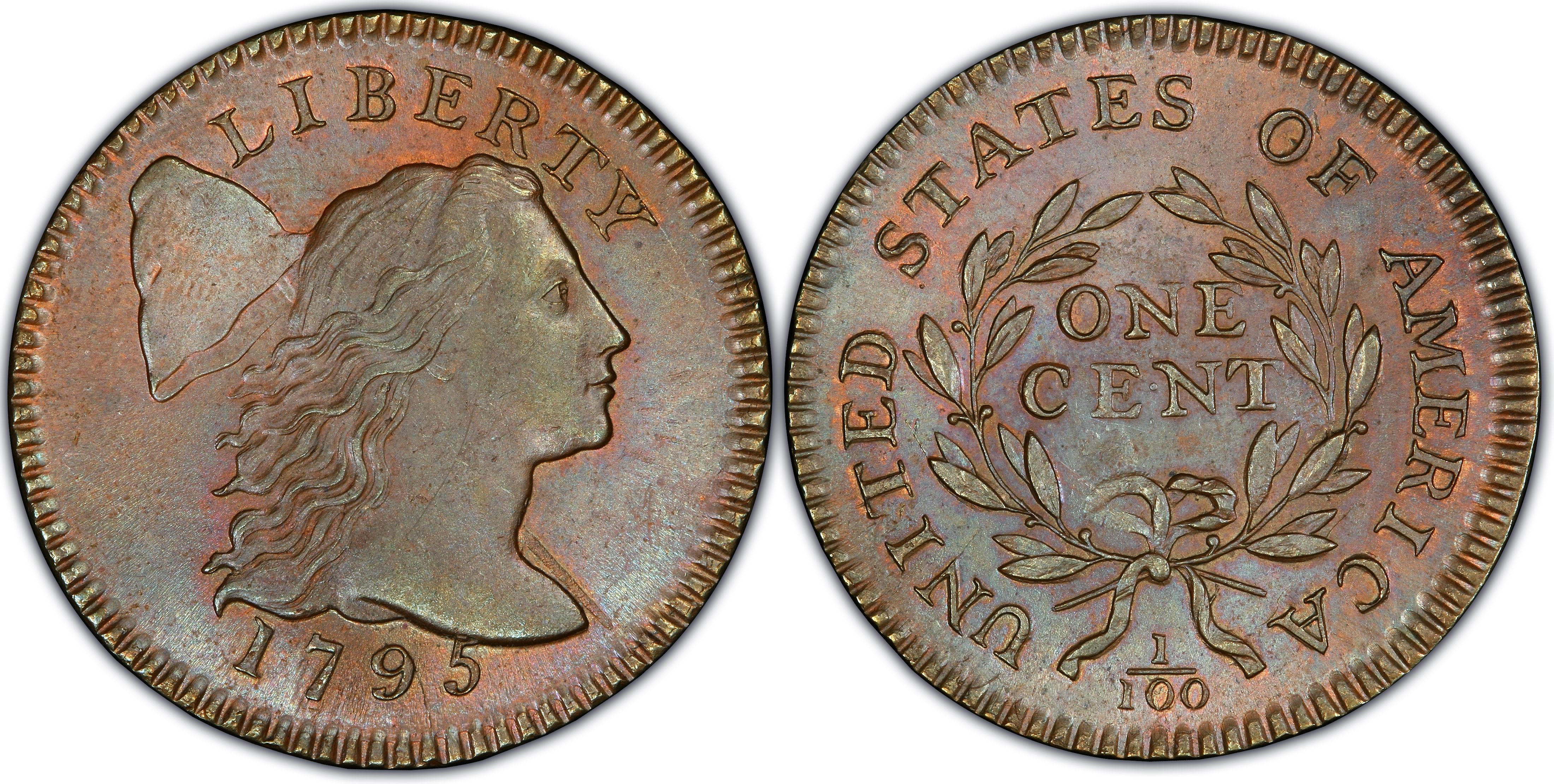
1795 1C Lettered Edge, RB (Regular Strike)
Series: Liberty Cap Cents 1793-1796

PCGS MS65+RB

PCGS MS65+RB

PCGS MS65RB
- PCGS #:
- 1378
- Designer:
- Attributed to Robert Scot
- Edge:
- Lettered: ONE HUNDRED FOR A DOLLAR
- Diameter:
- 28.00 millimeters
- Weight:
- 13.48 grams
- Mintage:
- 37,000
- Mint:
- Philadelphia
- Metal:
- Copper
- Auction Record:
- $207,000 • MS65 • 02-01-2008 • Heritage Auctions
Major Varieties
Rarity and Survival Estimates Learn More
| Survival Estimate | |
|---|---|
| All Grades | 4 |
| 60 or Better | 4 |
| 65 or Better | 2 |
| Numismatic Rarity | |
|---|---|
| All Grades | R-9.8 |
| 60 or Better | R-9.8 |
| 65 or Better | R-9.9 |
| Relative Rarity By Type All Specs in this Type | |
|---|---|
| All Grades | 3 / 5 |
| 60 or Better | 3 / 5 |
| 65 or Better | 3 / 5 |
| Relative Rarity By Series All Specs in this Series | |
|---|---|
| All Grades | 3 / 6 |
| 60 or Better | 3 / 6 |
| 65 or Better | 3 / 6 |
Condition Census What Is This?
|
#1 PCGS MS65+RB
Discovered in Europe; Sotheby's, October 1995, Lot 1395; Anthony Terranova; Lawrence Stack, sold privately as an entire collection in January 2003. As PCGS MS65+RB #32189853. "The D. Brent Pogue Collection, Part V," Stack's Bowers & Sotheby's, March 2017, Lot 5101 - $223,250; Mike Chipman. S-75. Die State I. |
|
#2 PCGS MS65RB
Virgil M. Brand; Carl Wurtzbach, 1935; Charles R. Mathewson, 1953; Dr. William H. Sheldon, April 1972; R.E. “Ted” Naftzger, Jr., February 1992; Eric Streiner; Jay Parrino; Superior, May 1999, Lot 1465 – $26,450. As PCGS MS65RB #13470603. “The Walter J. Husak Collection”, Heritage Auctions, February 15, 2008, Lot 2076 – $207,000. As PCGS MS65+RB #40323763. “The Bob R. Simpson Collection, Part I,” Heritage Auctions, September 17, 2020, Lot 10006 – $114,000. S-74. Die State VI. |
 #3 PCGS MS65RB
Virgil M. Brand; B.G. Johnson, January 1944; Arthur C. Fritz; Rudolph Khol; Federal Coin Exchange Fixed Price List 1952; Harold Bareford, September 1985; Herman Halpern, December 1986 - R.E. "Ted" Naftzger; Goldberg Auctioneers, September 2008, Lot 170 - $155,250. S-75. |
|
#3 PCGS MS65RB
As NGC MS65RB #339896-001. Heritage Auctions, January 7, 2010, Lot 2408 - $40,250. As PCGS MS65RB #27442689. S-75. Die State V. |
| #3 PCGS MS65RB |
| #6 PCGS MS64RB |
| #6 PCGS MS64RB |
| #6 PCGS MS62RB |
| #10 PCGS MS62RB |
The 1795 Liberty Cap Cent
1795-dated Liberty Cap Cents come in two planchet varieties: thick lettered-edge planchets (BN #1378), which were all struck earlier in 1795, and thin plain-edge planchets (BN #1380), which were struck in late December — likely on December 26, 27, and 31. Based on this timeline and the fact that plain-edge cents far outnumber lettered-edge examples, numismatists presume that production of 1795-dated plain-edge cents continued into the spring of 1796. Walter Breen speculated that production shifted from 1795-dated to 1796-dated dies around March or April.
Three obverse dies and three reverse dies were used to strike the 37,000 Lettered Edge cents. Struck on heavy copper planchets weighing 208 grains, these coins bore the incuse edge inscription ONE HUNDRED FOR A DOLLAR.
Why the Edge Changed
The one word answer is cost. Rising raw copper prices pushed production costs beyond face value. By October 1795, it cost $1.22 to manufacture $1.00 worth of cents.
Although Congress had authorized a weight drop earlier in March, official action took place late in the year. In December 1795, President George Washington instructed newly appointed Mint Director Elias Boudinot to reduce the cent's weight to 168 grains (formalized by presidential proclamation in January 1796).
This weight reduction resulted in thinner planchets, prompting the Mint to drop edge lettering altogether.
Plain Edge cents far outnumber Lettered Edge cents, with estimates ranging from 4:1 to 13:1 (according to numismatist Walter Breen). A few experimental Reeded Edge cents (BN #1383) were also produced; these remain extreme rarities that survive only in lower, circulated grades.
Lettered Edge Die Varieties
- Sheldon-73 (BN #35711): Widely spaced date. The "1" nearly touches Liberty's hair, while the "5" is spaced away from the bust. Lettering: The "ER" in LIBERTY is positioned notably higher than the surrounding letters. History: Discovered by numismatist Sylvester Crosby prior to 1883.
- Sheldon-74 (BN #35714): Obverse Die: Shared with S-75; distinguished by the upper flag of the "5" burrowing directly into the truncation of Liberty's bust. Reverse Die: Carried over from S-73; features distinct single leaves below "IT" (in UNITED) and "CA" (in AMERICA). Overall a challenging die marriage. PCGS records a single S-74 in Mint State Red-Brown, boasting an illustrious provenance tracing back to the legendary Virgil Brand collection.
- Sheldon-75 (BN #35717): Obverse carried over from S-74. Doubled leaf at the top right branch.
- Sheldon-76a (BN #35720): The "5" in the date is buried into the bust truncation. The placement of LIBERTY (positioned farther left) distinguishes this obverse from that of S-73. The reverse is notable because ONE CENT is positioned high above the center.
* * *