1909 VDB 1C, RD (Proof)
Series: Lincoln Cents 1909-1958
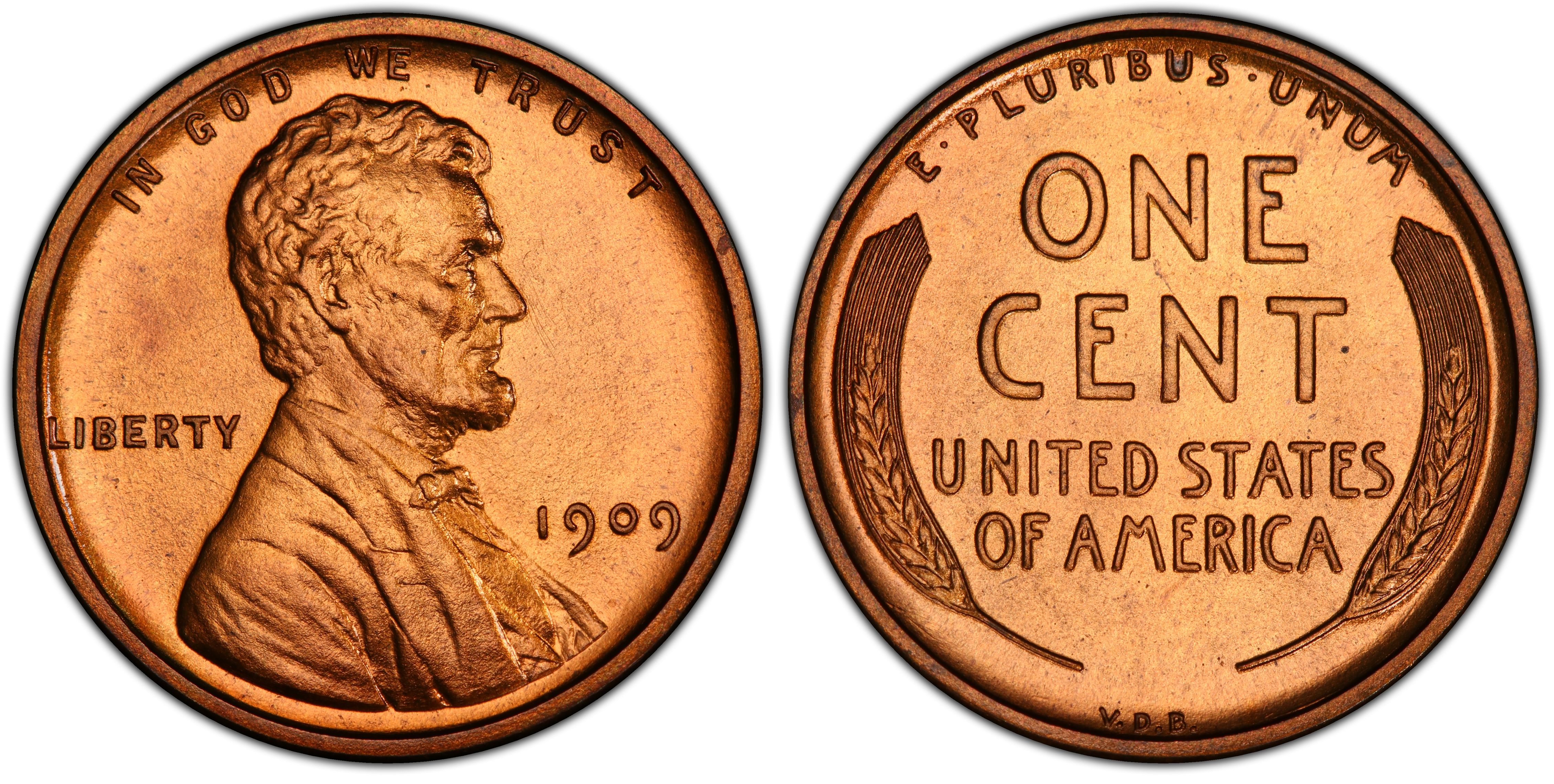
PCGS PR67+RD
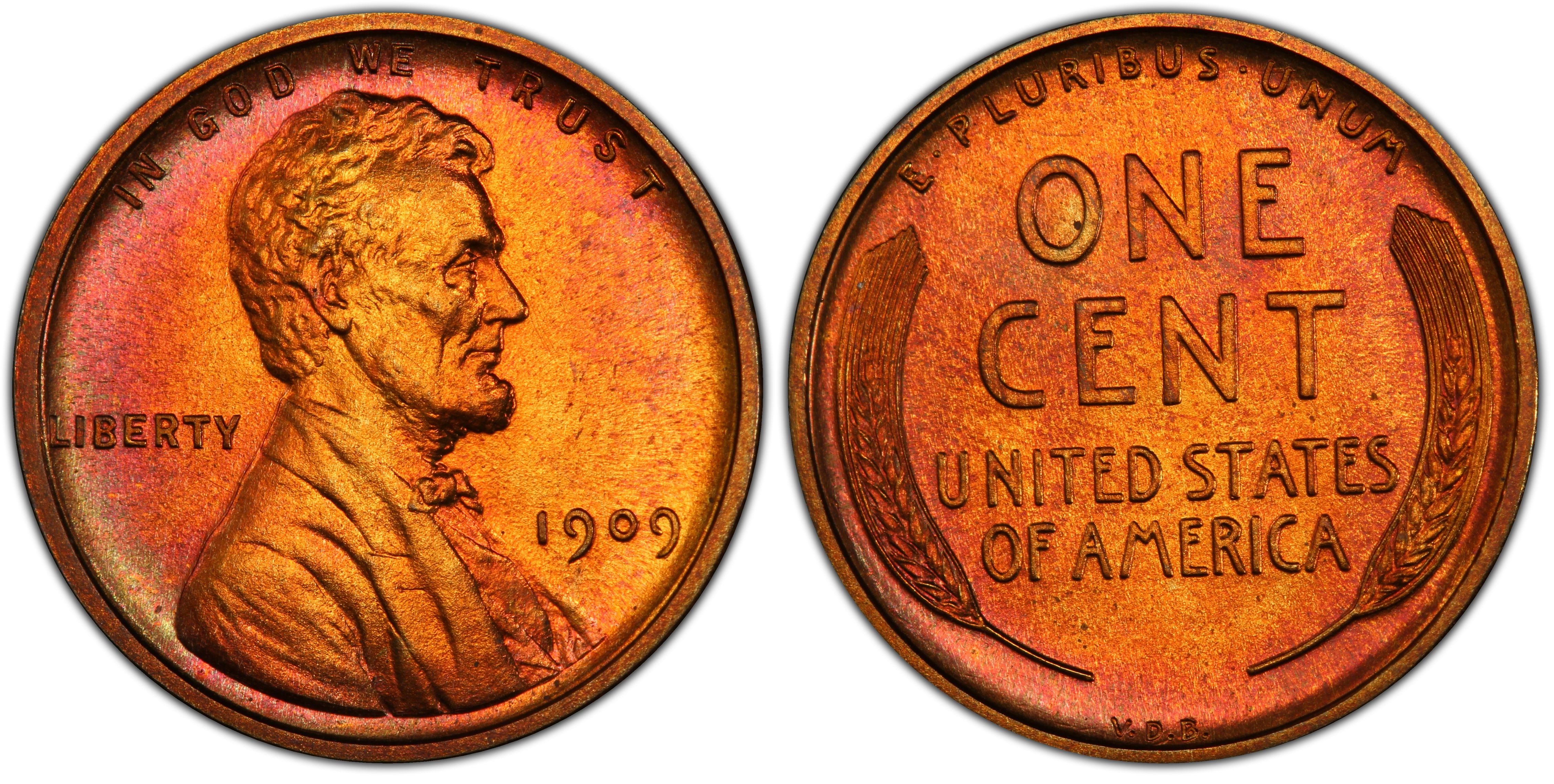
PCGS PR67+RD

PCGS PR66+RD
- PCGS #:
- 3302
- Designer:
- Victor David Brenner
- Edge:
- Plain
- Diameter:
- 19.00 millimeters
- Weight:
- 3.11 grams
- Mintage:
- 1,194
- Mint:
- Philadelphia
- Metal:
- 95% Copper, 5% Tin and Zinc
- Auction Record:
- $70,500 • PR66RD • 01-27-2019 • Legend Rare Coin Auctions
Rarity and Survival Estimates Learn More
| Survival Estimate | |
|---|---|
| All Grades | 65 |
| 60 or Better | 65 |
| 65 or Better | 35 |
| Numismatic Rarity | |
|---|---|
| All Grades | R-8.3 |
| 60 or Better | R-8.3 |
| 65 or Better | R-8.8 |
| Relative Rarity By Type All Specs in this Type | |
|---|---|
| All Grades | 2 / 26 |
| 60 or Better | 2 / 26 |
| 65 or Better | 2 / 26 TIE |
| Relative Rarity By Series All Specs in this Series | |
|---|---|
| All Grades | 2 / 26 |
| 60 or Better | 2 / 26 |
| 65 or Better | 2 / 26 TIE |
Condition Census What Is This?
|
#1 PCGS PR67+RD
|
|
#1 PCGS PR67+RD
GreatCollections, July 26, 2020, Lot 853569 - $194,062.50; "The Brenner's Masterpieces Collection" (PCGS Set Registry). |
|
#3 PCGS PR66+RD
ESM Collection; "The Louisiana Lagniappe Collection," Heritage Auctions, August 18, 2024, Lot 4108 - $66,000. |
 #4 PCGS PR66RD
|
 #4 PCGS PR66RD
As PCGS PR66RD #25274569. "The Bender Collection, Part II," Heritage Auctions, January 11, 2023, Lot 3332 - $52,800. As PCGS PR66RD #46780420. |
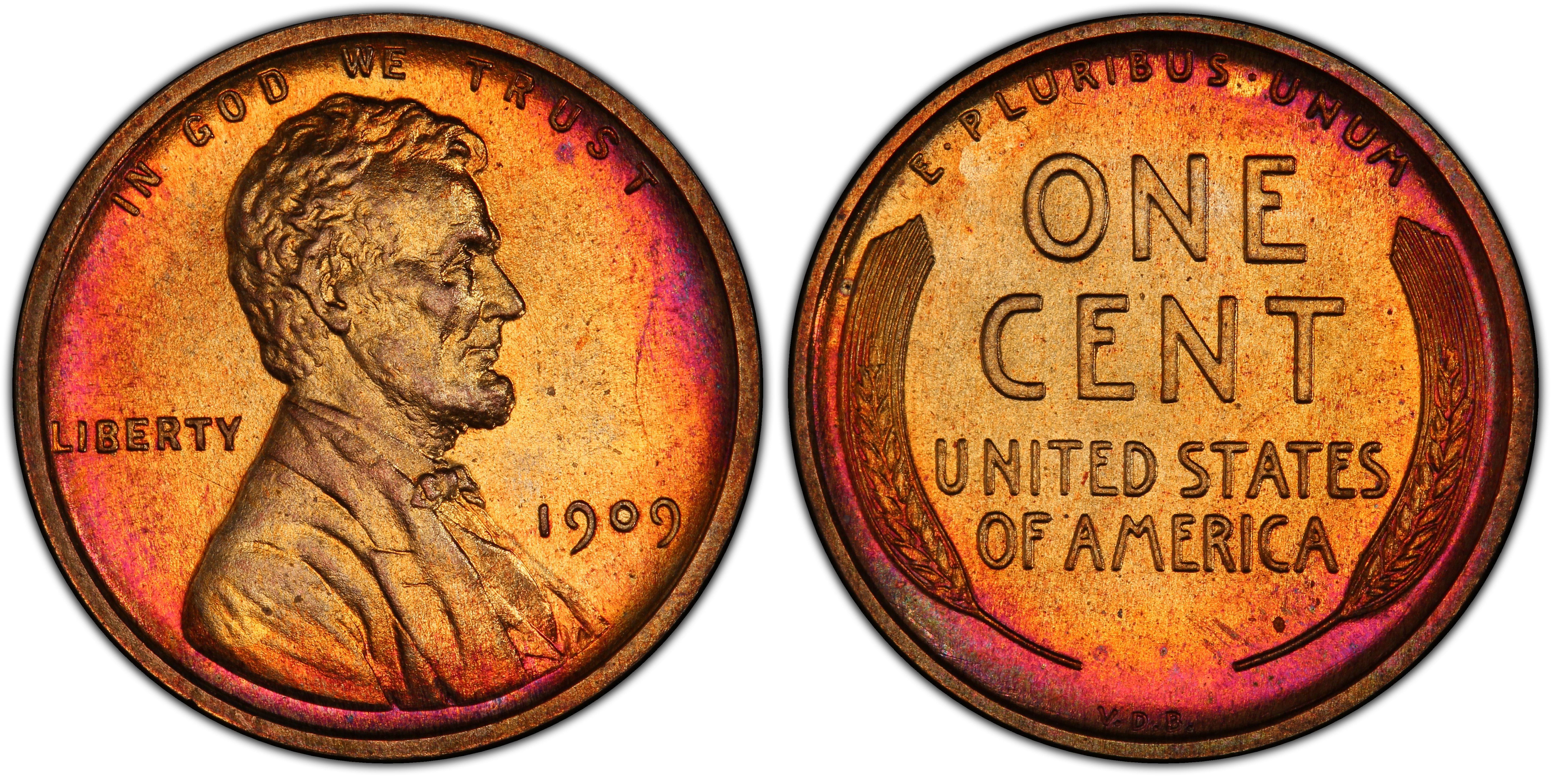 #4 PCGS PR66RD
As PCGS PR66RD #25220766. "The Wright Collection," Heritage Auctions, August 10, 2016, Lot 3970 - $54,050. As PCGS PR66RD #37482062. |
| #4 PCGS PR66RD |
| #4 PCGS PR66RD |
| #4 PCGS PR66RD |
The 1909 Lincoln Cent Proof, with V.D.B.
The Lincoln Cent was issued to mark the centennial of the birth of the Great Emancipator. Its design was the work of Victor David Brenner, a Litvak sculptor who immigrated to the United States in 1890. Settling in New York City, Brenner initially established himself by engraving badges for local clubs and cutting dies for jewelers.
In 1898, he left New York to train under famed medalist Oscar de la Roty in Paris. This proved to be the turning point in Brenner's career, elevating his work from commercial craft to fine art. His Mlle. C. at the Piano plaque was exhibited at the Paris Exhibition of 1900, where it won an honorable mention. Armed with a newfound reputation, Brenner returned to New York in 1901 and accepted multiple commissions for medals, including several for the American Numismatic Society.
As the centennial of Lincoln’s birth approached, Brenner immersed himself in a study of the president. This culminated in the production of a large Lincoln plaque in 1907, for which he expected high demand. In 1908, he produced a smaller, round commemorative medal featuring the Lincoln portrait. The reverse depicted an allegorical scene of an eagle atop a cliff alongside the words “Preserve, Protect, Defend.”
Were it not for Brenner obtaining the commission to design the Panama Canal Service Medal, he likely would not have had the opportunity to design the Lincoln Cent. While preparing that medal's design, Brenner requested that President Theodore Roosevelt sit for him so he could capture a true likeness. During these sessions, Brenner displayed his previous portrait models of Lincoln. Roosevelt, who was only two years removed from his collaboration with Augustus Saint-Gaudens on the gold Eagle and Double Eagle, recognized Brenner’s obvious talent and engaged him to design the new one-cent coin.
The Struggle for a Coinable Design
While Brenner’s portrait of Lincoln was undoubtedly remarkable, the sculptor failed to deliver a functionally "coinable" design. In February 1909, Chief Engraver Charles E. Barber wrote to Brenner requesting crucial technical adjustments. Barber noted that the plane of the field on Brenner's original Lincoln medal was uneven in front of and behind the portrait. He warned that the coin’s fields must be finished with a fixed radius (or curve), and that the highest points of relief on the obverse must not sit directly opposite the high points of relief on the reverse. For a coin intended for mass production, where circulating cents were struck at a rapid rate of 120 coins per minute per press, such a defect would prevent the metal from flowing properly, rendering the design unsuitable for coinage.
Plaster casts of the modified design arrived at the Philadelphia Mint on March 1, but the technical issues persisted. Mint Director Frank A. Leach desired the cent to be finished with a dished field of a single curve, matching the recently completed Philippine Islands coinage and traditional U.S. coins. However, Barber reported to Philadelphia Mint Superintendent John Landis that Brenner had failed to follow these instructions.
Because the plaster models lacked a uniform curve, the mint could not utilize a fixed-radius basining stone to polish the dies. Barber complained that "before one part of the die came to the radius, another part would be ground out, consequently we cannot use a basin at all, there not being one radius to the model." The fields behind, in front of, and above the head all differed from one another.
Brenner was more successful with his reverse design, though the mathematical proportions were still incorrect. Barber noted:
“The model so far as I am able to ascertain has a radius of sixty and the reduction will be about ten or one-tenth that of the model, this will bring the first reduction to a radius of six, and by the time the dies are made and tempered they will be still rounder, or something less than six. Our one-cent dies finish at twenty-five radius.”
In short, the reverse model was far too round. Furthermore, the borders were too narrow; Barber warned that once the models were mechanically reduced to coin size, the rims would be reduced to nothing but a sharp knife-edge. Barber concluded that if the requirement to basin these dies was abandoned, the die-making process would be simplified, suggesting that the initial reductions be sent back to Brenner for further revisions.
Trial Strikes are Made
The first experimental pieces soon followed. On May 12, 1909, Acting Philadelphia Mint Superintendent Albert Norris sent three initial Proofs to Superintendent Landis. Two days later, on May 14, Norris forwarded two more pieces to Acting Mint Director Robert Preston. At this juncture, only these five initial proofs had been struck.
Following these trial strikes, several changes were made at Preston's request. On May 20, Landis sent Preston six additional examples of the 1909 Proofs: two from the original hubs (presumably) and four featuring the newly requested modifications.
Believing his designs were finally approved, Brenner wrote to Director Leach on May 21 requesting an example of the new coin. Leach’s reply on May 22 was undoubtedly a disappointment to the sculptor:
“I have to inform you that I was not satisfied with the first Proof of the Lincoln Cent. I found that you had not dropped the Lincoln portrait down so that the head would come nearer the center of the coin, a matter I called your attention to when we were discussing your model. This is necessary to get the best result in bringing out the features in striking the coin. Therefore, I had Mr. Barber make me a Proof of this change, and as this left so much blank space over the top, we concluded that it would be better on putting the motto “IN GOD WE TRUST.” This change has made a marked improvement in the appearance of the coin. I cannot send you a sample, but if you feel enough interest in the matter, it would be better for you to go down to Philadelphia where Mr. Barber can explain and show you what has been done.
There is such a demand from influential people for samples of this coin that we cannot comply without unjust discrimination, neither will we be able to make any distribution of the coins until enough have been struck to supply all demands. I acknowledge receipt of your bill, and as soon as the design has been finally adopted, I will file it for payment.”
While Leach was writing to Brenner, bureaucratic momentum continued. On May 21, Acting Director Preston authorized the preparation of new dies for additional test strikings. On May 26, Director Leach and Assistant Secretary of the Treasury Norton visited the White House to show President William Howard Taft the trial pieces. They presented both Brenner’s original design and Barber’s modified version, which included the repositioned portrait and the added motto. The President was “greatly pleased” with the modifications and praised Barber’s mechanical interventions.
The following day, May 27, Preston returned a total of 13 specimen pieces representing the various experimental designs to the Philadelphia Mint. All of them were destroyed in the presence of Barber and Landis.
Production of the Lincoln Cent was set to begin.
The 1909 V.D.B. Controversy Impacts the Proof Issue
When the regular-issue Lincoln cents finally debuted in August 1909, early public correspondence was highly favorable. Brenner's portrait was widely admired; however, some voiced displeasure regarding the prominent placement of his initials at the bottom of the reverse. This public outcry led to a suspension of coinage almost immediately following the coin's release. Ahead of the official debut, the Philadelphia Mint began producing business-strike 1909 V.D.B. Lincoln Cents (RD #2425) from June 10 through August 5, striking a total of 27,995,000 examples. Meanwhile, the San Francisco Mint struck the 1909-S V.D.B. Lincoln Cent (RD #2428) in a tight window from August 2 to August 5, producing just 484,000 pieces.
On August 2, the Mint's medal room delivered 1,194 V.D.B. Lincoln Cent Proofs (RD #3302), all of which were struck from a single die pair. Because they share the same dies, all genuine examples exhibit specific obverse diagnostics: a thin diagonal die scratch extending from the back of Lincoln’s coat into the field under the RT in LIBERTY, alongside a cluster of diagonal, sometimes overlapping die scratches directly in front of Lincoln’s nose. Additionally, two parallel diagonal scratches can be found in the upper right obverse field beneath the RU in TRUST. To accompany these cents in that year's Minor Proof sets, the medal room also struck and delivered 1,497 Liberty Nickel Proofs (#3907) on August 2.
Following the suspension of V.D.B. coinage and the mandated removal of the designer's initials, Proof cent production resumed on August 17 with an initial delivery of 852 No V.D.B. Lincoln Cents (RD #3305). Additional quantities of the 1909 No V.D.B. Proofs were delivered later in August and December. The suspension of V.D.B. cent Proof production caused great consternation among collectors and dealers—no doubt due to the lost opportunity to acquire and market examples of the controversial issue. Some correspondence between collectors and dealers and the Mint is preserved in the National Archives and is reprinted in Kevin Flynn's informative Lincoln Cent Matte Proofs. One notable exchange came from prominent coin dealer Lyman Low.
On October 7, Low wrote to the Mint attempting to purchase 100 Minor Proof Sets that included all three cents struck that year: the 1909 Indian Cent Proof (RD #2416), the 1909 Lincoln with V.D.B., and the 1909 Lincoln without V.D.B. Low argued that the Mint had established a precedent for fulfilling late orders of obsolete or suspended coinage, citing the 1883 nickels, which were made available in all three types. The mint was unmoved.
Collector complaints regarding the availability of these minor proof sets persisted through December. Because the Matte Proofs were produced in a single, limited production run. Ultimately, only a small fraction of the collectors who ordered the Proof sets managed to secure them.
* * *