1903 G$1 LA Purchase, Jefferson (Regular Strike)
Series: Gold Commemoratives 1903-1926

PCGS MS68

PCGS MS68
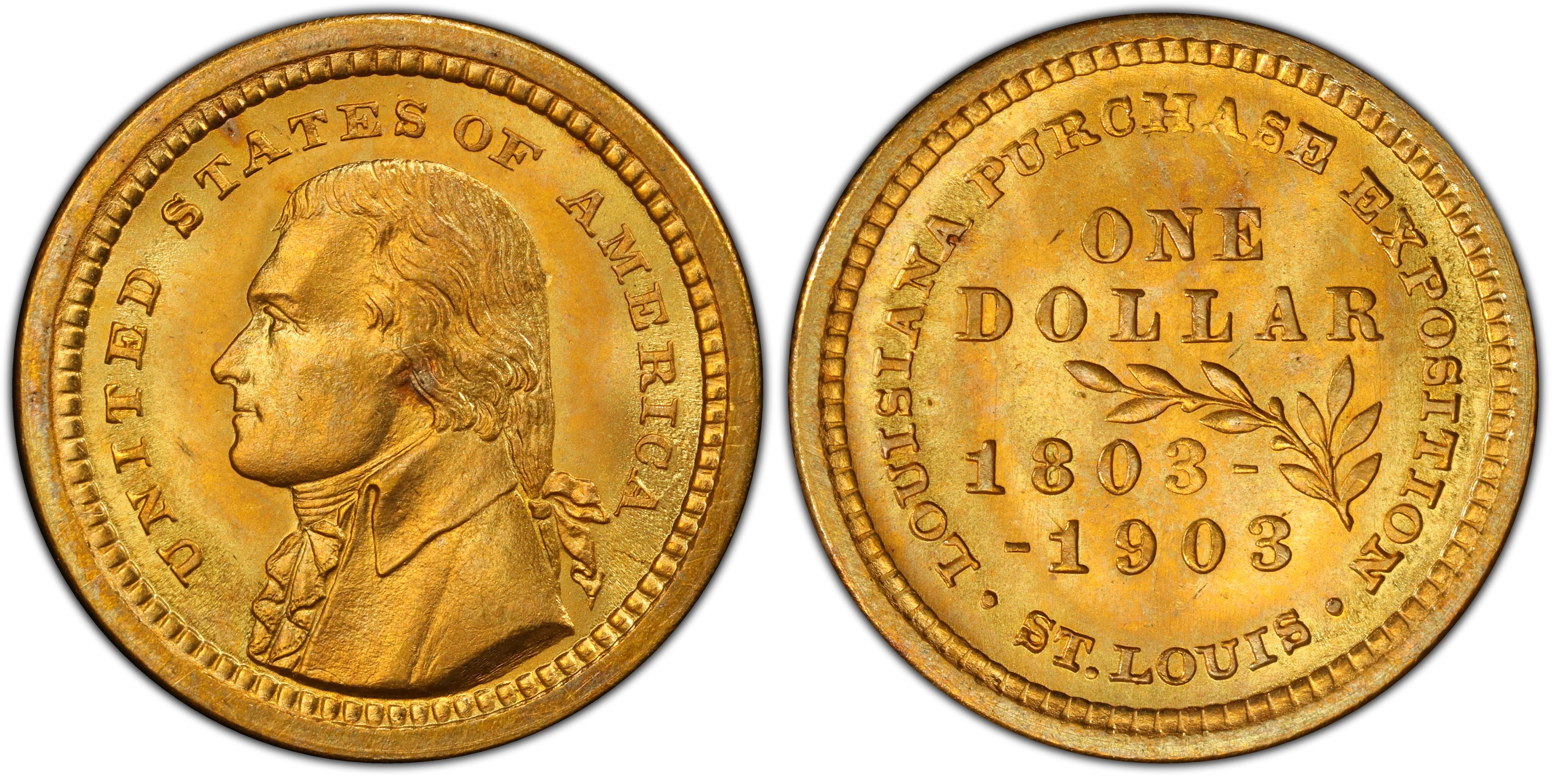
PCGS MS68
- PCGS #:
- 7443
- Designer:
- Charles E. Barber
- Edge:
- Reeded
- Diameter:
- 14.30 millimeters
- Weight:
- 1.70 grams
- Mintage:
- 17,500
- Mint:
- Philadelphia
- Metal:
- 90% Gold, 10% Copper
- Auction Record:
- $25,850 • MS67 • 01-07-2015 • Heritage Auctions
Rarity and Survival Estimates Learn More
| Survival Estimate | |
|---|---|
| All Grades | 10,000 |
| 60 or Better | 9,000 |
| 65 or Better | 3,000 |
| Numismatic Rarity | |
|---|---|
| All Grades | R-3.0 |
| 60 or Better | R-3.2 |
| 65 or Better | R-4.4 |
| Relative Rarity By Type All Specs in this Type | |
|---|---|
| All Grades | 11 / 13 |
| 60 or Better | 11 / 13 |
| 65 or Better | 12 / 13 |
| Relative Rarity By Series All Specs in this Series | |
|---|---|
| All Grades | 11 / 13 |
| 60 or Better | 11 / 13 |
| 65 or Better | 12 / 13 |
Condition Census What Is This?
 #1 PCGS MS68
"The Atlantic Collection 13" (PCGS Set Registry). |
|
#1 PCGS MS68
"The Elite Collection" (PCGS Set Registry). |
|
#1 PCGS MS68
|
|
#1 PCGS MS68
|
|
#1 PCGS MS68
|
The 1903 Louisiana Purchase Jefferson Gold Dollar
When the United States formally took possession of the Louisiana Territory on December 20, 1803, effectively doubling the nation's geographical size, Napoleon Bonaparte was preoccupied in Europe, navigating conflicts with Great Britain and rival Continental powers. The French emperor had envisioned a sweeping global empire, but the previous year, his brother-in-law General Charles Leclerc and tens of thousands of French troops perished from yellow fever while attempting to suppress the Haitian Revolution. With Saint-Domingue lost as a strategic Western base, Louisiana lost its appeal to Napoleon, becoming a lucrative asset to liquidate to finance his European military campaigns.
For Americans, the Louisiana Purchase was an unequivocal triumph. Unlike later acquisitions like Alaska ("Seward’s Folly"), its immense economic value was recognized immediately. The territory contained some of the richest agricultural soil on Earth, destined to become the agricultural heartland of the nation.
The Centennial & Coinage Authorization
A century later, the nation celebrated this pivotal territorial expansion. To commemorate the 1904 Louisiana Purchase Exposition in St. Louis, Missouri, Congress authorized $5 million for the world’s fair. On June 28, 1902, federal legislation provided for the mintage of 250,000 commemorative gold dollars — the very first gold commemoratives ever authorized by the United States Mint.
The enabling legislation left the design open-ended, prompting the Mint to create two distinct coins sharing a common reverse. President Thomas Jefferson, who orchestrated the 1803 purchase, was the obvious choice for the first obverse. The second portrait choice arose following the September 1901 assassination of President William McKinley at the Pan-American Exposition in Buffalo, New York. While sitting President Theodore Roosevelt might have seemed the logical pick, McKinley had signed the original Exposition appropriations bill just six months before his death. To honor his memory, officials immortalized McKinley on the second coin.
Chief Engraver Charles E. Barber designed both obverses, drawing criticism for a lack of artistic originality. For Jefferson, Barber modeled his work on John Reich’s 1801 Indian Peace Medal, which was itself derived from Jean-Antoine Houdon's classic sculpted bust. For McKinley, Barber simply recycled his own 1901 presidential medal — a design famously derided as "deadly!" by master sculptor Augustus Saint-Gaudens. Both portraits are encircled at the periphery by UNITED STATES OF AMERICA. The conservative reverse features ONE DOLLAR 1803-1903 at center, surrounded by LOUISIANA PURCHASE EXPOSITION ST. LOUIS, separated at the bottom by a single olive branch symbolizing the peaceful acquisition of the 828,000-square-mile territory.
Production & Commercial Distribution
The Philadelphia Mint struck the authorized 250,000 pieces (plus 258 assay coins) in two batches: 75,080 in December 1902, and 175,178 in January 1903. Construction delays postponed the exposition's opening to April 30, 1904. On the fairgrounds, the gold dollars were sold for $3 each under the direction of Farran Zerbe, a charismatic coin dealer and tireless promoter of numismatics.
Zerbe, famous for his traveling "Money of the World" exhibit, was entrusted by Mint officials with full distribution authority. It was Zerbe’s idea to feature two distinct portraits to encourage collectors to purchase pairs. Despite his unflagging enthusiasm, public sales were a commercial failure, and the coins traded below their $3 issue price for a decade after the fair closed. In 1914, after Zerbe and other distributors had exhausted their markets, 215,000 unsold pieces (86% of the total mintage) were returned to the Treasury and melted. Famous Fort Worth dealer B. Max Mehl purchased remaining discounted stock from Zerbe, offering them to collectors for decades. While financially disappointing at launch, the surviving coins eventually found an appreciative collector base in the latter half of the 20th century.
Collecting the 1903 Lousiana Puchase Jefferson Gold Dollar
Although official records do not track melt figures by design, researchers estimate that roughly 17,375 examples of each variety survived. The PCGS Population Report suggests the McKinley dollar is marginally scarcer than the Jefferson, especially in Gem grades (PCGS MS65 and higher). Most collectors treat them as distinct issues, requiring both to complete a U.S. gold commemorative type set.
While thousands were preserved by collectors, non-collectors on the fairgrounds frequently converted them into jewelry, leaving edge damage or solder traces on the reverse. Unmounted surviving coins typically grade between PCGS MS62 and PCGS MS64, with Gems commanding significant premiums.
Luster ranges from satiny to semi-prooflike. Additionally, the Mint produced 100 official brilliant Proofs of each design from the first 100 pieces struck. These were mounted on large cardboard displays secured with string and red-wax Philadelphia Mint seals. Extremely few intact, sealed originals survive today.
When evaluating raw pieces, watch for initial friction on the obverse high point (the cheek) and the reverse olive branch near the "3" in 1803. Counterfeits exist for both issues, typically characterized by a soft overall strike, unnatural surface texture, and tooling marks in the fields.
* * *