1833 $5 Large Date (Proof)
Series: Capped Bust $5 1820-1833
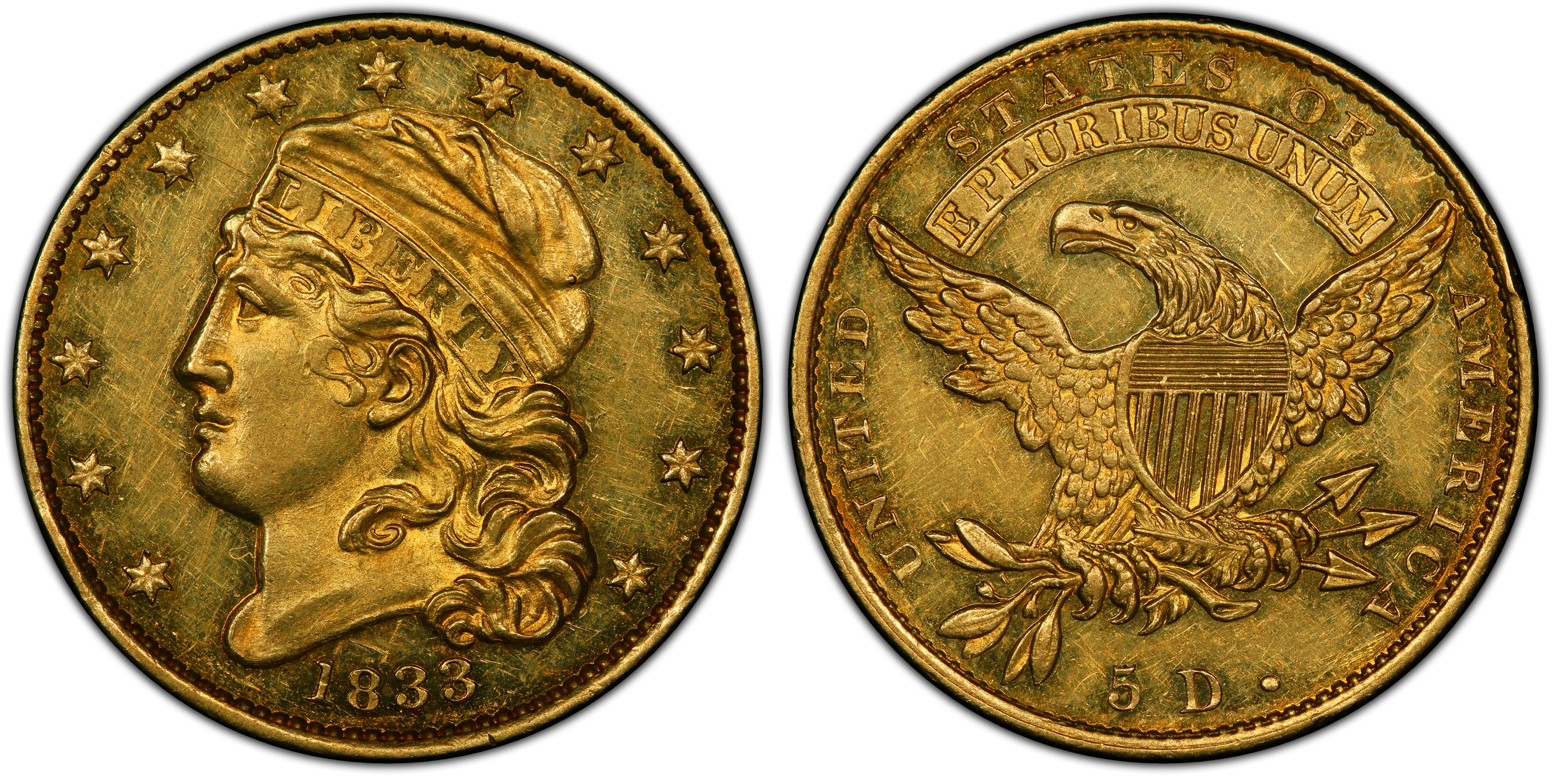
PCGS PR61
- PCGS #:
- 8167
- Designer:
- Robert Scot & John Reich
- Edge:
- Reeded
- Diameter:
- 23.80 millimeters
- Weight:
- 8.75 grams
- Mintage:
- 5
- Mint:
- Philadelphia
- Metal:
- 91.7% Gold, 8.3% Copper
- Auction Record:
- $1,351,250 • PR67 • 05-24-2016 • Stack's Bowers
Rarity and Survival Estimates Learn More
| Survival Estimate | |
|---|---|
| All Grades | 2 |
| 60 or Better | 2 |
| 65 or Better | 1 |
| Numismatic Rarity | |
|---|---|
| All Grades | R-9.9 |
| 60 or Better | R-9.9 |
| 65 or Better | R-10.0 |
| Relative Rarity By Type All Specs in this Type | |
|---|---|
| All Grades | 2 / 3 TIE |
| 60 or Better | 2 / 3 TIE |
| 65 or Better | 1 / 3 TIE |
| Relative Rarity By Series All Specs in this Series | |
|---|---|
| All Grades | 5 / 8 TIE |
| 60 or Better | 5 / 8 TIE |
| 65 or Better | 1 / 8 TIE |
Condition Census What Is This?
|
#1 PCGS PR61
"The Nicholas Petry, Esq. Collection," Samuel Hudson & Henry Chapman, May 10, 1893, Lot 314; unknown intermediaries; As NGC AU58. Bowers and Merena, July 2002, Lot 784. As NGC PF61 #1997485-001. Heritage Auctions, October 2012, Lot 5838 - $146,875; Heritage Auctions, April 24, 2021, Lot 5119 - $240,000. As PCGS PR61 #42233570. |
The Evolution of "Proof" Coinage
The term “Proof” to describe special presentation coins did not enter common usage in the United States until the mid-19th century, when the United States Mint began offering such examples for sale to the general public. Before this, coins of Proof quality were generally referred to as “Master Coins.” These were presentation pieces struck in extremely limited quantities for reasons not well documented.
In contrast, foreign mints began producing sets of these Master Coins nearly a century before the U.S. Mint followed suit. The first famous American Proof Set is arguably the 1834 set, produced for Edmund Roberts’ diplomatic mission to the Far East. These sets contained the legendary Class I 1804 Draped Bust Dollar (#6907), along with the even rarer "Plain 4" 1804 Capped Bust Eagle (#8570).
The 1834 set also featured an example of William Kneass’s Classic Head $5 Proof (#8180)—a first-year issue of the design that is also exceptionally rare.
Rarity in Early U.S. Proof Gold
Rarity is the defining characteristic of early U.S. Proof gold. For the Capped Bust Half Eagle design, the series is practically uncollectible due to the sheer lack of surviving specimens:
Large Size Capped Bust $5 (1813–1829)
- 1820 (Curl Base 2, Large Letters): 1 known.
- 1821: 2 known (one in private hands).
- 1822–1824: No Proofs known. (Note: The 1822 business strike is a legendary rarity with only three total known, only one of which is in private hands).
- 1825/4/1: A bizarre overdate; the 1821 die was repurposed twice. 2 known (one private, one in the National Numismatic Collection).
- 1826: 1 known (NNC). A second was sold to an Egyptian buyer in 1954 and has not been seen since.
- 1827: None known.
- 1828: Unique (Smithsonian).
- 1829 (Large Size): 2 known.
Summary: Only 7 specimens known to exist, with a mere 4 in private hands.
Small Size Capped Bust $5 (1829–1834)
- 1829 (Small Size): 2 known (one in the NNC).
- 1830: Disputed; possibly 2 or 3, but potentially 0.
- 1831: None known.
- 1832: 1 known.
- 1833: 4 known (one in the NNC).
Summary: Approximately 7 to 10 known, with 5 to 8 in private hands.
The 1833 Half Eagle
With four known examples and three traded privately, the 1833 is the only semi-collectible issue of the type. Preservation states range from PCGS PR61 to the staggering PCGS PR67+CAM.
The PR67+CAM specimen—the finest known Proof of the entire type—can be traced back to the 19th-century J. Colvin Randall Collection. When it appeared at David W. Akers’ sale of the John Jay Pittman Collection, it realized $467,500 ($952,000 in 2026 inflation-adjusted dollar), the highest price of the sale. Pittman, a savvy collector and "white-collar worker" at Kodak, famously took out a second mortgage on his home to secure this and other rarities from the 1954 King Farouk sale—a feat of dedication nearly unthinkable today.
Die Characteristics & Diagnostics
Traditional numismatic nomenclature identifies two date styles for the 1833 Half Eagle: Large and Small. However, precise measurements reveal that the actual size of the punches (excluding the "1") is nearly identical. The distinction lies in the spacing (wide apart or close together) and the morphology:
Large Date: The “8” is formed by a two-loop stack, and the “3” features the central spine. Date wide apart. A die-center punch lump is visible on the lower two horizontal lines of the shield. The eagle’s rear talon—an unattached crescent-shaped mound between the leaf clusters—is significantly sharper on Proofs than on business strikes.
Small Date: The “8” is constructed of a continuous, overlapping stroke, and the center point of the “3” is blunted, lacking the spine. Date close together.
Cameo
To achieve the Cameo effect, the Mint dipped the dies in acid to impart frost. This frost was fleeting; research suggests the dies may have been used for circulation strikes both before and after the Proofs were produced, as the die state shows clear deterioration throughout the production run.
There are two known proofs. The finest is the amazing Gem PCGS graded PR67. The pedigree of this incredible coin includes such famous collectors as Parmelee, Woodin, Farouk, and John Pittman. The coin brought $467,500 in the October, 1997 Pittman auction, and then brought $977,500 when it was resold in a Heritage auction in January, 2005. There is also a supposedlt impaired PR58.