
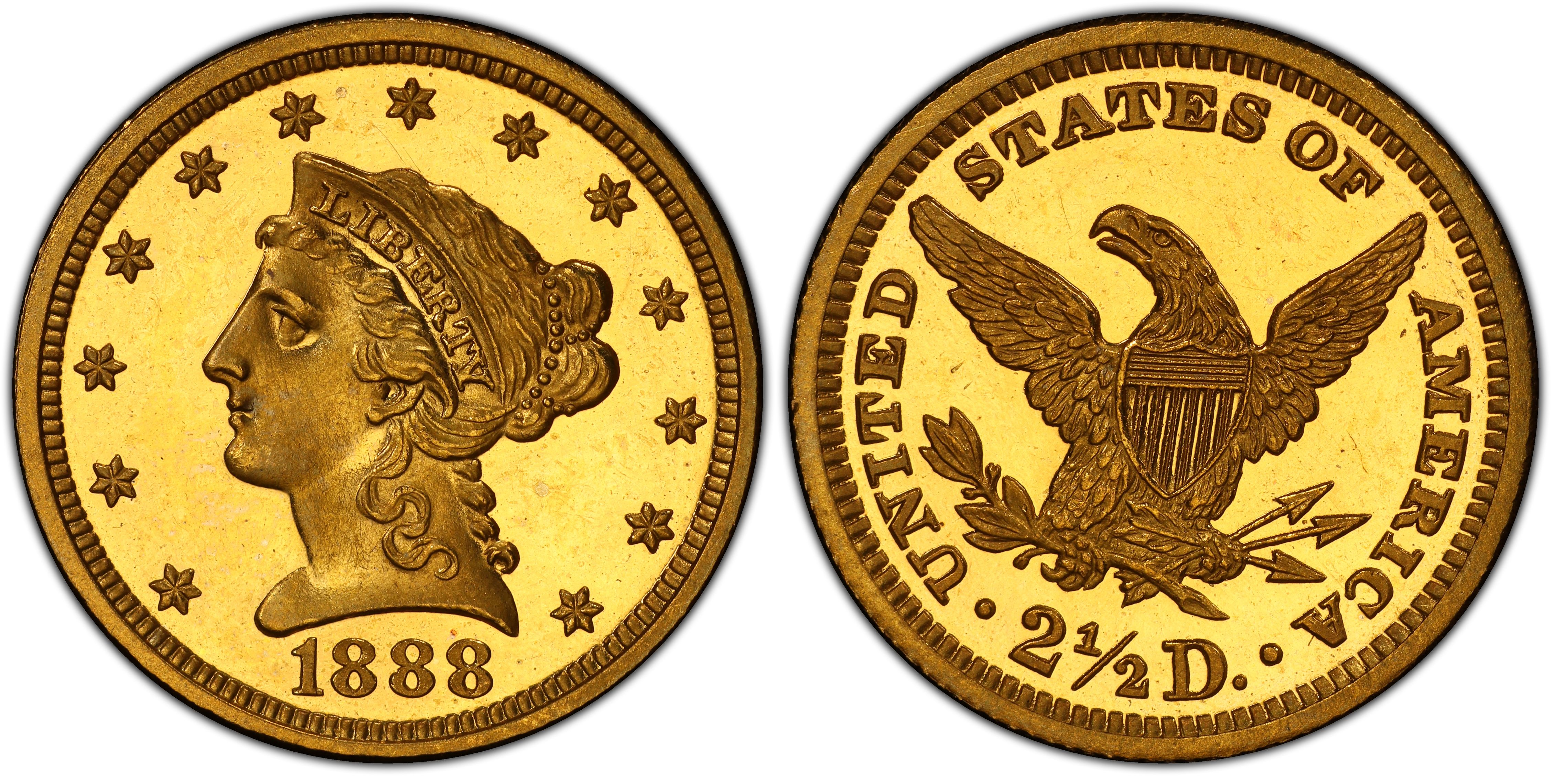
PCGS PR65+CAM

PCGS PR65CAM
- PCGS #:
- 87914
- Designer:
- Christian Gobrecht
- Edge:
- Reeded
- Diameter:
- 18.00 millimeters
- Weight:
- 4.18 grams
- Mintage:
- 97
- Mint:
- Philadelphia
- Metal:
- 90% Gold, 10% Copper
- Auction Record:
- $44,650 • PR66CAM • 11-15-2018 • Legend Rare Coin Auctions
Condition Census What Is This?
 #1 PR66CAM PCGS grade
Legend Rare Coin Auctions 11/2018:298, $44,650 |
|
#1 PR66CAM estimated grade
Stack's/Bowers 5/2016:63, $39,950 |
|
#3 PR65+CAM PCGS grade
|
 #4 PR65CAM PCGS grade
|
|
#4 PR65CAM PCGS grade
Legend Rare Coin Auctions 3/2019:397 |
| #4 PR65CAM PCGS grade |
| #4 PR65CAM PCGS grade |
| #4 PR65CAM PCGS grade |
| #4 PR65CAM PCGS grade |
| #4 PR65CAM estimated grade |
In 1888, the Mint produced 97 Proof Quarter Eagles, which appeared to be the limit of their sales capacity. Times have certainly changed and any coin with a mintage of less than 100 pieces is considered a great rarity today. At least half of the known examples of the Proof 1888 Quarter Eagles have been certified by either PCGS or NGC, giving us a good luck at how that population has survived. The typical proof 1888 Quarter Eagle grades PR64, with a slightly smaller number in PR63. These diminished grades usually are the result of surface hairlines or post-Mint damage caused by improper storage or handling. Gems are very rare and anything better than PR66 is a true condition-rarity. The majority of the coins graded by PCGS are listed as brilliant, but this is because PCGS did not always recognize Cameo and Deep Cameo Proofs. Now that PCGS does recognize them, the majority (if not all) of the non-Cameo examples will probably move to the other categories. My guess is that the populations of the Cameo and Deep Cameo examples are nearly equal, though the Deep Cameo examples may be slightly less common.