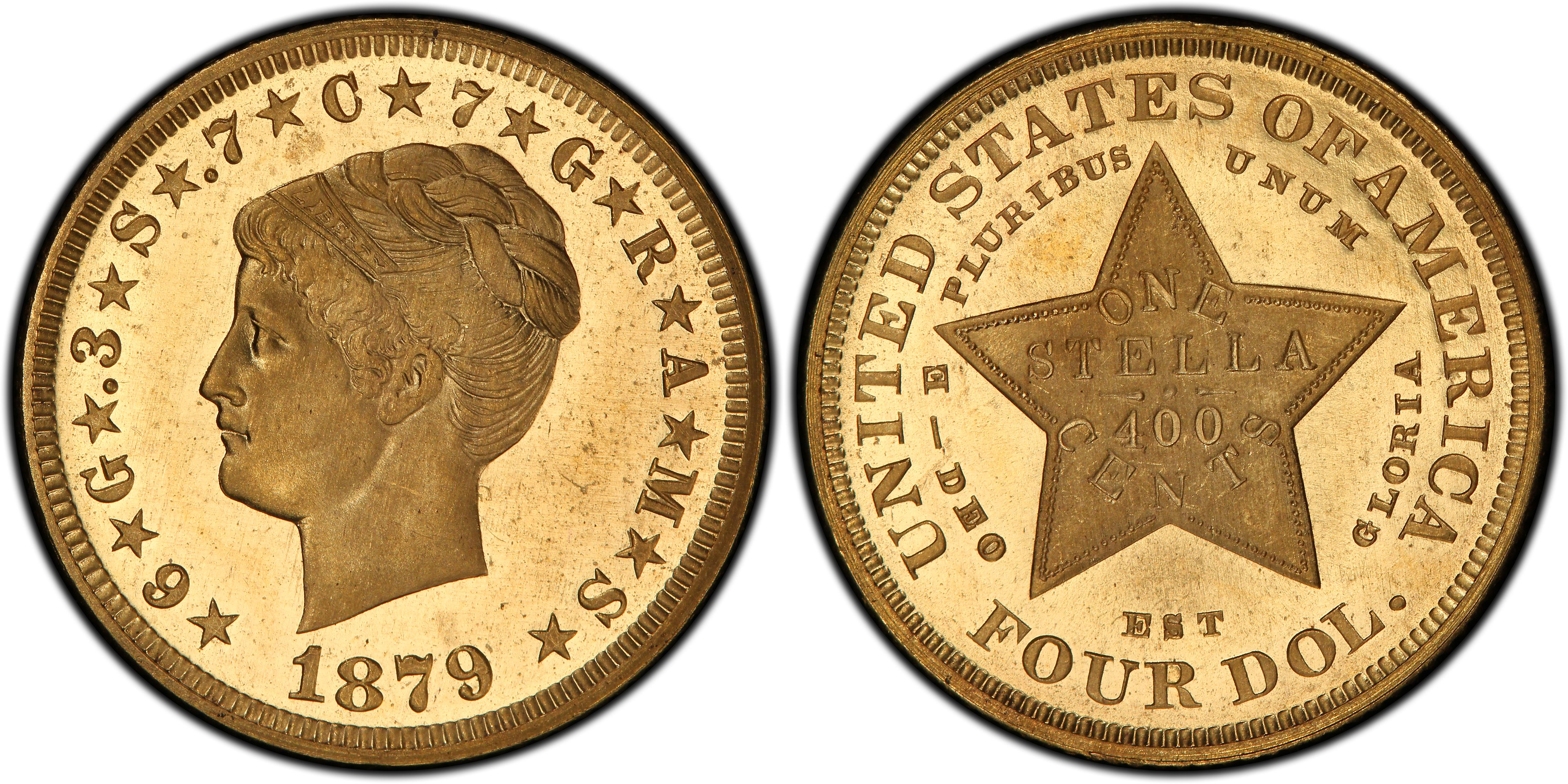
1879 $4 Coiled Hair, CAM (Proof)
Series: Stella $4 1879-1880
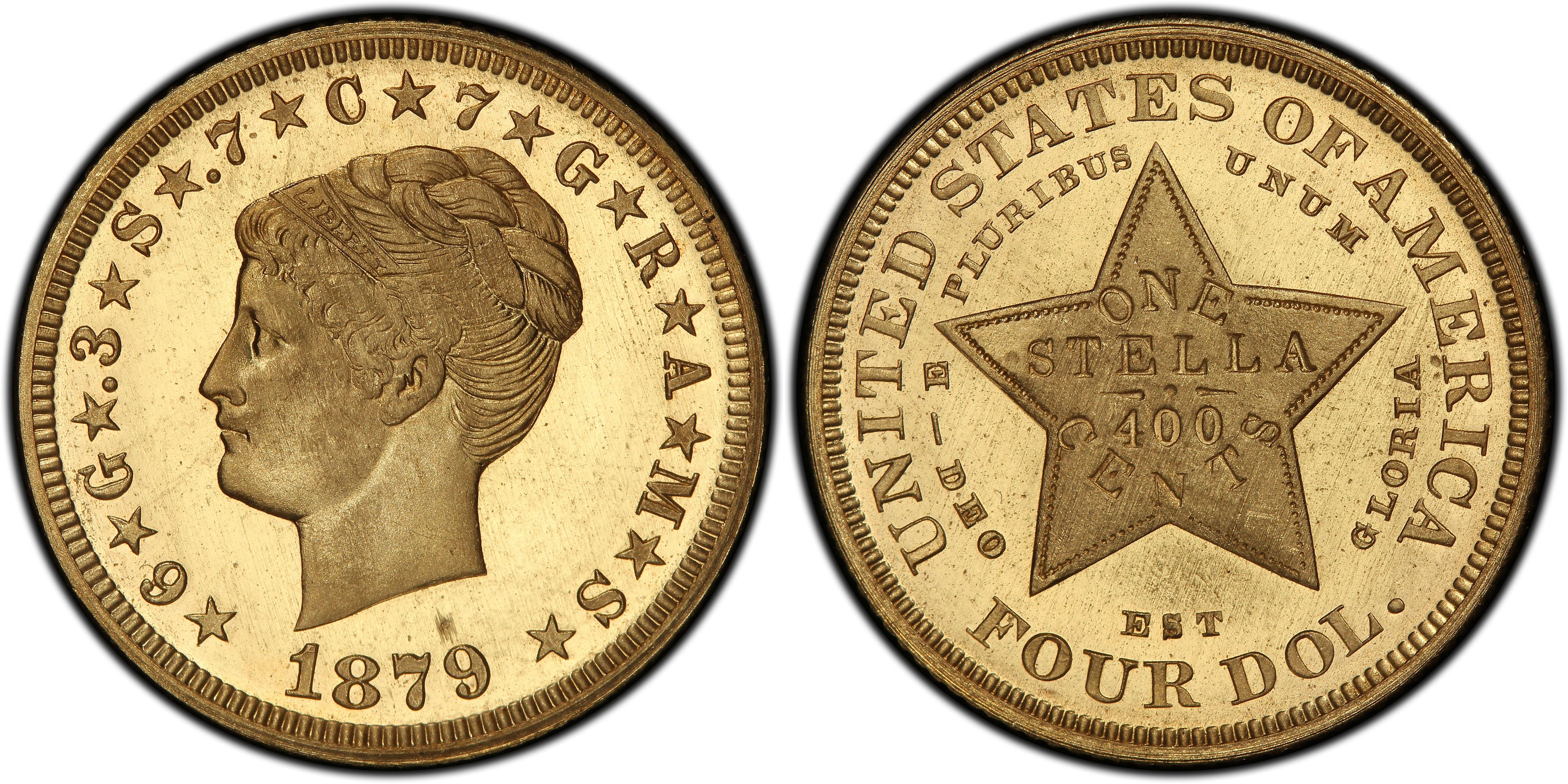
PCGS PR66+CAM
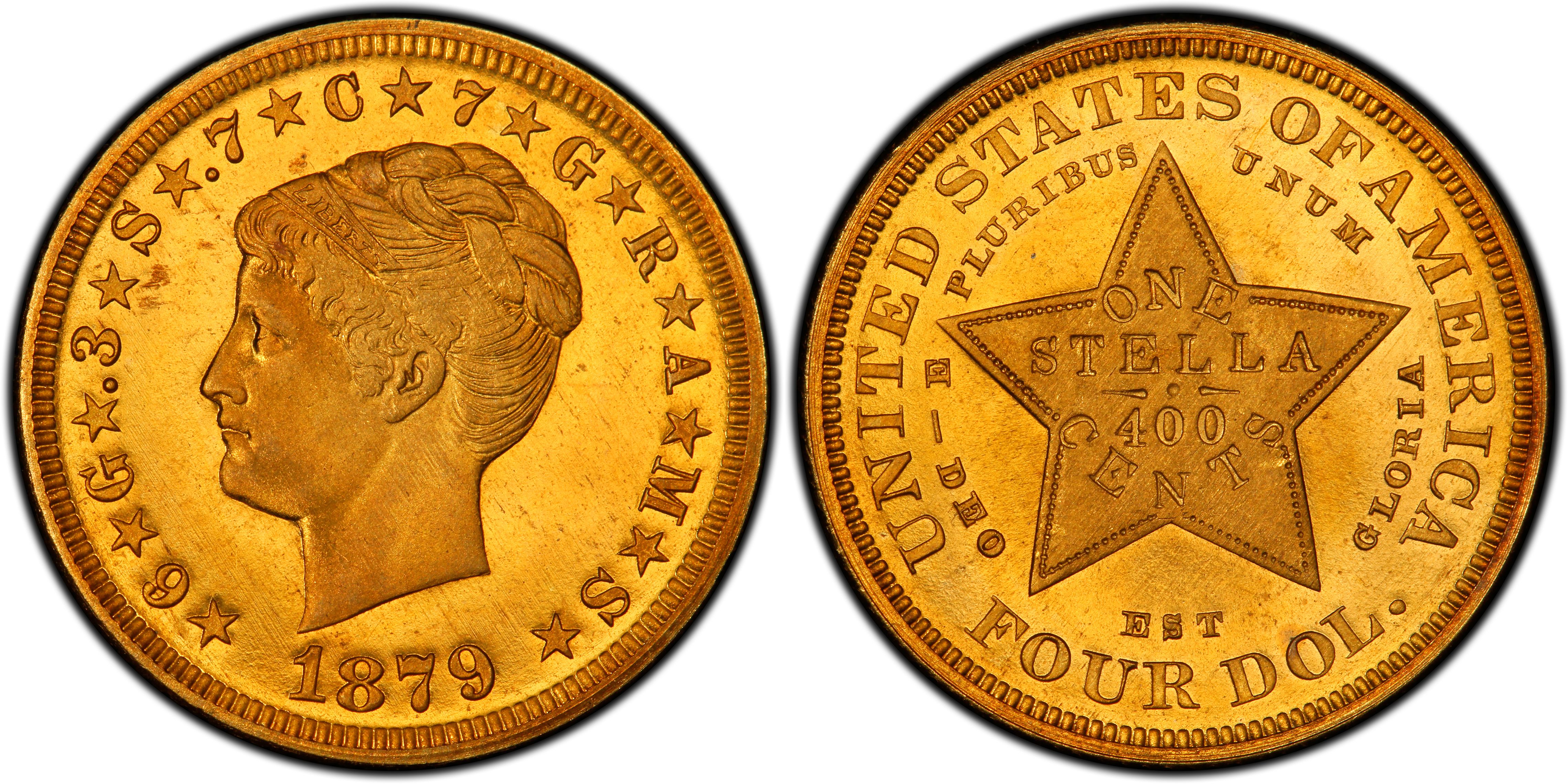
PCGS PR66+CAM
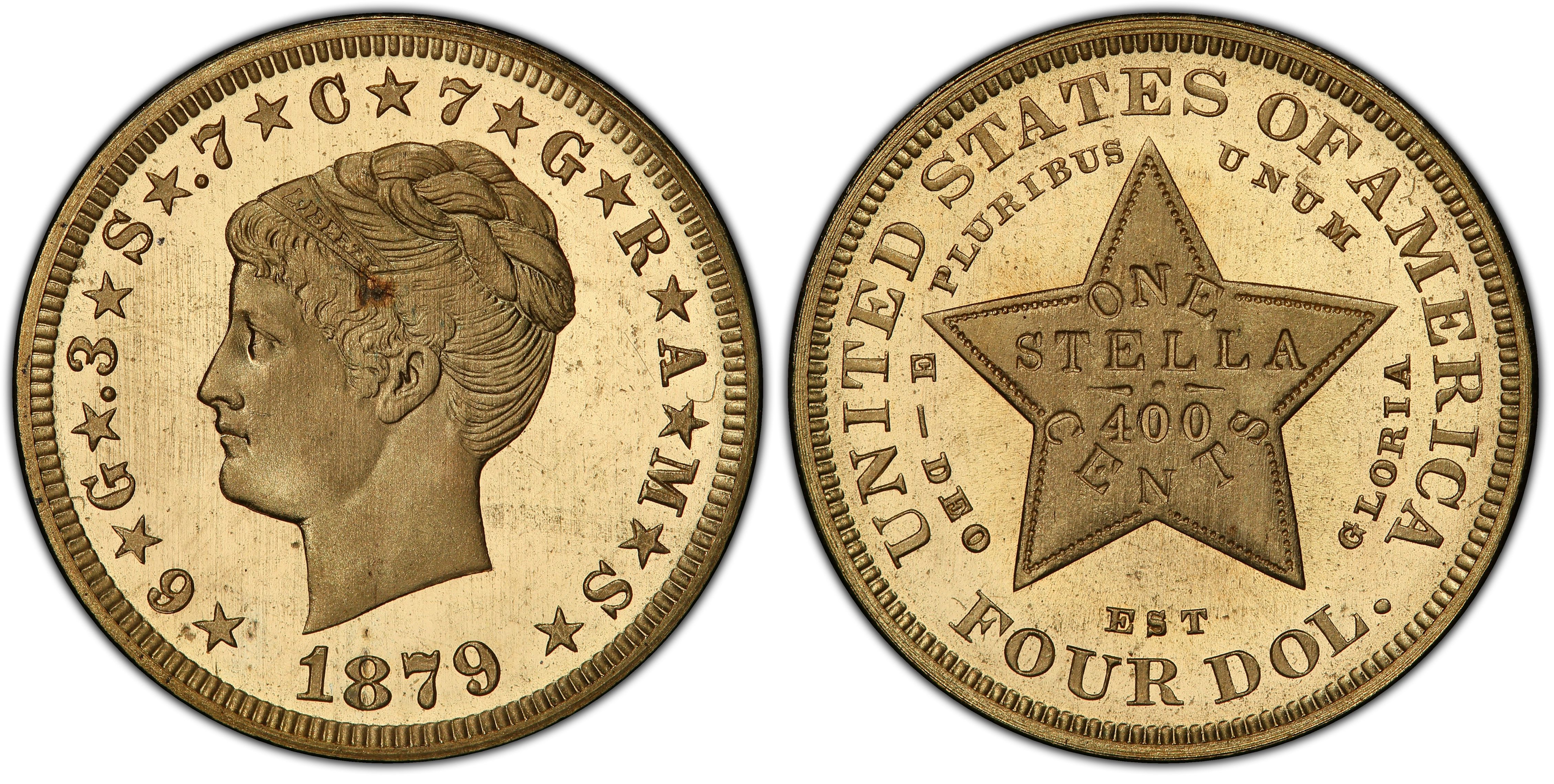
PCGS PR66CAM
- PCGS #:
- 88058
- Designer:
- George T. Morgan/Charles E. Barber
- Edge:
- Reeded
- Diameter:
- 22.00 millimeters
- Weight:
- 7.00 grams
- Mintage:
- 20
- Mint:
- Philadelphia
- Metal:
- 86% Gold, 4% Silver, 10% Copper
- Auction Record:
- $2,135,000 • PR67CAM • 05-02-2026 • Heritage Auctions
Rarity and Survival Estimates Learn More
| Survival Estimate | |
|---|---|
| All Grades | 6 |
| 60 or Better | 6 |
| 65 or Better | 3 |
| Numismatic Rarity | |
|---|---|
| All Grades | R-9.7 |
| 60 or Better | R-9.7 |
| 65 or Better | R-9.8 |
| Relative Rarity By Type All Specs in this Type | |
|---|---|
| All Grades | 1 / 2 TIE |
| 60 or Better | 1 / 2 TIE |
| 65 or Better | 2 / 2 |
| Relative Rarity By Series All Specs in this Series | |
|---|---|
| All Grades | 1 / 4 TIE |
| 60 or Better | 1 / 4 TIE |
| 65 or Better | 2 / 4 |
Condition Census What Is This?
|
#1 PCGS PR66+CAM
As Part of a four-coin set. "The Will W. Neil Collection," B. Max Mehl, June 17, 1947, Lots 2602-2605 (sold as set) - $3,850; Grant Pierce and Son Collection; Stack's, August 24, 1976, Lot 2920 - $225,000; Jay Parrino; As PCGS PR65. Superior Galleries, May 1991, Lot 1374 - Passed. Unknown intermediaries. As PCGS PR66+CAM. "The Elite Collection" (PCGS Set Registry). Pin-sized indentation between 9 and bust truncation. |
|
#1 PCGS PR66+CAM
Louis E. Eliasberg, Sr.; "The Louis E. Eliasberg, Sr. United States Dolf Coin Collection," Bowers & Ruddy, October 27-29, 1982, Lot 317 - $101,750; Hugh Sconyers; unknown intermediaries; Dr. Jerry Buss; "The Dr. Jerry Buss Collection," Superior Galleries, January 1985, Lot 1766. As PCGS PR66. "The Lee Kuntz Collection," Superior Galleries, October 8, 1991, Lot 3389 - Passed. As PCGS PR66+CAM #26594662. |
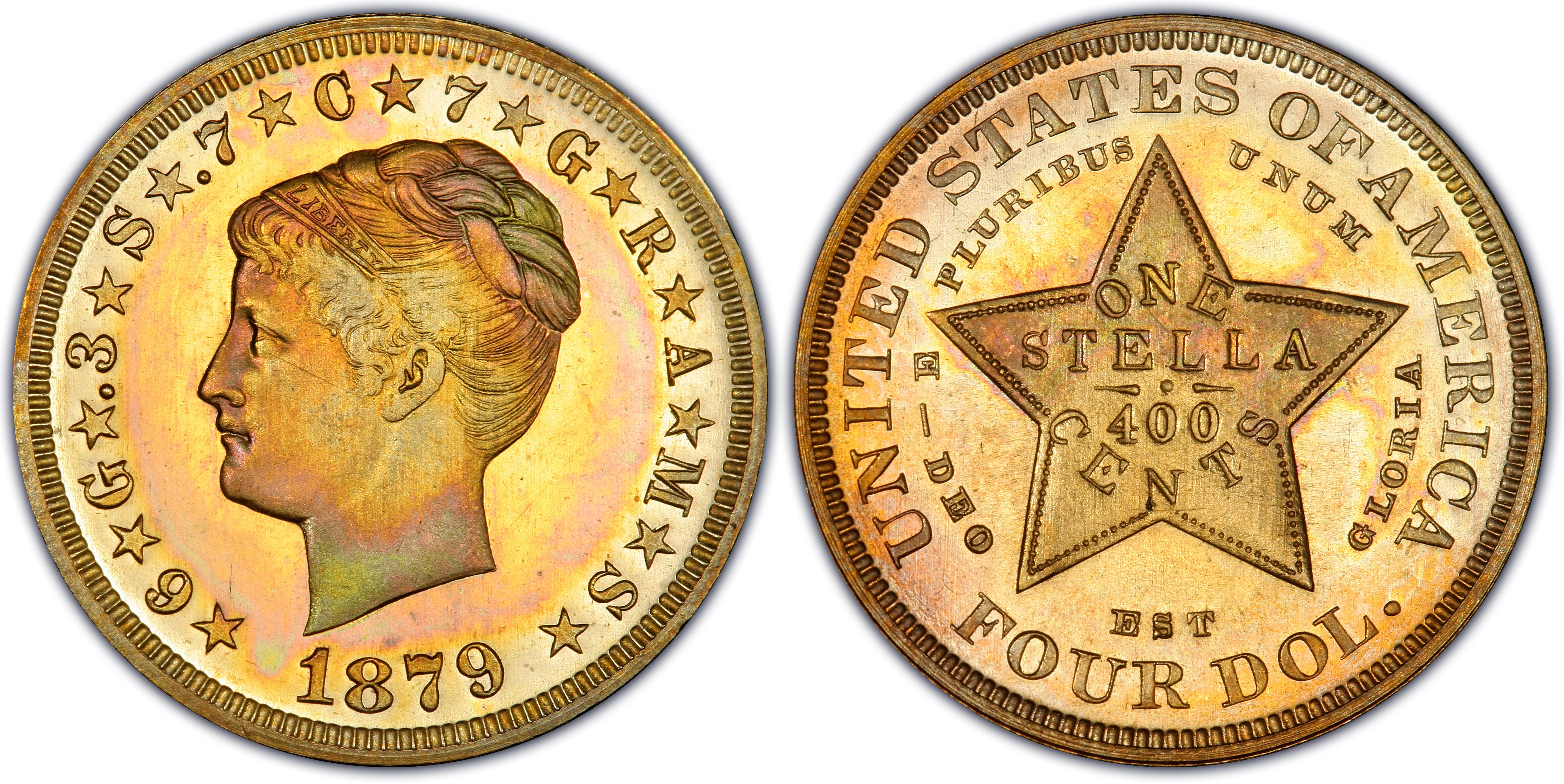 #3 PCGS PR66CAM
As "Gem Brilliant Proof." "The Rio Rancho Estate Collection," Superior Galleries, October 15, 1974, Lot 133 0 $105,000. As PCGS PR66CAM #22106270. "The Lighthouse Collection," Stack's, June 1978, Lot 828 - $90,000; Ed Trompeter; "The Ed Trompeter Collection, Part 1," Superior Galleries, Heritage Auctions, January 14, 2026, Lot 3210 - $1,464,000. Swirling toning in magenta, gold, and green. Planchet flake at the base of the right serif of the "M." An embossed image of this coin adorns the cover of the Rio Rancho Collection catalog. The coin is also one of the cover coins of the Superior Trompeter sale catalog—the final sale cataloged by Walter Breen. |
|
#3 PCGS PR66CAM
Bangs & Co., January 1882; T. Harrison Garrett; Robert Garrett; John Work Garrett; Johns Hopkins University; "The Garrett Collection," Bowers & Ruddy, November 29, 1979, Lot 431 - $115,000. As "Brilliant Proof 65." “Auction ‘80,” Superior Galleries, August 1980, Lot 385 - $175,000; "The Buddy Ebsen Collection," Superior Galleries, June 2, 1987, Lot 2444 - $165,000; The Holecek Family Trust Collection; As NGC PF66. Stack's, October 17-19, 2000, Lot 1623 - $310,500; As PCGS PR66CAM #25376953. Heritage Auctions, January 9, 2014, Lot 5405 - $851,875; Dell Loy Hansen; "The D.L. Hansen Gold Type Set Collection" (PCGS Set Registry). Drawbench marks run nearly vertically but are minimally intrusive. There is a copper-red toning spot in Liberty's hair and a small mark extending from below Star 1 toward the denticles. This coin was featured on the cover of Superior’s Buddy Ebsen Collection catalog, alongside many of the actor's most significant gold and silver holdings. |
|
#3 Est. PR66CAM
As "Gem Brilliant Proof." "The Western Collection," Stack’s, December 1981, Lot 1137 - $80,000. As NGC PF67CAM #116535-001. "The Gold Rush Collection," Heritage Auctions, January 2005, Lot 30041 - $655,500. As NGC PF67CAM #1963260-002. "The Tacasyl Collection," Bonham’s, Setpember 23, 2013, Lot 1009 - $1,041,300; Heritage Auctions, March 2026, Lot TBD - View. Drawbench marks run at a diagonal. Tiny curved lintmark under R of AMERICA. Pinsized copper spot touching the upper left corner of the T of EST. |
|
#3 Est. PR66CAM
As NGC PF66CAM. Dan O'Dowd; "The Tyrant Collection (O'Dowd)". Apparent fingerprint in upper left obverse field. Rose toning over IT of UNITED. Small tick above N of CENTS. |
|
#3 Est. PR66CAM
Josiah K. Lilly; The National Numismatic Collection at the Smithsonian Institution. |
 #8 PCGS PR65+CAM
Silvano DiGeneva; "Tangible Investments Inc. Collection" (PCGS Set Registry). |
 #9 PCGS PR64CAM
King Farouk of Egypt. As an 1879 Flowing Hair and Coiled Hair Set, "both brilliant Proofs." "The Palace Collections of Egypt (Farouk)," Sotheby's, February 1954, Lot 322 - 545£ (approximately 1,526 USD). As "Brilliant Proof." "The Gaston DiBello Collection," Stack's, May 15, 1970, Lot 796 - $22,000; The Globus Collection; "The Globus-Corson Collection," Stack's, March 1999, Lot 134 - $138,000. As NGC PF62. Bowers and Merena, January 2000, Lot 350 - $126,500. As NGC PF63. Heritage Auctions, August 2001, Lot 7750 - $132,250. As PCGS PR64CAM #27333258. Stack's Bowers, May 2013, Lot 1294 - $646,250. Tiny curved lintmark behind Liberty's neck. |
The Four-Dollar Stella: A Short-Lived Experiment
The Four-Dollar Stella was a brief series of experimental patterns struck at the Philadelphia Mint in 1879 and 1880. Named for the prominent star on the reverse, the Stella was conceived as a vehicle for international commerce. Its composition was based on Dr. William Wheeler Hubbell’s patented "goloid" alloy—an idiosyncratic mix of 85.71% gold, 4.29% silver, and 10.00% copper—though the numismatic community almost universally categorizes it as a gold coin.
The Stella’s primary advocate was John A. Kasson, a former Congressman then serving as the U.S. Minister to the Austro-Hungarian Empire. Kasson proposed that the United States produce trade coinage adhering to the Latin Monetary Union (LMU) standard. A precursor to the modern Eurozone, the LMU required member states to adopt and adhere to unified specifications to facilitate cross-border trade.
While designed to interface with this metric-based system, the Stella did not perfectly align with international requirements; its stated weight and fineness resulted in a metal value of approximately $3.85, falling short of the intended parity.
Kasson’s proposal was championed by Alexander H. Stephens, former Confederate Vice President and then-Chairman of the Committee on Coinage, Weights, and Measures. Stephens successfully petitioned Treasury Secretary John Sherman to produce pattern coins for Congressional review. Following their distribution to lawmakers, a tawdry bit of numismatic lore suggests that more than a few of these specimens eventually changed hands in the upscale bordellos of Washington, D.C. Supporters of this theory cite the number of coins that appear to have been removed from jewelry.
Design and Production
The Stella featured two distinct obverse designs, both dated 1879 and 1880:
- The "Flowing Hair" – Designed by Charles Barber, heir-apparent to the Chief Engraver position.
- The "Coiled Hair" – Designed by George T. Morgan, creator of the Morgan Dollar.
Both designs featured a left-facing Liberty wearing a diadem, surrounded by the inscription * 6 * G * .3 * S * .7 * C * R * A * M * S *, denoting the coin's metallic proportions. The reverse, shared by both types, featured a five-pointed star inscribed with ONE STELLA / 400 CENTS, surrounded by the mottos E PLURIBUS UNUM and DEO EST GLORIA.
The first 40 sets were struck on a medal press in January 1880. Due to high demand among lawmakers, Congress ordered 100 additional sets in March. Ultimately, hundreds more 1879 Flowing Hair examples were struck to satisfy Congressional interest.
Rarity and Market Significance
Though technically a pattern, the Stella’s $4 denomination and distinctive beauty have made it a cornerstone of American numismatics and it typically collected as a regular issue.
It is currently ranked 28th in the PCGS list of 100 Greatest U.S. Coins. While the 1879 Flowing Hair (#8059) is the most accessible, the 1879 Coiled Hair (#8060) and 1880-dated issues remain world-class rarities.
The 1879 Coiled Hair Stella (#8058, CAM #88058)
Judd-1638, Pollock-1838. Rarity-6. Only 14–15 known.
Morgan's coiled hair design features a woman whose locks are tied up into a chignon. This was a popular Victorian-era hairstyle that became increasingly elaborate depending on one's social class. The chignon worn by Morgan's Liberty is indicative of the complexity favored by upper-class women. PCGS estimates that only 20 examples were struck—all Proofs—and today, only 13–15 are known to exist.
The PCGS Population Report comprises examples certified throughout the company’s 40-year history. The population table is likely bloated on the base specimen number, as this figure almost certainly includes coins that were later cracked out and regraded once PCGS adopted Cameo and Deep Cameo designations for Proof issues.
In United States Proof Coins Volume IV: Gold (2018), John W. Dannreuther lists 13 specimens in his "Significant Examples" table. Through photo-matching, I identified four discrete examples without Cameo attributions—the finest grading PCGS PR65—and nine examples with Cameo contrast. The latter group includes the Lilly specimen at the Smithsonian, a pair of PCGS PR66+CAM coins, and the Tacasyl Collection example, which Heritage is scheduled to sell in March 2026. I believe I have identified 13 distinct examples using a variety of methods, including matching the orientation of drawbench marks, lintmarks, reflective areas, and copper spots. As these examples continue to cycle through the market, it may be possible to further refine the condition census. Regardless, the 1879 Coiled Hair Stella remains a rare pattern coin that only a few will ever have the good fortune to own.
Vintage Market Snippet
The first auction appearance of an 1879 Coiled Hair Stella took place at George Cogan's sale of the J Colvin Randall Collection on March 29, 1882. The coin was listed as part of a Goloid Set (Lot 631), which Cogan described thusly:
631 1879 Goloid Set. Goloid Dollar. Hair done up in a knob. Band of ribbon with Liberty on it. Rev. "895-8-S. 42 - G. 100 C 25 Grams" in centre of wreath. "One Dollar" below. "Deo Est Gloria" above. Brilliant Proof.
Metric Dollar. Hair braided and done up in a coil. Ribbon "with Liberty on it." Rev. 15.3 - G. 236-7-S. 28-C.14 Grams with circle of 38 stars. "100 Cents" below. Brilliant Proof.
Gold Stella (No 4. Piece). Hair braided and done up in a coil, head of Liberty surrounded by *6*G*.3*S*.7*C*7*G*R*A*M*S Rev. A star inscribed "One Stella, 400 Cents." Brilliant proof. This set has never been offered before at either public or private sale. Excessively rare.
Note.— This set must not be taken for the ordinary "Goloid Set," as the obverse is nothing like it. In this set hair of Liberty is arranged in coils, while in the other, it falls down the nect in curls, and the face is totally different."
One can infer, based on the sophisticated tone of this lot description, that Cogan—and perhaps the bidders at this auction—were well-acquainted with Goloid Sets, as he refers to the Flowing Hair type as 'ordinary.' For the Coiled Hair type presented here to be labeled 'excessively rare' by the cataloger indicates that this offering was highly unusual.
Randall was a prominent Philadelphia numismatist who operated a coin and curio shop. According to researcher John N. Lupia III, more than 10,000 rare coins passed through Randall's hands during his career; he likely acquired some of his more unusual material through a direct connection with the Mint. Beyond the Coiled Hair Stella, Randall owned several significant rarities, including the famous Cardinal 1794 Dollar (#86851), which was purchased by Laura Sperber of Legend Numismatics for a then-record $10 million in 2013.
* * *