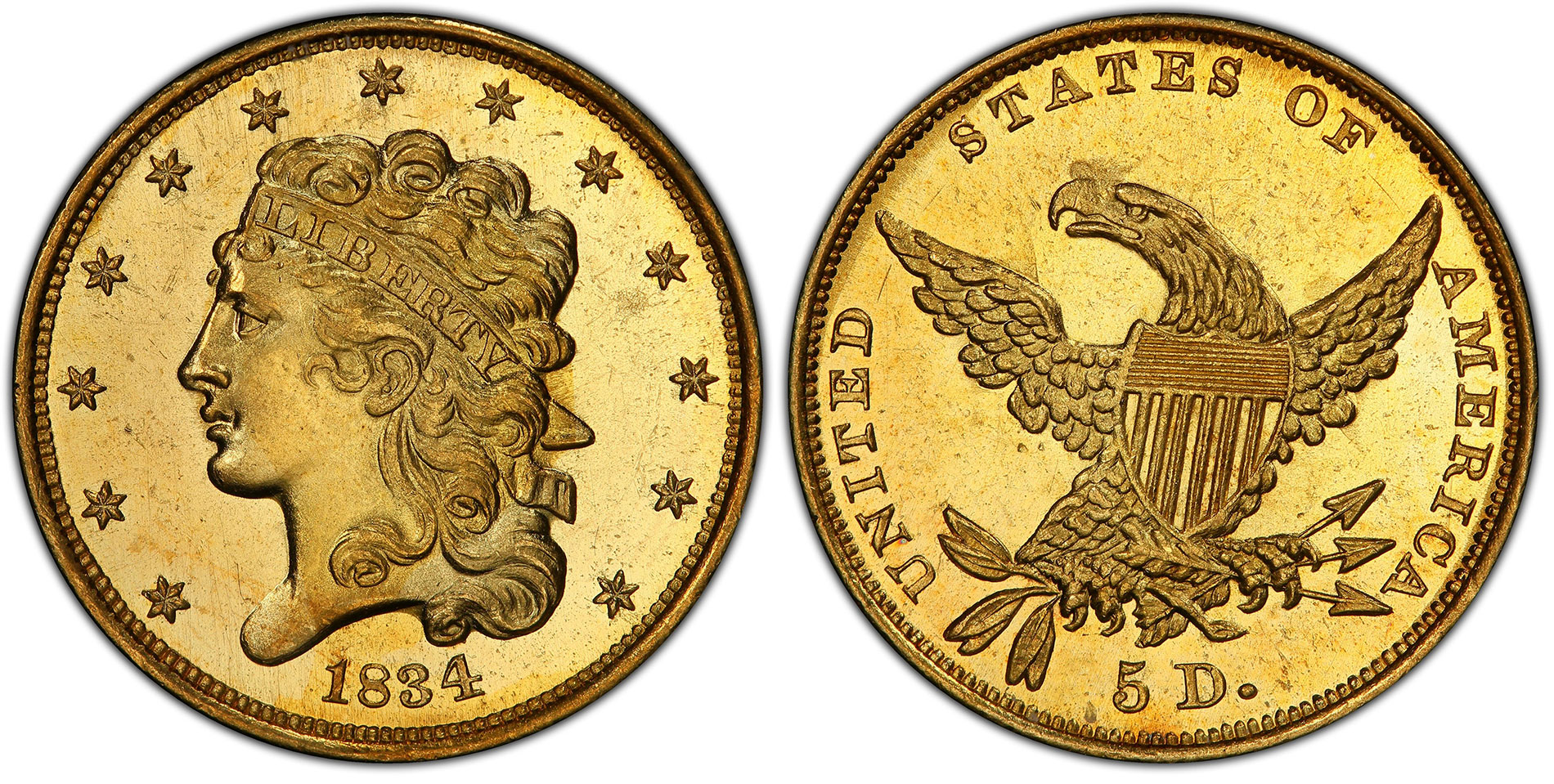
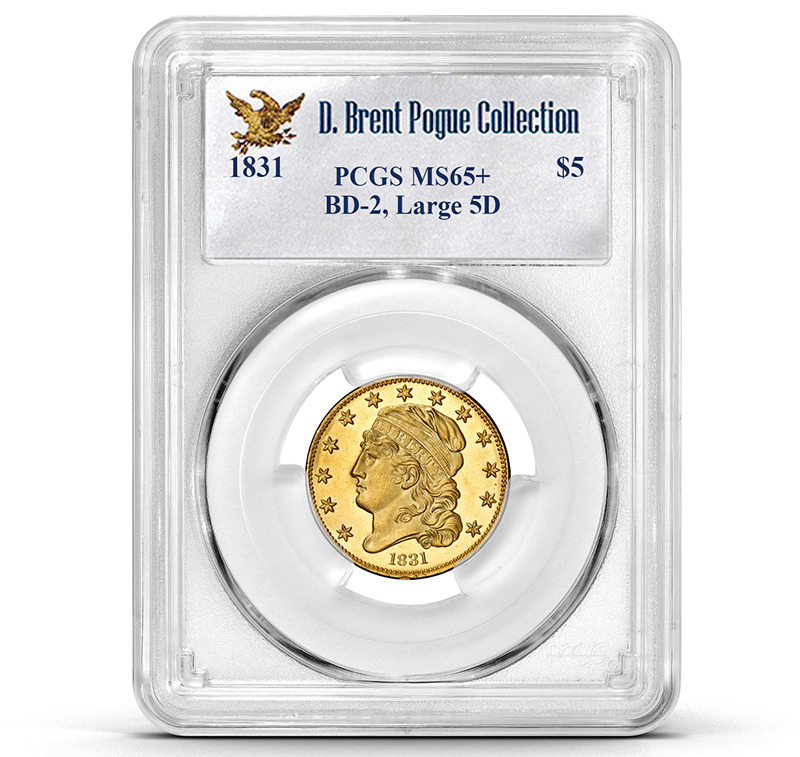
1834 Half Eagle Plain 4 PCGS MS65+.
Pre-1933 United States gold coinage represents some of the most popular coins enjoyed by both diehard numismatists and precious metals investors. Gold coins are not only collected by type and date by seasoned numismatists, but they’ve become an affordable alternative for bullion investors. In fact, many find the collapsing premiums on some of vintage gold coins means these pieces are sometimes cheaper, gram for gram, than the equivalent amount of gold in the form of American Gold Eagles. Yet, many of the gold coins struck before 1839 is not only difficult to find in the marketplace, but it’s also relatively much more expensive.
Most pre-1839 gold coins were minted in tiny numbers, even by early 19th-century standards. And the majority of those pieces met their ultimate fates in smelting pots or were lost to time. But there’s at least one gold coin from the early era of United States gold coinage that remains relatively easy to find and affordable for many collectors. That piece is the 1834 Classic Head Half Eagle.
Struck to the tune of 657,460 pieces, the 1834 Half Eagles saw not only the highest mintage of any pre-1839 United States gold coin, but it also boasts one of the highest survival rates among any of that subset of United States gold coinage. Part of this is due to the physical resizing of the Half Eagle in 1834, a time when the price of gold began exceeding the denomination’s face value under the coin’s previous weight and dimension.
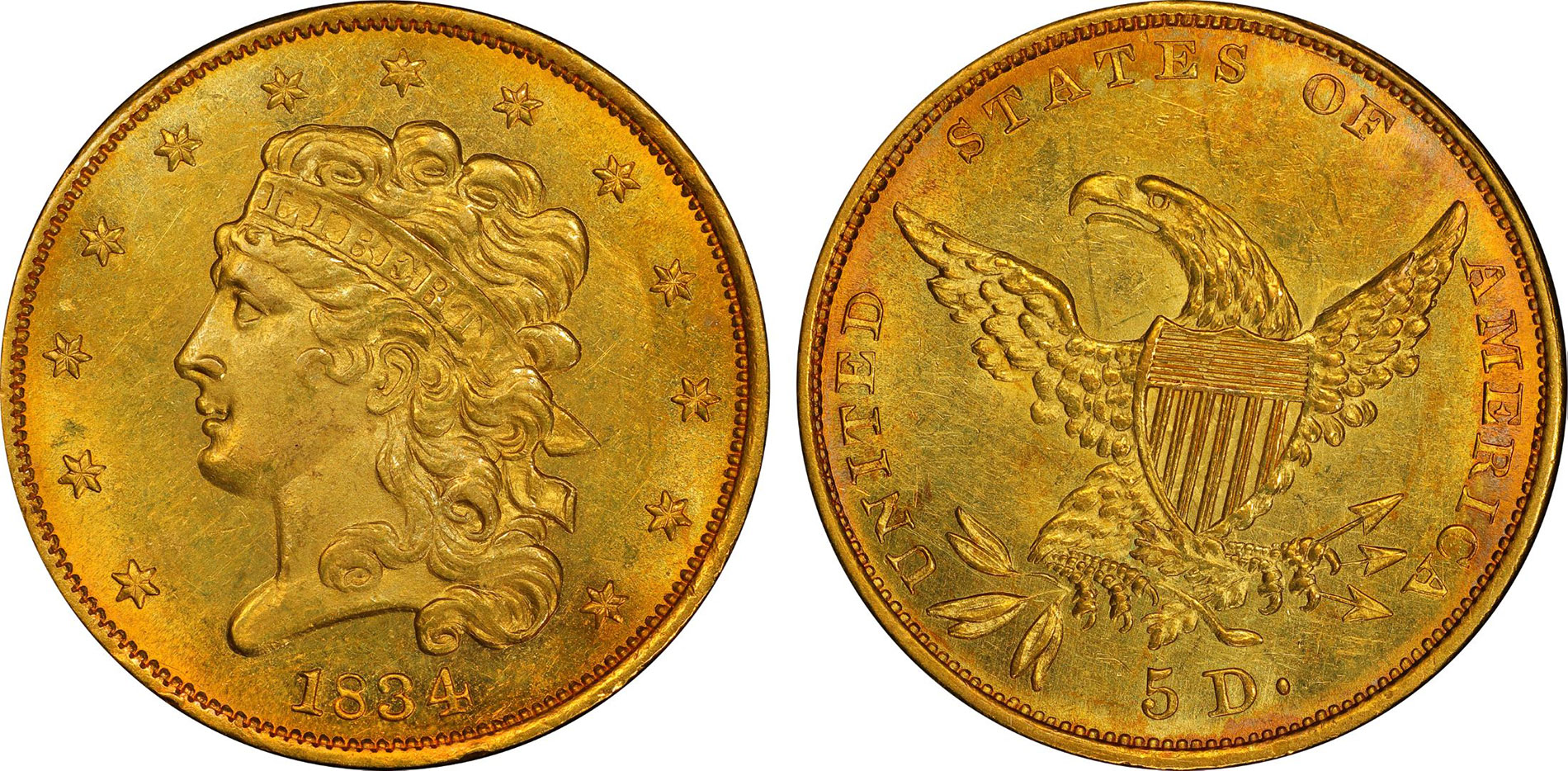
1834 Half Eagle Crosslet 4 PCGS MS63.
From the half eagle’s initial release in 1795, the coin weighed 8.75 grams; had a composition of .9167 gold, .0833 silver and copper; and carried an approximate diameter of 25 millimeters – making it wider than a modern-day quarter dollar. A slight reduction in the coin’s diameter came in 1829, with the width shrinking to 23.8 millimeters but other physical standards remaining the same.
Increasing bullion prices forced more changes in the mid 1830s. The 1834 Classic Head Half Eagles were released with a lighter weight of 8.36 grams, slightly less gold content (.8992 gold, the balance silver and copper), and a smaller diameter of 22.5 millimeters. With the reduction in the coin’s weight, size, and overall gold content in 1834 came a leaner half eagle that continued circulating well throughout much of the young, expanding United States. And to meet the demands of commerce, the United States Mint struck well more than a half-million new half eagles – a then-unprecedented mintage figure for any United States gold coin.
Two varieties of 1834 Half Eagles were eventually struck by that year’s end. The more common variety, known as the 1834 Plain 4, is the type most widely seen in the marketplace and is also the coin that serves as one of the least-expensive pre-1839 classic gold coins. The other half eagle variety from that year, the 1834 Crosslet 4, is much rarer than the 1834 Plain 4 and scarcely appears in auctions or in other marketplace venues. PCGS has certified fewer than 120 specimens, possibly much of that number representing resubmissions of the same coins since the 1980s – and virtually all in circulated grades.
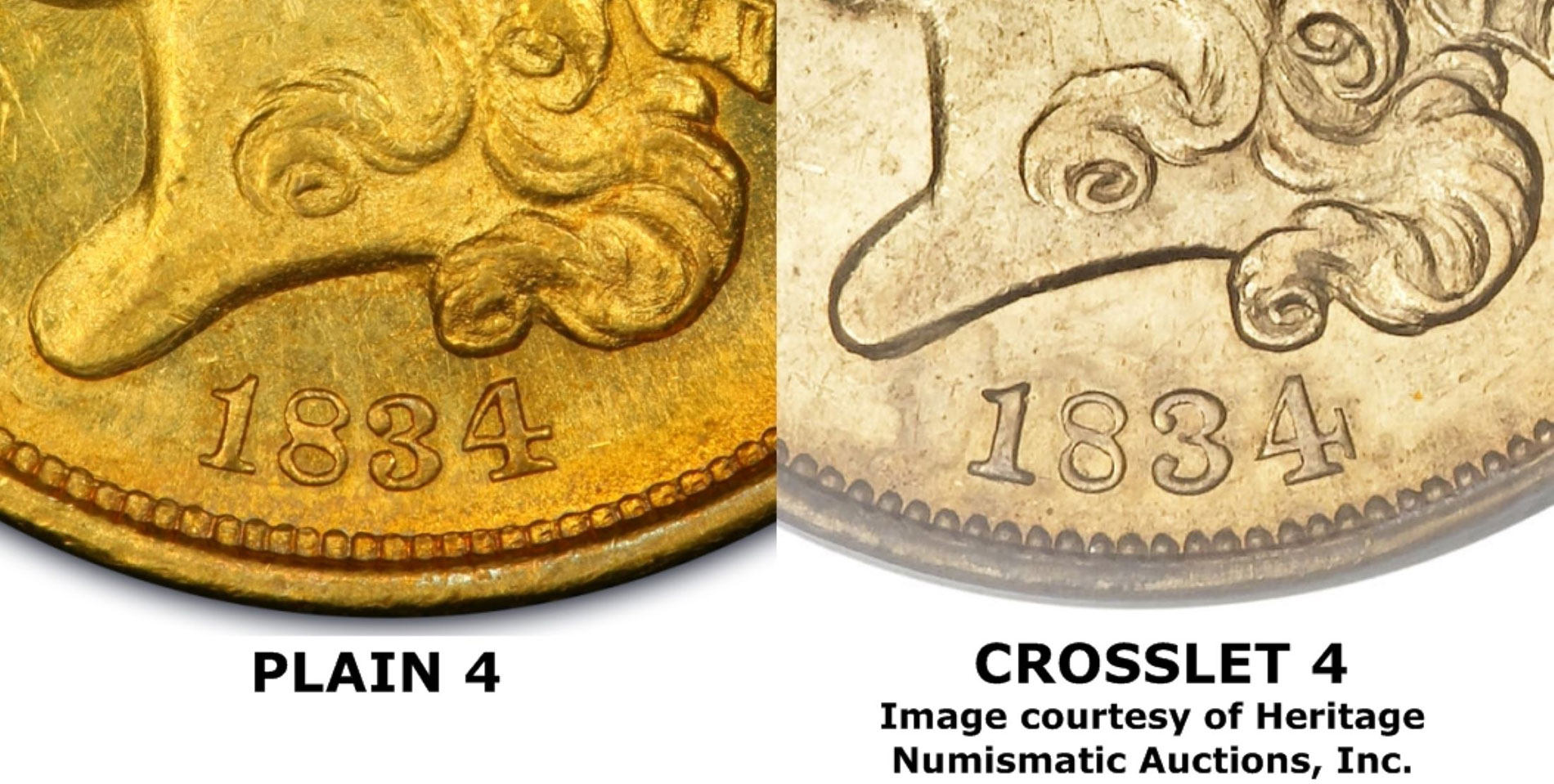
Obverse comparison of 1834 Half Eagle Plain 4 and 1834 Half Eagle Crosslet 4.
Conversely, the 1834 Plain 4 Classic Head Half Eagle is much more frequently encountered in the marketplace and is readily available in grades ranging from Good to Uncirculated, with the finest known examples represented by a pair of two specimens certified by PCGS as MS66. While the more expensive of those two pieces hammered for $111,625 in a 2016 Stack’s Bowers auction, one won’t need to fork over six figures to obtain a nice example of an 1834 Plain 4 Classic Head Half Eagle!
Entry-level Uncirculated examples in the MS60 to MS62 range trade in the vicinity of $3,000 to $5,000, with MS65s commanding prices closer to $60,000. If those figures are still financially intimidating, one has the option of buying a circulated example of the 1834 Half Eagle. And it’s easily possible to land a nice, lightly worn specimen for less than $1,000, with XF45s trading in the neighborhood of $700 to $800. Collectors who are looking for lower prices still might consider buying an example under Very Fine-20, though it’s somewhat difficult to find a specimen in that low of a grade. Collectors who do manage to find a well-worn piece less than VF20 may need to pay but $400 to $500 – a price temptingly close to melt value.



 Copper & Nickel
 Silver Coins
 Gold Coins
 Commemoratives
 Others
 Bullion
 World
World
 Coin Market
 Auctions
 Coin Collecting
 PCGS News