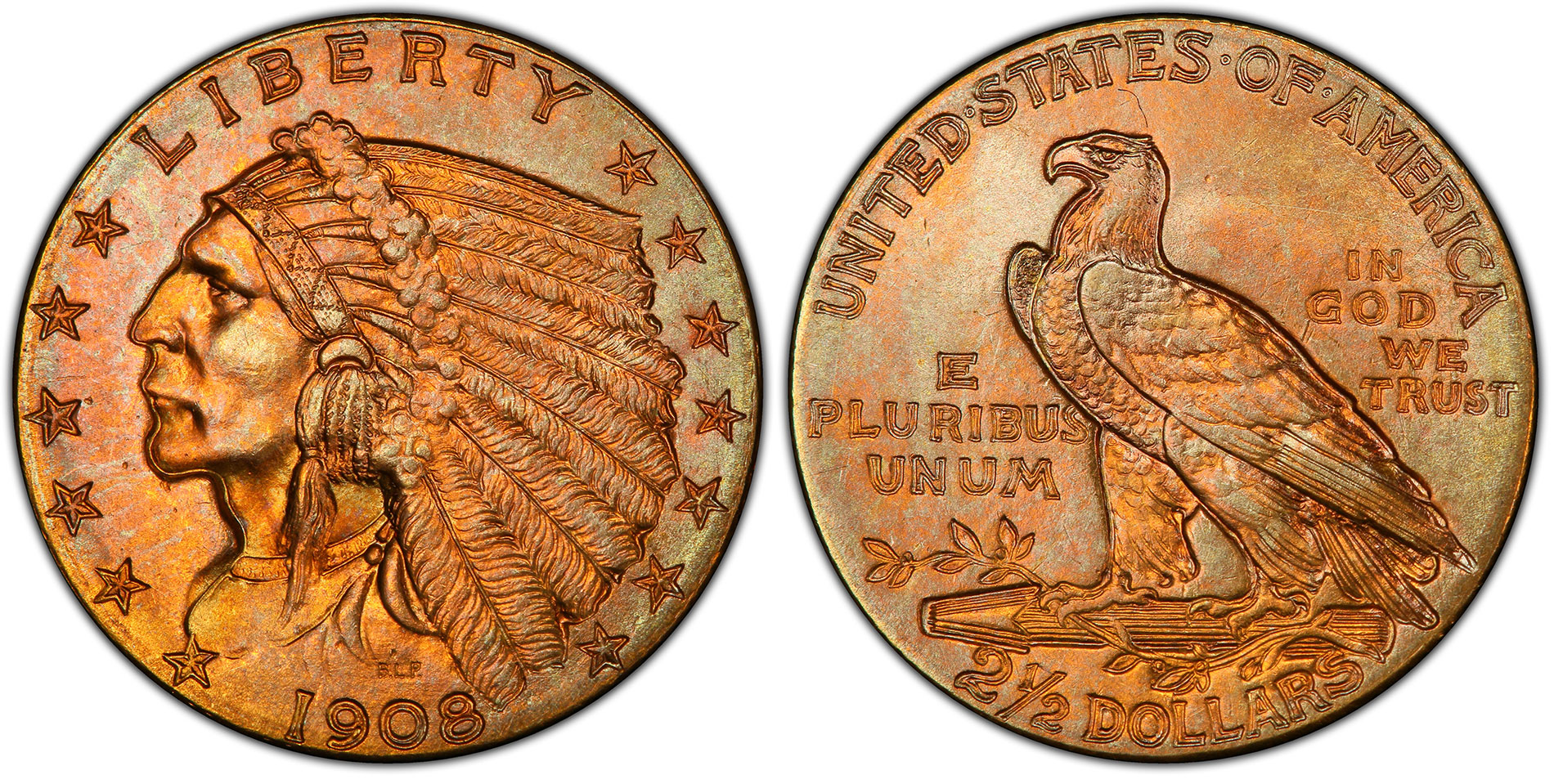
The Indian Quarter Eagle is indisputably one of the most popular pre-1933 United States gold coins. This famous coin is linked to one of the respected names in early 20th century sculpture but registers mere modest physical proportions. Coming in at 18 millimeters in diameter, the 90% gold coin approximates the physical size of a modern U.S. dime yet weighs nearly twice as much at 4.18 grams, with a pure gold weight of .12094 ounces. However, this coin’s legacy and stature in numismatic circles looms as large as any coin many times its weight or diameter, the Morgan Dollar and Saint-Gaudens Double Eagle among them.
Looking Back at the Indian Quarter Eagle
Indian Head Quarter Eagles were designed by Bela Lyon Pratt, a renowned artist and student of celebrated sculptor Augustus Saint-Gaudens. Pratt designed his Indian Quarter Eagle in 1908, shortly after mentor Saint-Gaudens, himself chosen by President Theodore Roosevelt to artistically reimagine the nation’s coins, died from cancer at the age of 59 in 1907 having redesigned only the eagle and double eagle during the last months of his life. Pratt’s Indian Quarter Eagle motif, identically replicated on the half eagle, adorned the first United States coin to carry an incuse design.
The novelty of the intaglio design on United States coins rose the concern of Americans, who feared the recesses of the circulating coinage would pick up bacteria and spread illnesses. Philadelphia coin dealer Samuel Chapman was no champion of the coin, citing the incuse design could “permit enough germs to accumulate to prove a health hazard” and serve as “a great receptacle for dirt and conveyor of disease.” He concluded the “coin[s] will be the most unhygienic ever issued.”
Yet, more than a century on from the coin’s release in 1908, not one illness can be reliably traced back to Pratt’s Indian Quarter Eagle or similarly incused Indian Half Eagle. Contrarily, the coins became a big hit with holiday gift givers in the 1910s and ‘20s and saw extensive use in the West, where gold coins had been popular since the first days of the California Gold Rush in 1848. Today, coin collectors throughout the United States and beyond enthusiastically collect Indian Quarter Eagles, a series that offers relative affordability in the context of collecting pre-1933 U.S. gold coins and provides exciting opportunities for those who want to build a challenging, dynamic set.
A Compact Set Offering Outstanding Challenges
The Indian Quarter Eagle was struck from 1908 through 1929, though there was a nearly decade-long interruption in production that yielded no new quarter eagles during a period spanning from 1916 through 1924. When all was said and done, collectors could count just 23 distinct issues, including 15 business strikes and eight proofs. To help put this relatively small number of issues in perspective, the short-lived Susan B. Anthony Dollar (1979-81; 1999) saw 18 entries, including business strikes, proofs, and major varieties, and the Twenty Cent (1878-78) merely 10, accounting for business strikes, proofs, and special strikes. And while many who purchase an Indian Quarter Eagle buy just one example for a type collection, those so inclined to build an entire set must prepare for a real collecting challenge.
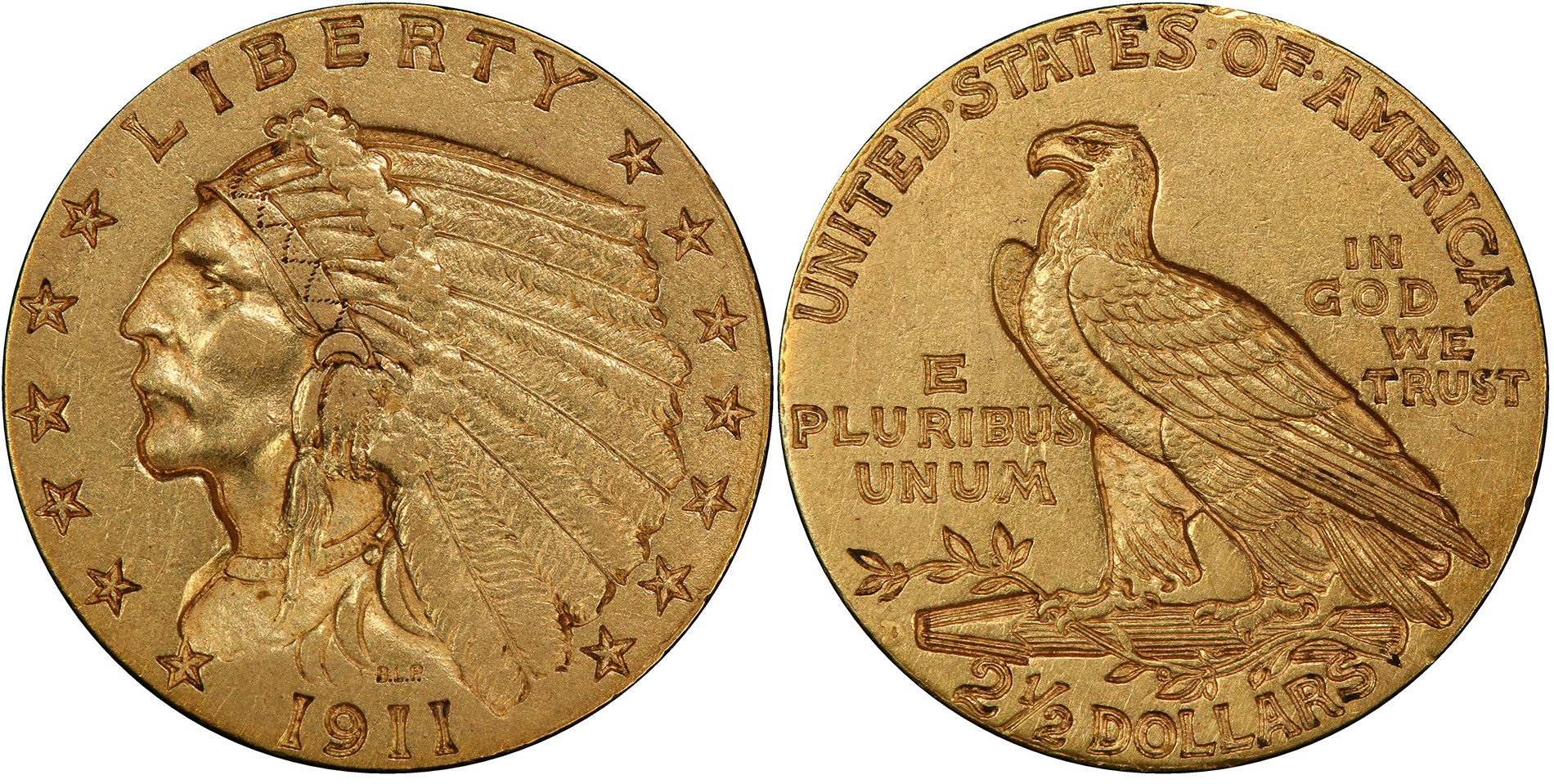
There is only one true key date for the series, and that’s the 1911-D, a rarity from the Denver Mint that has a mintage of only 55,680 pieces and perhaps offers only 8,000 or so survivors today across all grades. The most desirable examples of this issue are the Strong D, antithetical to its less-valuable Weak D counterpart and trading for around $1,650 and up in VF30. The 1914 Philadelphia issue is the next-rarest business strike, with a mintage of 240,000. However, values for this piece in the most commonly traded grades are about on par with most other issues from the series and thus may best rank as a semi-key only in terms of its low mintage rather than by its monetary expense. Meanwhile, all Indian Quarter Eagles become conditional rarities in the grade of MS66 and higher, while the eight proofs in the series mostly have mintages of fewer than 300 each and are considered rare; all the proofs are priced in excess of $5,000 apiece even in a grade of PR60.
Collecting Indian Quarter Eagles
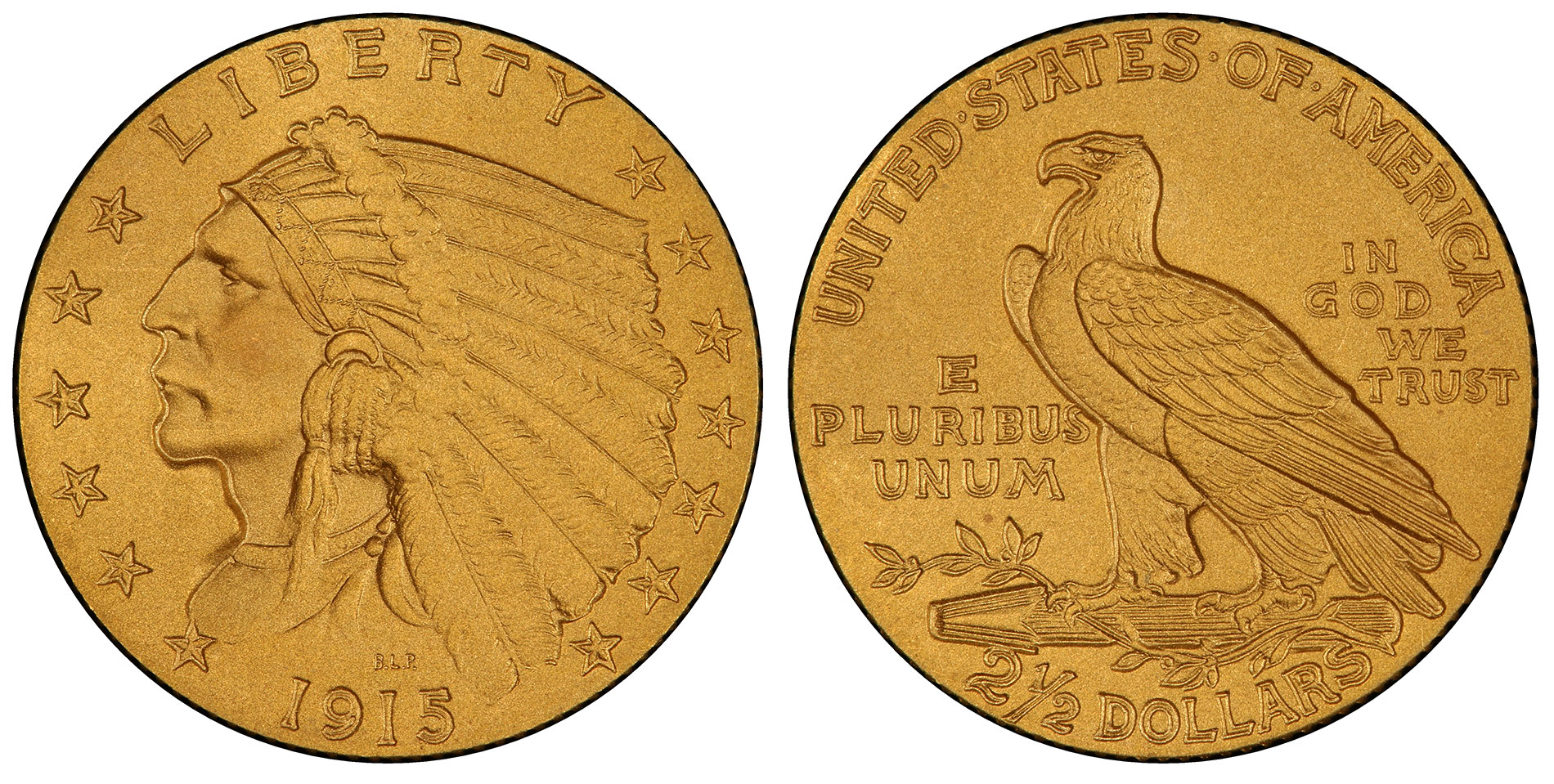
Indian Quarter Eagles encompassing relatively few issues, collectors who wish to build a comprehensive date set representing a pre-1933 U.S. gold series usually turn to this coin. It’s certainly the most accessible of the 20th-century gold coin series, even when compared to its virtual twin in the Indian Half Eagle.
The Indian Quarter Eagle contains only half as much gold as the half eagle, which is an advantage from the perspective of affordability, especially given that pricing for the coin in lower grades is largely dictated by prevailing bullion values. Price matters aside, the Indian Quarter Eagle is much less complex than the Indian Half Eagle, which entails nearly twice as many issues and two significant keys that are each much costlier than the 1911-D $2.50.
The PCGS Set Registry offers a wonderful platform for collectors who endeavor upon completing a set of Indian Quarter Eagles. Around a half-dozen PCGS Registry Sets cater exclusively to different types of Indian Quarter Eagle collections, with the Indian Head $2-1/2 Gold Basic Set, Circulation Strikes (1908-1929) among the top as far as popularity goes. This set requires the 15 business-strike coins. Those who wish to incorporate the proofs can focus their efforts on the exciting Indian Head $2-1/2 Gold Basic Set, Circulation Strikes and Proof (1908-1929), a 23-coin objective that proves formidable and fulfilling for many collectors.


 Copper & Nickel
 Silver Coins
 Gold Coins
 Commemoratives
 Others
 Bullion
 World
World
 Coin Market
 Auctions
 Coin Collecting
 PCGS News