1794 1C Head of '95, S-67, RB (Regular Strike)
Series: Liberty Cap Cents 1793-1796

PCGS MS67RB
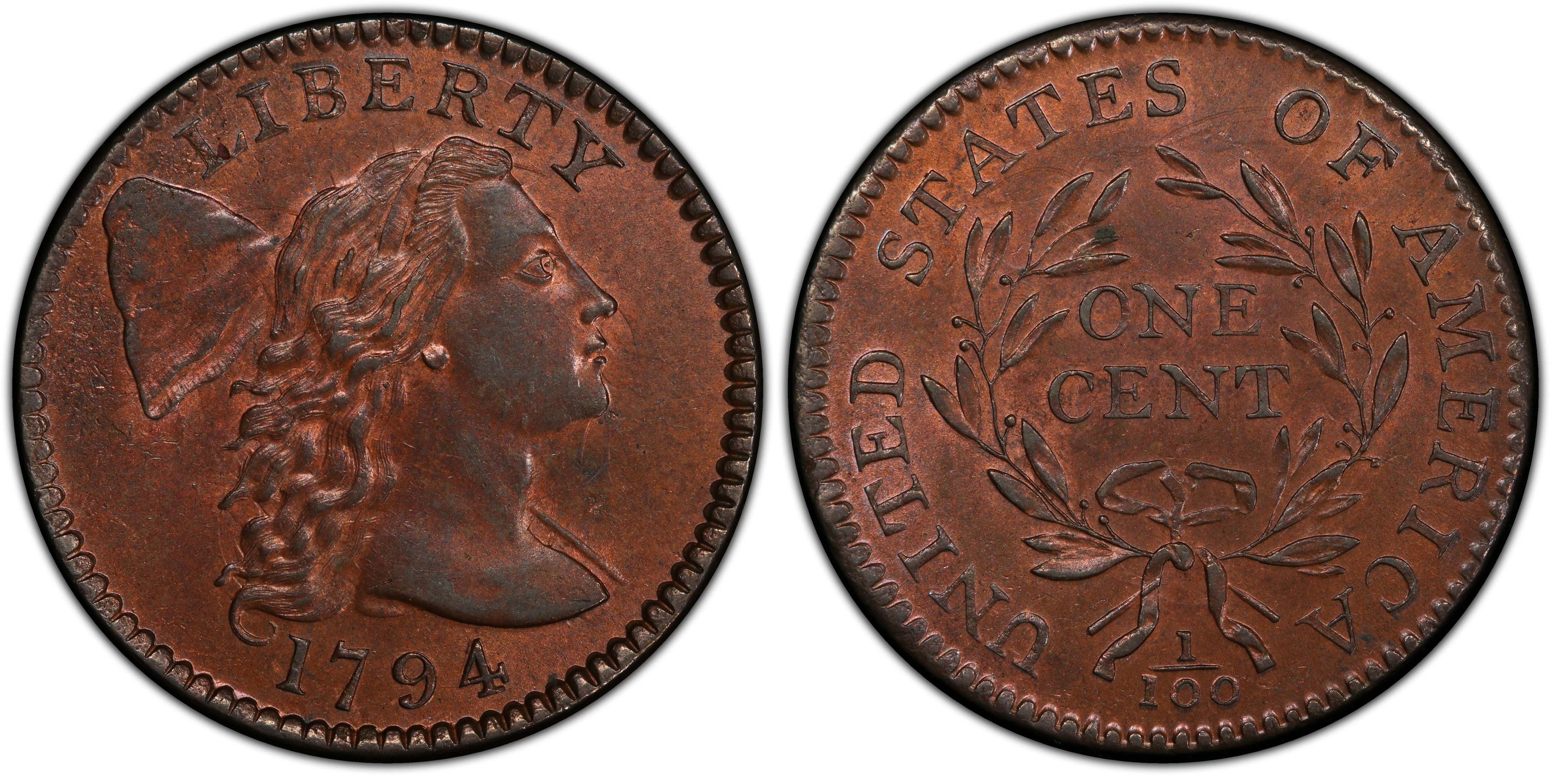
PCGS MS64RB
- PCGS #:
- 35685
- Designer:
- Attributed to Robert Scot
- Edge:
- Lettered: ONE HUNDRED FOR A DOLLAR
- Diameter:
- 28.00 millimeters
- Weight:
- 13.48 grams
- Mintage:
- 918,521
- Mint:
- Philadelphia
- Metal:
- Copper
- Auction Record:
- $499,375 • MS67 • 01-01-2013 • Stack's Bowers
Die Varieties
Condition Census What Is This?
|
#1 PCGS MS67RB
William Strickland, taken to England from the United States Mint in 1794; Charles Winn (husband of Priscilla Strickland, son-in-law and cousin of William Strickland), by sale, 1834; Rowland Winn, 1st Baron St. Oswald of Nostell, by descent, 1874; Rowland Winn, 2nd Baron St. Oswald of Nostell, by descent, 1893; Rowland George Winn, 3rd Baron St. Oswald of Nostell, by descent, 1919; Rowland Denys Guy Winn, Major the Lord St. Oswald, M.C., by descent, 1957; “English, Foreign, and Important American Coins, the Property of Major the Lord St. Oswald, M.C.,” Christie, Manson, and Woods, Ltd., October 1964, Lot 158 – $2,184; A.H. Baldwin & Sons, Ltd.; Dorothy I. Paschal; Dr. William H. Sheldon, April 19, 1972; R.E. "Ted" Naftzger, Jr. As PCGS MS67RB #13470596. "The Walter J. Husak Collection," Heritage, February 2008, Lot 2069 - $488,750; "The Flambeau Collection"; Joseph O’Connor; "The Cardinal Collection Educational Foundation," Stack’s Bowers, January 2013, Lot 13005 - $499,375. S-67. Die State III. |
|
#2 PCGS MS64RB
William Strickland, taken to England from the United States Mint in 1794; Charles Winn (husband of Priscilla Strickland, son-in-law and cousin of William Strickland), by sale, 1834; Rowland Winn, 1st Baron St. Oswald of Nostell, by descent, 1874; Rowland Winn, 2nd Baron St. Oswald of Nostell, by descent, 1893; Rowland George Winn, 3rd Baron St. Oswald of Nostell, by descent, 1919; Rowland Denys Guy Winn, Major the Lord St. Oswald, M.C., by descent, 1957; “English, Foreign, and Important American Coins, the Property of Major the Lord St. Oswald, M.C.,” Christie, Manson, and Woods, Ltd., October 1964, Lot 159 – $2,016; A.H. Baldwin & Sons, Ltd.; Lester Merkin October 1973, Lot 255 - $8,750; Andrew M. Hain; Dennis Steinmetz; Steve Ivy, September 1980, Lot 94 - $29,000; R.E. "Ted" Naftzger, Jr. As "Gem Uncirculated (65/65)." "Auction '86," Paramount, July 1986, Lot 1517 - $20,900; Stack’s; "The Marvin Taichert Collection," Stack’s, May 9, 2001, Lot 11 - $36,800; W.M. “Jack” Wadlington, June 30, 2005. As PCGS MS64RB #13666795. "The Daniel W. Holmes, Jr. Collection," Goldberg Auctioneers, September 2009, Lot 109 - $184,000; "The Walter J. Husak Collection," Heritage Auctions, Janaury 4, 2024, Lot 2061 - $90,000; Walter L. “Wally” Husak. S-67. Die State V. |
The 1794 Liberty Cap Cent, Sheldon 67, Roman Plicae
Named the "Roman Plicae" by Dr. Edward Maris, the Sheldon-67 (#35684) variety pairs Obverse 34 (credited to John Smith Gardner) with Reverse II. It represents the second of four varieties to utilize this specific reverse die. Notably, it is the first 1794 cent variety to fall into the "Head of 1795" category. This classification, however, is a bit of a misnomer; while these later 1794 heads anticipate the 1795 design, they are not an exact match. Instead, this period represents a distinct transitional phase leading toward the true Head of 1795, which is introduced in 1795 with the Sheldon-72 (#35699).
The Influence of John Smith Gardner
John Smith Gardner was hired by the Mint in November 1794. A skilled engraver and technician, Gardner was brought in to assist Robert Scot and address inefficiencies in the die-making process. Starting with the Sheldon-67, Gardner worked to improve the quality of Liberty’s portrait, specifically refining the facial features and hair detail.
In 1795, he oversaw the transition of the Large Cent from thick, lettered-edge planchets to thin, plain-edged ones. Despite his significant contributions, Gardner was paid on a daily basis (earning between $2.25 and $3.00) and was never granted a commission as an officer of the Mint. He eventually left the institution around August 1796.
Obverse Characteristics
On the obverse, Liberty is depicted with a large, circular curl at the base of her hair, while the locks at the top terminate directly beneath the upright bar of the "T" in LIBERTY. Collectors will frequently find this variety displaying heavy clash marks, most notably a leaf impression where Liberty’s forehead meets her hair. Characteristic die cracks are also common, typically running through her cheek, upper lip, and face.
Reverse Diagnostics
The reverse is easily distinguished by a double leaf positioned under the "O" in OF, a departure from the more common triple-leaf arrangement. Other notable features include:
- Oversized Lettering: The "A" and "M" in AMERICA are notably large, with the "A" often showing a repunched appearance.
- Fraction Bar: A short fraction bar that stops shy of the denominator’s right tip.
- Berry Count: A "6x7" arrangement (six berries on the left branch, seven on the right).
- Die Damage: Characteristic damage is often visible above the wreath and below the ribbon knot.
Provenance and Quality
This variety was among the coins acquired directly from the Mint by William Strickland and taken to England in 1795. These coins famously became part of the Lord St. Oswald Collection, representing some of the finest surviving specimens of the era. One of the three Lord St. Oswald examples has been graded PCGS UNC Details due to an attempt to repair a planchet lamination. Laminated planchets appear with some frequency for this variety—a testament to the inconsistent quality of the copper flans used during the Mint's infancy.
* * *